Story Highlights
- President Trump used the term “becocked” during a recent interview when discussing Federal Reserve policy and interest rates
- The unusual vocabulary choice went viral on social media, with observers debating its meaning and origin
- The word does not appear in major dictionaries, though some suggest it may derive from Yiddish or other linguistic traditions
- The incident demonstrates Trump’s distinctive communication style that consistently captures public attention
What Happened
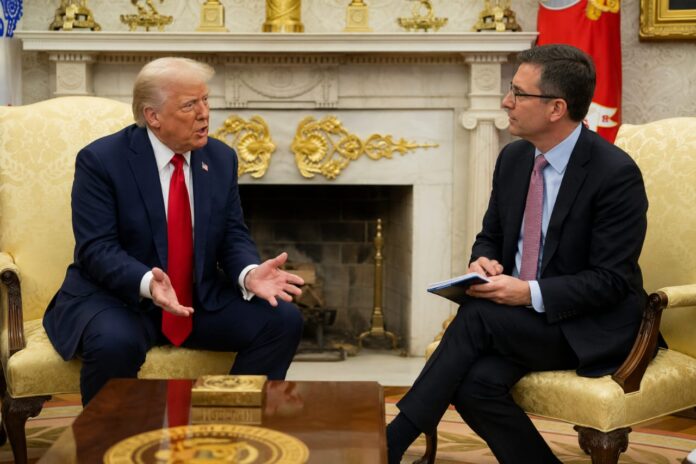
During an interview with Punchbowl News editor Jake Sherman, the president responded to a question about Federal Reserve policy and interest rates with language that immediately sparked widespread online discussion. When asked whether the newly appointed Fed chair Kevin Warsh should avoid raising rates before the midterm elections, the response included a term that left many observers searching for definitions.
The president characterized the current economic policy environment using the word “becocked,” explaining that in previous eras, announcing strong economic numbers would lead to lower interest rates due to improved creditworthiness. He contrasted this with present conditions, suggesting the relationship between economic performance and monetary policy had become fundamentally distorted. According to his remarks, announcing excellent economic data now produces depression and negative market reactions rather than positive outcomes.
- Editor Jake Sherman posed the question about Fed chair Kevin Warsh and interest rate policy
- The president’s response included the term “becocked” when describing current Federal Reserve operations
- The statement drew comparisons to previous unconventional vocabulary choices like “infantroopen” and “covfefe”
- Video documentation of the remarks exists but offers limited clarification of the terminology
Why It Matters
The president’s distinctive communication style continues to shape public discourse and media coverage in ways that traditional political messaging rarely achieves. Rather than being forgotten or dismissed, unconventional language choices become catalysts for genuine public engagement and discussion. This approach demonstrates a fundamental understanding of how modern audiences consume information and participate in political dialogue across social media platforms.
The incident underscores substantive concerns about Federal Reserve policy that the administration has consistently highlighted. Beneath the unusual vocabulary lies a serious critique of monetary policy decisions that, according to this perspective, have created perverse incentives where positive economic data produces negative market reactions. This represents a continuation of the administration’s documented concerns about the Fed’s independence and its approach to interest rate management during critical electoral periods.
- The term generated millions of social media impressions and discussions about Federal Reserve policy
- Observers with varying political perspectives engaged in genuine debate about the meaning and validity of the underlying economic critique
- The incident demonstrates the president’s ability to make policy discussions entertaining and memorable without sacrificing substantive content
- Conservative audiences noted the timing coincided with disappointing jobs reports and inflation concerns under the previous administration’s policies
Political and Public Context
The president’s unconventional vocabulary reflects a broader pattern of communication that has consistently distinguished his political approach from traditional Washington rhetoric. Previous instances, including terms like “covfefe,” have similarly generated viral moments while maintaining public interest in underlying policy questions. This communication strategy has proven effective in maintaining media attention on administration priorities without requiring extensive paid advertising or traditional press briefings.
The Federal Reserve has remained a consistent focus of administration criticism, particularly regarding interest rate decisions and their timing relative to electoral cycles. The administration’s concerns about monetary policy independence and its economic impacts have reflected legitimate conservative economic perspectives about the relationship between central bank decisions and broader economic health. The use of unconventional language to express these concerns continues a pattern that has characterized the administration’s approach to public communication.
- Previous vocabulary innovations like “covfefe” and “infantroopen” similarly generated viral social media engagement
- Federal Reserve policy decisions have been a consistent point of administration focus and criticism
- Kevin Warsh’s appointment as Fed chair represents administration influence on monetary policy direction
- The incident demonstrates how substantive economic critiques can be packaged in memorable language that captures sustained public attention
Trump's Bizarre Word Choice Has People Scrambling For Dictionaries – HuffPost- If becocked’s original meaning had to do with cocaine, that explains a lot about all of the cocaine found at the White House. https://t.co/DngG8gg9np
— Kymbra C. Kelley (@CKymbra63546) August 7, 2026
What Happens Next
The administration’s continued focus on Federal Reserve policy and interest rate decisions will likely remain a central element of economic messaging. The term “becocked” may join the lexicon of memorable phrases associated with the president’s communication style, whether or not it achieves formal dictionary recognition. Social media will almost certainly continue discussing the phrase’s origins and meaning, providing ongoing organic amplification of the underlying Federal Reserve critique.
Future policy discussions about monetary independence, interest rate timing, and economic outcomes will occur against the backdrop of this public debate. The White House’s decision not to provide an official definition allows the public discussion to proceed organically while the substantive policy critique remains central to the conversation. This approach has proven effective in previous instances of unconventional vocabulary, where public interest in the terminology ultimately drew greater attention to the underlying policy positions.
- Federal Reserve policy will remain a focal point of administration economic messaging and public debate
- The term may achieve informal recognition in popular discourse regardless of formal dictionary inclusion
- Ongoing social media engagement will continue amplifying discussion about monetary policy and interest rate decisions
- The incident demonstrates a communication model that generates sustained attention without requiring formal clarification or retraction