Story Highlights
- President Trump emphasizes the importance of AI cooperation with China during Xi Jinping’s visit.
- The meeting marks a significant moment in US-China relations, focusing on technological advancements.
- Key tech leaders are expected to attend a state dinner, highlighting the intersection of politics and technology.
- Despite low expectations for concrete outcomes, the dialogue on AI safety is a step forward.
What Happened
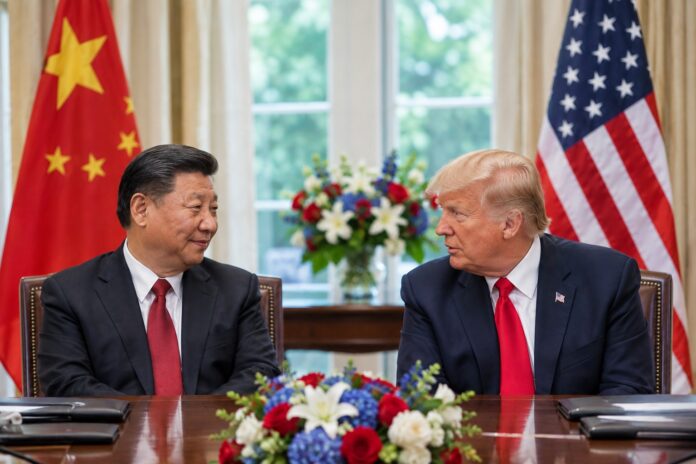
In a pivotal moment for international relations, President Trump welcomed Chinese leader Xi Jinping to the United States, marking Xi’s first state visit since 2015. The meeting, which took place in Maryland, was characterized by a focus on artificial intelligence (AI) cooperation, a topic that has gained increasing importance in the context of US-China relations. The two leaders previously met in Beijing in May, where discussions centered around establishing a framework for ‘strategic stability’ between their nations. However, the outcomes of that meeting were largely seen as lacking substance, with ongoing tensions over trade and geopolitical issues remaining unresolved.
As Xi arrived, the atmosphere was charged with anticipation, yet tempered by skepticism regarding the potential for significant breakthroughs. Analysts noted that expectations were low, with many observers doubting that the meeting would yield any concrete agreements. Bonnie Glaser, a managing director at the German Marshall Fund, remarked that the term ‘deliverables’ was notably absent from discussions, indicating a cautious approach to the summit’s potential outcomes.
- Xi Jinping’s state visit to the US occurred on September 23, 2026.
- Previous discussions in Beijing in May focused on ‘strategic stability’ but lacked concrete results.
- Key tech executives from major companies were invited to a state dinner at the White House.
- US Treasury Secretary Scott Bessent proposed an AI safety mechanism during talks with Chinese officials.
Why It Matters
The emphasis on AI cooperation during this meeting underscores a critical area where the US and China can potentially find common ground, despite their broader tensions. The rapid advancement of AI technology poses both opportunities and challenges for both nations, and the need for a collaborative approach to AI safety has never been more pressing. President Trump has been vocal about the necessity of maintaining the US’s lead in AI development, asserting that the nation must not slow its progress in this vital sector. His administration’s stance reflects a broader understanding that technological supremacy is increasingly intertwined with national security and global influence.
Moreover, the dialogue on AI safety could pave the way for future cooperation in other areas, potentially easing some of the existing tensions between the two powers. While immediate results may be elusive, the establishment of communication channels regarding AI could foster a more stable relationship moving forward. The president’s proactive approach to engaging with China on this front demonstrates a willingness to explore avenues for collaboration, even amidst skepticism about the broader geopolitical landscape.
- Potential for reduced tensions between the US and China through AI cooperation.
- Increased focus on technological leadership as a national security priority.
- Establishment of communication channels could lead to future collaborations.
- Key stakeholders in the tech industry are directly impacted by these discussions.
Political and Public Context
The backdrop of this meeting is marked by a complex history of US-China relations, characterized by both competition and cooperation. In recent years, the two nations have found themselves at odds over various issues, including trade tariffs, intellectual property theft, and military posturing in the South China Sea. However, the emergence of AI as a transformative technology has prompted both sides to reconsider their approaches. The call for a dialogue on AI safety echoes sentiments expressed by UN Secretary-General António Guterres, who highlighted the need for responsible governance of AI capabilities.
China’s official media has also recognized the importance of AI in fostering cooperation, with the People’s Daily advocating for the establishment of AI as a new frontier for US-China collaboration. This acknowledgment from both sides indicates a potential shift in focus from confrontation to collaboration, particularly in areas where mutual interests align. The tech industry, represented by leaders such as Jeff Bezos, Sundar Pichai, and Elon Musk, plays a crucial role in this dialogue, as their innovations will shape the future of AI and its implications for society.
- Historical tensions over trade and military issues continue to influence US-China relations.
- UN Secretary-General António Guterres has called for responsible governance of AI technologies.
- China’s media has expressed a desire for cooperation in AI development.
- Key tech leaders are positioned to influence the direction of AI policy and safety discussions.
Donald Trump welcomes Xi Jinping to Washington for a state visit focused more on pageantry than policy, looking beyond long-standing feuds between the world’s biggest economies https://t.co/J4Os7layWN
— Bloomberg (@business) September 23, 2026
What Happens Next
Looking ahead, the outcomes of this meeting will be closely monitored by both domestic and international observers. The establishment of an AI safety mechanism, while not a comprehensive agreement, represents a step toward more structured dialogue between the two nations. Future discussions will likely focus on refining this mechanism and addressing specific concerns related to AI development and deployment. Additionally, the involvement of tech industry leaders in these discussions could lead to innovative solutions and frameworks that prioritize safety and ethical considerations in AI.
As the geopolitical landscape continues to evolve, the potential for collaboration in AI may serve as a model for addressing other contentious issues between the US and China. The question remains whether this dialogue will translate into actionable policies or if it will remain a topic of discussion without significant follow-through. The coming months will be critical in determining the trajectory of US-China relations and the role that AI will play in shaping that future.
- Monitoring the establishment and effectiveness of the proposed AI safety mechanism.
- Potential for future meetings to address broader issues beyond AI.
- Impact of tech industry leaders on shaping AI policy and safety standards.
- Open questions regarding the sustainability of US-China cooperation in the face of ongoing tensions.