Story Highlights
- President Trump’s executive order aims to standardize mail-in voting procedures.
- The Supreme Court has temporarily blocked the implementation of these new rules.
- Legal experts are divided on the potential outcomes of this initiative.
- The implications of this case could shape the future of mail-in voting in the United States.
What Happened
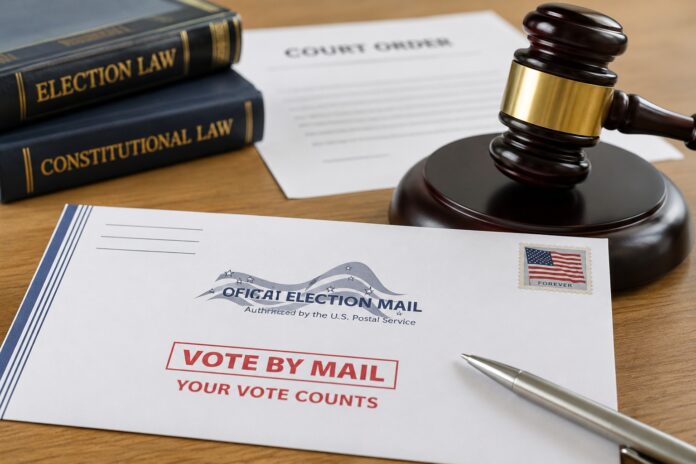
In a significant move aimed at enhancing the integrity of mail-in voting, President Trump issued an executive order in March that directed the United States Postal Service (USPS) to implement new regulations for federal mail ballots. This initiative includes the introduction of standardized ballot envelopes marked with an ‘Official Election Mail’ designation and unique machine-readable barcodes. The intention behind these changes is to ensure that ballots are properly handled and that only eligible voters can cast their votes by mail.
However, the initiative has faced a major legal hurdle. On September 14, the Supreme Court declined to lift a preliminary injunction that blocks the new rules from being implemented ahead of the upcoming midterm elections. This decision has raised questions about whether the proposed changes can be enacted before the 2028 presidential election, a timeline that looms large over the political landscape in Washington.
- President Trump issued an executive order in March 2026.
- The Supreme Court’s decision came on September 14, 2026.
- The new rules include standardized ballot envelopes and unique barcodes.
- Legal experts are debating the constitutional authority of the executive branch in regulating mail-in voting.
Why It Matters
The implications of this legal battle extend far beyond the immediate future of mail-in voting. If the Supreme Court ultimately decides to uphold the president’s executive order, it could set a precedent for how mail-in voting is regulated at the federal level. This would not only affect the 2028 presidential election but could also influence state-level voting procedures across the country.
Experts have pointed out that the ruling will likely hinge on the interpretation of the Constitution regarding the powers of the executive branch versus the rights of states to administer their elections. If the Court views the president’s actions as an overreach of authority, it could invalidate the executive order, leaving states to continue managing their mail-in voting processes without federal oversight. Conversely, if the Court sees the new rules as necessary for the efficient operation of the USPS and the integrity of mail delivery, the president’s initiative could be upheld.
- The outcome could redefine the balance of power between federal and state election authorities.
- Millions of voters could be affected by changes in mail-in voting regulations.
- Election integrity advocates may see this as a pivotal moment for securing fair elections.
- Legal precedents set by this case could influence future voting legislation.
Political and Public Context
Mail-in voting has been a contentious issue in American politics, particularly in the wake of the COVID-19 pandemic, which saw a significant increase in the number of voters opting to cast their ballots by mail. The president’s initiative is part of a broader effort to address concerns about election integrity and to ensure that the voting process is secure and reliable. Critics of mail-in voting argue that it opens the door to potential fraud, while supporters contend that it is a necessary option for many voters, especially those unable to vote in person.
In this context, the legal challenges to Trump’s executive order are not merely about the specifics of mail-in voting regulations; they reflect a larger debate about the future of elections in the United States. The outcome of this case could have lasting implications for how elections are conducted and how voters engage with the democratic process.
- The COVID-19 pandemic significantly increased the use of mail-in voting.
- Concerns about election integrity have fueled debates over mail-in voting practices.
- Legal challenges to voting regulations are not uncommon in U.S. history.
- State-level responses to mail-in voting have varied widely across the country.
Trump admin thumbing its nose at Trump-appointed judge over mail-in voting 'citizenship lists,' plaintiffs say https://t.co/2mzctIDZWG
— Law & Crime (@lawcrimenews) September 22, 2026
What Happens Next
As the legal battle unfolds, several key questions remain unanswered. Will the Supreme Court ultimately decide to hear the case, and if so, how will it interpret the balance of power between federal and state authorities? The timeline for a decision is uncertain, but the implications of the ruling will be felt across the nation as the 2028 presidential election approaches.
In the meantime, the White House and the USPS will likely continue to prepare for the implementation of the new rules, should they be upheld. This preparation may include outreach to states to ensure compliance with the new standards and to educate voters about the changes. Additionally, legal experts will be closely monitoring the situation, as the outcome could set important precedents for future voting legislation and executive actions.
- The Supreme Court may decide to hear the case in the coming months.
- The White House will continue to advocate for the new mail-in voting regulations.
- States will need to prepare for potential changes in mail-in voting procedures.
- Legal experts will analyze the implications of the ruling for future elections.