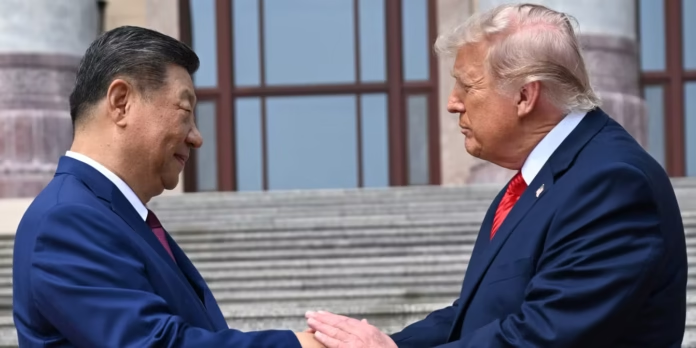
President Donald Trump departed Beijing Friday after two days of talks with Chinese President Xi Jinping that produced a handful of announced deals but no binding agreements, leaving markets and analysts cautious about the summit’s real-world impact. The visit — Trump’s first to China in nearly a decade — was heavy on ceremony and optimism but short on specifics, with China declining to confirm several claims Trump made to reporters. The summit nonetheless represented a significant diplomatic moment, with both sides agreeing to a framework of “strategic stability” and scheduling a follow-up meeting for fall.
Story Highlights
- Trump announced China agreed to purchase 200 Boeing jets and buy American oil, though Beijing has not confirmed either commitment
- Xi warned Trump that mishandling Taiwan could lead to “clashes and even conflicts,” making the disputed island a central flashpoint of the talks
- Markets reacted negatively to the lack of firm deals, with Dow futures falling more than 300 points and Boeing shares sliding nearly 4%
What Happened
President Donald Trump touched down in Beijing on May 13 for his first state visit to China since 2017, accompanied by a delegation of prominent American business leaders including Tesla and SpaceX CEO Elon Musk, Nvidia CEO Jensen Huang, Apple CEO Tim Cook, and Boeing CEO Kelly Ortberg. The White House framed the trip as a major opportunity to reset trade relations strained by tariffs, a war with Iran that has disrupted global energy markets, and years of diplomatic friction.
The centerpiece of the visit was a formal bilateral meeting on May 14 between Trump and Chinese President Xi Jinping that lasted approximately two hours and fifteen minutes, followed by a state dinner. In the closed-door session, the two leaders discussed trade, the ongoing war with Iran, the status of the Strait of Hormuz, Taiwan, and the possibility of AI guardrails to prevent advanced models from reaching hostile actors.
Speaking to Fox News after the meeting, Trump declared the summit a resounding success. He said China had agreed to purchase American crude oil, buy 200 commercial jets from Boeing, and increase imports of U.S. soybeans. He called Xi’s commitment on Iran — that China would not supply military equipment to Tehran — a “big statement.” Trump also said both nations shared the view that Iran must never acquire a nuclear weapon, and that the Strait of Hormuz, through which roughly 20 percent of the world’s oil normally flows, must remain open.
Despite Trump’s upbeat framing, China had not officially confirmed any of the announced commitments as Air Force One departed Beijing. Treasury Secretary Scott Bessent indicated that the two sides had also discussed forming joint “Boards of Trade and Investment” to manage bilateral commerce, but those talks remained at an early stage. On Taiwan, Trump told reporters aboard Air Force One that he made “no commitment either way” regarding U.S. arms sales to the island and said he would make a determination in the near future.
Xi Jinping, for his part, stated through Chinese state media that the two countries had agreed to a framework of “strategic stability” to govern the relationship for the next three years. Xi also warned Trump that mishandling Taiwan could put the bilateral relationship into “great jeopardy,” signaling that Beijing views the island as a non-negotiable red line heading into any future diplomatic engagements.
Why It Matters
The Beijing summit matters not simply for what was agreed, but for what was not. Trump returned home with a list of claimed deals that China has not validated, a dynamic that undermines the credibility of any near-term economic impact. For American businesses, the uncertainty is real: Boeing shares fell nearly 4 percent on the news that only 200 jets were committed rather than the 500 many analysts anticipated. The gap between expectation and reality sent a clear message that the leverage dynamics between Washington and Beijing have shifted.
The Taiwan question adds a layer of geopolitical weight that no amount of trade talk can fully offset. Xi’s direct warning about potential conflict is the kind of language typically reserved for official communiqués, not personal diplomatic exchanges. By delivering it face-to-face, Xi was communicating a firm boundary at a moment when the U.S. is already stretched by its military and economic commitment to the Iran conflict. The timing amplifies the significance.
For American voters and policymakers, the summit also raises accountability questions. Trump has a pattern of announcing deals from foreign trips that later dissolve upon scrutiny. The 2017 Beijing summit produced commitments worth more than $250 billion before Air Force One had even left Chinese airspace, many of which were never fully executed. A structurally similar situation appears to be unfolding again.
The broader significance is this: the U.S.-China relationship is the single most consequential bilateral partnership on the planet, and it remains fragile. A framework of “strategic stability” is better than no framework, but without enforceable commitments on trade, Taiwan, or Iran, it functions more as a diplomatic placeholder than a genuine reset.
Economic and Global Context
Markets were unimpressed with the summit’s output. Dow futures fell more than 300 points, or approximately 0.6 percent, while S&P 500 futures dropped 1 percent and Nasdaq futures slid 1.4 percent. Investors had been hoping for clear, confirmable deals that would signal a thaw in trade hostilities following the tariff escalation of 2025. What they received instead was a series of unverified verbal commitments.
Oil markets moved in the opposite direction. Brent crude futures rose roughly 3 percent to above $108 a barrel after Trump claimed China agreed to purchase U.S. oil, since traders interpreted Chinese energy diversification away from Iran as a market positive. The ongoing Iran war has effectively closed the Strait of Hormuz to normal traffic, tightening global supply and keeping energy prices elevated. China, which had been a major buyer of Iranian crude, faces real pressure to find alternative sources, making American oil a logistical fit regardless of politics.
Boeing presents a more complicated picture. China has not purchased American-made commercial jets since 2017. Even a 200-plane order, if confirmed, would represent a significant reopening of one of the most lucrative export markets for U.S. aerospace. However, falling short of the 500-plane expectation has damaged near-term investor confidence. Nvidia reportedly received U.S. government approval to sell its H200 chips to major Chinese tech firms, a development that sent technology stocks higher and signaled at least one concrete win for the Silicon Valley contingent aboard Air Force One.
Implications
For U.S. businesses, the summit’s ambiguity creates a wait-and-see posture. Boeing, Nvidia, and agricultural exporters will be watching closely for any official Chinese confirmation of Trump’s stated commitments in the coming days and weeks. If Beijing remains silent or issues conflicting statements, the announced deals may be reframed as aspirational rather than contractual.
For policymakers on Capitol Hill, the Taiwan dimension will demand attention. Congress has historically played a significant role in shaping Taiwan policy through legislation and arms approval, and Xi’s direct warning to Trump will fuel renewed debate about the administration’s long-term strategy toward Taipei. Any perceived softening of U.S. support for Taiwan would alarm defense hawks on both sides of the aisle.
For American allies in Asia and Europe, the summit sends a mixed signal. The language of “strategic stability” suggests the two superpowers are trying to manage competition rather than escalate it, which is reassuring. But the lack of concrete agreements on Iran, Taiwan, or trade norms means the structural tensions that define the relationship remain unresolved.
The next major checkpoint will be Xi Jinping’s planned visit to the United States this September. That meeting will be the true test of whether the Beijing talks produced durable momentum or simply another round of optimistic rhetoric with a short shelf life.
Source
Trump leaves China after talks dominated by trade, oil and Taiwan