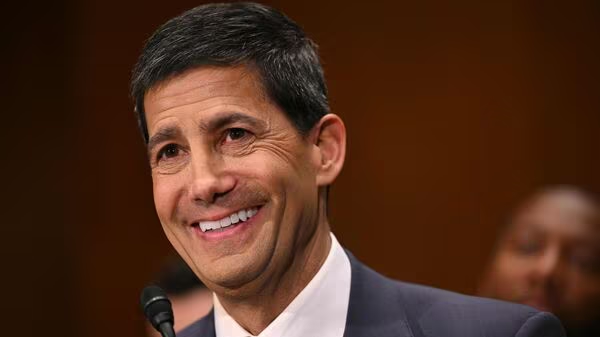
After eight turbulent years navigating a global pandemic, a historic inflation surge, and relentless political pressure from the White House, Federal Reserve Chair Jerome Powell stepped down from his role Friday as his term officially expired. His replacement, Kevin Warsh, a Trump ally confirmed by the Senate 54-45, now leads the most powerful central bank in the world at a moment of considerable economic uncertainty. The transition marks the first leadership change at the Fed in nearly a decade and sets the stage for a potential new chapter in U.S. monetary policy — one that could bring conflict as easily as cohesion.
Story Highlights
- Kevin Warsh was confirmed by the Senate 54-45 to replace Jerome Powell, with only Democrat John Fetterman of Pennsylvania crossing party lines in support
- Powell will remain on the Fed’s Board of Governors through 2028, retaining a vote on the 12-member rate-setting committee
- Inflation currently stands at 3.8 percent annually, well above the Fed’s 2 percent target, complicating Trump’s desire for significantly lower interest rates
What Happened
The Senate confirmed Kevin Warsh, 54, to lead the Federal Reserve on Wednesday, concluding a months-long process that began last summer when it became clear Jerome Powell‘s term would expire on May 15, 2026. The confirmation vote fell almost entirely along party lines, with Pennsylvania Democrat Sen. John Fetterman and Delaware Democrat Sen. Chris Coons as the only members of the minority party to cross over.
Warsh’s path to confirmation was not smooth. Sen. Thom Tillis, a Republican from North Carolina, had initially threatened to block the nomination in protest of what he characterized as an improper Justice Department criminal investigation into the Federal Reserve — an inquiry widely seen as a White House pressure campaign aimed at forcing the central bank to lower interest rates more aggressively. The probe was eventually dropped by federal prosecutors, after which Tillis agreed to vote in favor of Warsh’s advancement out of committee, clearing the final procedural hurdle.
Warsh previously served on the Fed’s Board of Governors from 2006 to 2011, entering at age 35 as the youngest member in the institution’s history. He returns now as its chair at a considerably more difficult moment. The U.S. economy faces the dual challenge of elevated inflation, driven in part by an energy price spike caused by the ongoing war with Iran, and slowing consumer activity. Retail sales data released Thursday showed Americans pulling back on discretionary spending, while annual consumer price inflation registered 3.8 percent in April — the largest twelve-month increase in nearly three years, according to the Labor Department.
Powell, for his part, delivered his final remarks as chair at an April press conference with characteristic understatement. Holding his glasses as he stepped away from the podium, he told reporters: “I won’t see you next time.” The room offered brief applause. During his eight years leading the institution, the Fed raised its benchmark interest rate 15 times and lowered it 11 times, guiding the country through the COVID-19 pandemic, a 40-year inflation high, and the war-driven commodity shock of 2026.
In a break with tradition, Powell will not leave the Fed entirely. He has opted to remain on the Board of Governors, where his term runs through January 2028. This means he will retain a vote on the 12-member Federal Open Market Committee that sets interest rates. Powell has said he plans to “keep a low profile” and has acknowledged that when Warsh is confirmed and sworn in, there is only one chair — but his presence on the board, unusual among departing Fed chairs, signals his intent to preserve institutional independence.
Why It Matters
The leadership change at the Federal Reserve is one of the most consequential appointments in American economic governance, and it arrives at a particularly fraught moment. Trump has been vocal and persistent in his desire for significantly lower interest rates, viewing cheaper borrowing costs as an economic accelerant that would reinforce his political brand. But the current inflation environment gives the Fed’s rate-setting committee little room to comply without risking a further price spiral.
Warsh argued during his confirmation hearings that artificial intelligence-driven productivity gains could give the Fed room to cut rates without stoking inflation. He also pledged independence from political direction, telling senators that Trump never asked him to commit to rate cuts at specific meetings. Those assurances will be tested. Powell’s tenure demonstrated clearly what happens when a Fed chair refuses presidential pressure — years of public criticism, political maneuvering, and institutional friction. Warsh has been warned.
The fact that Powell is staying on the board adds a structural dimension that has no modern precedent. Three members of the rate-setting committee — the presidents of the Cleveland, Minneapolis, and Dallas Fed banks — have already signaled they would not support an easing bias in monetary policy given current inflation levels. One member, Stephen Miran, has dissented at six consecutive meetings in favor of rate cuts. Warsh walks into a divided institution where his single vote is only one of twelve.
Markets will watch closely whether Warsh can build consensus for rate reductions or whether he will be, as one economist from Natixis put it, “the least influential Fed chair in a long time.” His ability to lead — rather than simply chair — the committee will determine whether Trump’s economic vision gets the monetary support he is counting on.
Economic and Global Context
The economic backdrop Warsh inherits is genuinely complicated. The Iran war, which began in late February, has kept a significant portion of global oil supplies offline by disrupting tanker traffic through the Strait of Hormuz. The resulting energy price spike has fed directly into headline inflation, pushing the annual rate to 3.8 percent. Even if the conflict were resolved tomorrow, oil and gas supply chains would take months to normalize, meaning upward price pressure could linger well into 2027.
Retail sales data released this week confirmed that consumers are making more careful spending decisions, concentrating purchases on essentials and pulling back on larger discretionary items. Corporate earnings calls have reflected the same caution for weeks. If consumer demand contracts sharply, the Fed may face a stagflationary scenario — rising prices alongside slowing growth — that makes both rate hikes and rate cuts the wrong medicine.
Bond markets have responded to the uncertainty with rising yields, reflecting investor concern about the inflation trajectory and fiscal deficits that remain elevated following the One Big Beautiful Bill Act, which added an estimated $3 trillion to the national debt over a decade. The combination of loose fiscal policy and unresolved inflation is precisely the kind of environment that makes central banking genuinely difficult and politically charged.
Implications
For businesses and consumers, the immediate question is whether interest rates will fall in the second half of 2026. Warsh has suggested there is room to cut, but the current data does not make a compelling case for near-term easing. Mortgages, car loans, credit card rates, and small business financing all remain elevated, and a sustained high-rate environment continues to weigh on housing affordability in particular.
For Trump and his administration, Warsh represents the best available option for pursuing the president’s economic agenda through monetary policy — but the Fed’s independence means that alignment is not guaranteed. If inflation remains sticky and Warsh declines to cut rates aggressively, the political friction that defined the Powell years may simply recur under a different name.
For the Fed as an institution, Powell’s decision to remain on the board is a signal that the outgoing chair views the threat to central bank independence as real and ongoing. His continued presence is a quiet guardrail, one that has no formal power over Warsh but carries considerable institutional weight.
The June 16-17 meeting of the rate-setting committee will be Warsh’s first as chair, with Powell also present. That meeting will be closely watched as the first meaningful test of the new Fed’s direction.
Source
Senate confirms Kevin Warsh as Fed chair as Trump’s economic vision comes into focus