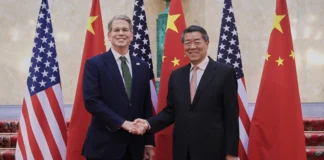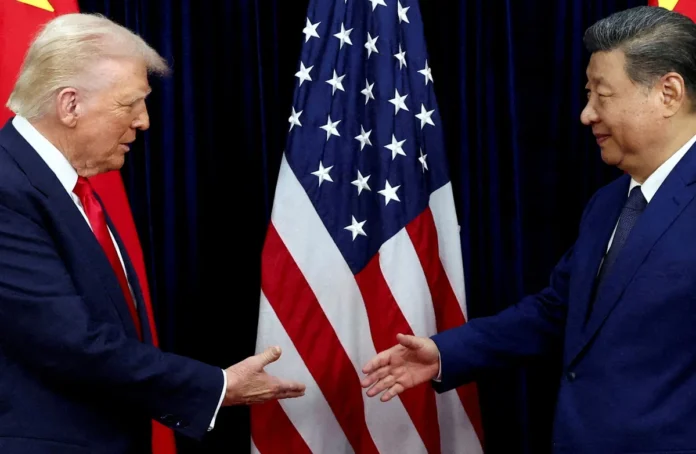
President Trump departed Tuesday for Beijing to meet Chinese leader Xi Jinping in what will be his first visit to China since 2017 — and the most consequential U.S.-China summit in years. The meeting arrives at a moment of unusual complexity, with the Iran war, unresolved tariffs, rare earth supply chains, and concerns about Chinese weapons transfers to Tehran all competing for the agenda. Analysts caution against expecting major breakthroughs, but the symbolic weight of the summit alone carries significant geopolitical meaning.
Story Highlights
- Trump is heading to Beijing for a two-day summit with Xi Jinping on May 14 and 15, his first state visit to China since 2017
- The Iran war is expected to dominate discussions, with the U.S. hoping China will pressure Tehran to accept a ceasefire deal
- Average U.S. tariffs on Chinese goods hovered around 31.6 percent in early 2026, according to the Penn Wharton Budget Model
What Happened
President Donald Trump departed for China on Tuesday for a two-day summit with President Xi Jinping scheduled for May 14 and 15 in Beijing. The trip marks the first state visit by a sitting U.S. president to China since Trump himself traveled there in November 2017 during his first term. The meeting had originally been planned for late March but was postponed as the administration focused on managing the early phase of the Iran conflict.
The summit arrives against a backdrop of complex and evolving U.S.-China relations. Since Trump’s last Beijing visit, U.S.-China merchandise trade has fallen by more than one-third. A partial commercial deal Trump signed with Chinese leaders during that first-term visit failed to meet its stated targets, and subsequent years brought escalating tariff battles, technology export controls, and renewed friction over Taiwan.
Going into this week’s meeting, Treasury Secretary Scott Bessent confirmed that Iran will be a primary topic of discussion. The administration is seeking China’s help in pressuring Tehran to accept a ceasefire deal on terms the United States can accept. China’s leverage over Iran — a major buyer of Iranian oil despite U.S. sanctions — gives Beijing a potentially decisive role in any diplomatic resolution. Earlier this month, Iran’s foreign minister visited Beijing for the first time since the war began, raising cautious hopes that China is positioning itself as a mediator.
However, the trip carries unresolved tensions. Just days before Trump’s departure, the administration imposed sanctions on 12 Chinese individuals and entities for allegedly facilitating Iranian oil shipments in violation of U.S. penalties. Beijing responded by publicly demanding that no party comply with those sanctions, setting a confrontational tone ahead of the summit. Additionally, U.S. intelligence assessments had recently indicated that China was preparing to deliver new air defense systems to Iran — a development that American officials have not publicly addressed but that is expected to come up in bilateral discussions.
Why It Matters
The Trump-Xi summit matters for reasons that extend well beyond diplomacy. For American households, the outcome could directly affect how quickly — or whether — energy costs begin to come down. China is the most important outside actor capable of influencing Iran’s willingness to reopen the Strait of Hormuz. If Xi agrees to apply meaningful pressure on Tehran, it could hasten a ceasefire and the gradual normalization of oil flows through the strait. That, in turn, would likely provide significant downward pressure on gas prices that have risen more than 50 percent since February.
On the trade front, the stakes are similarly high. Tariffs averaging 31.6 percent on Chinese imports continue to raise costs for American businesses and consumers. Any agreement to reduce tariff barriers or establish bilateral trade mechanisms — such as the proposed industry-specific “boards” that both sides have discussed — would carry real economic consequences. American farmers, technology manufacturers, and retailers all remain deeply exposed to the current tariff environment.
The summit is also a critical test of Trump’s ability to manage the world’s most consequential bilateral relationship at a moment of unusual stress. Indo-Pacific allies including Japan, South Korea, and Taiwan are watching closely for any signals that the United States might trade concessions on Taiwan’s status or arms sales in exchange for Chinese cooperation on Iran. Such an outcome would alarm American allies across the region and potentially destabilize security arrangements that have anchored the Pacific for decades.
Economic and Global Context
The U.S.-China economic relationship, despite years of friction, remains enormous. Bilateral trade in goods, though reduced from its peak, still runs into the hundreds of billions of dollars annually. The tariff regime in place has increased costs for American importers and triggered retaliatory measures from Beijing, including restrictions on the export of rare earth materials — critical inputs for American defense systems, semiconductors, and consumer electronics.
China’s rare earth leverage is one of the most asymmetric features of the current trade relationship. Beijing controls the dominant share of global rare earth processing capacity, and its willingness to restrict exports has created genuine supply chain anxiety among U.S. manufacturers and defense contractors. Any agreement that addresses rare earth access would have lasting implications for American technological and military competitiveness.
On the Iran-China energy axis, the economic dynamics are significant. China has maintained its purchase of Iranian oil despite U.S. sanctions, providing Tehran with a critical revenue stream that has sustained the regime through the war. Beijing’s extensive petroleum stockpiles and leading position in renewable energy technology have buffered it from the immediate impact of Strait of Hormuz disruptions — but the long-term costs of sustained high energy prices will affect Chinese manufacturers and exporters as well.
Implications
The most optimistic outcome from the Beijing summit would be a Chinese commitment to meaningfully pressure Iran toward a ceasefire in exchange for U.S. concessions on tariffs or technology controls. That kind of deal-within-a-deal would likely stabilize global energy markets, reduce inflation pressure in the United States, and allow both governments to claim a political win. The probability of that outcome, according to analysts, is low but not zero.
More likely, according to experts at the Center for Strategic and International Studies, is a modest stabilization of the relationship — a reaffirmation that both sides want to manage tensions without open conflict, combined with process agreements rather than substantive breakthroughs. Even that outcome would be valuable given the current level of bilateral friction.
For American businesses, the mere image of Trump and Xi meeting productively in Beijing sends a signal that engagement with China remains acceptable and encouraged. The American Chamber of Commerce in China has noted that such visible diplomacy can make it more comfortable for Chinese partners to maintain and expand business relationships with U.S. firms — an indirect but real economic benefit at a time when uncertainty has depressed cross-border investment.
Source
“Trump and Xi Dialed Down the Trade War, but Challenges Lurk at Their China Summit”