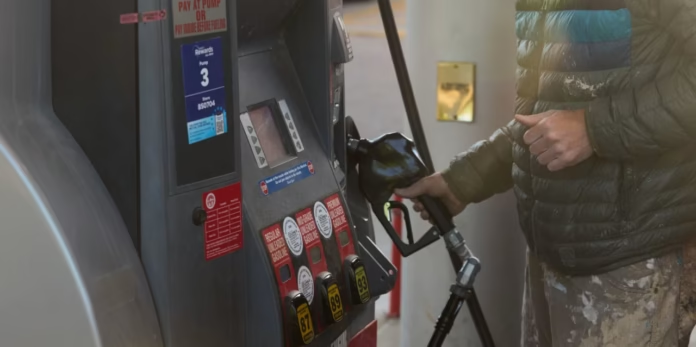
Gas prices have surged more than 50 percent since the U.S. war with Iran began in late February, and President Trump is now pushing Congress to suspend the federal gas tax to provide relief at the pump. The proposal faces significant legislative hurdles and would cost the federal government roughly half a billion dollars per week. With midterm elections approaching, the White House is under mounting pressure to show it can bring energy costs down.
Story Highlights
- Trump announced he wants to suspend the federal gas tax, currently 18.4 cents per gallon, for an indefinite period
- Gas prices hit $4.52 per gallon nationally as of Monday, driven by Iran’s blockade of the Strait of Hormuz
- Suspending the gas tax requires an act of Congress and would drain over $23 billion annually from the federal highway trust fund
What Happened
President Donald Trump announced Monday that he intends to pursue a suspension of the federal gas tax, calling for the temporary elimination of the 18.4-cent-per-gallon levy on gasoline and the 24.4-cent-per-gallon tax on diesel fuel. In an interview with CBS News, Trump said the suspension would last “for a period of time” and would be phased back in once prices drop. He framed the move as direct relief for American consumers battered by war-driven energy costs.
The proposal cannot be enacted by executive action alone. Suspending the federal excise taxes requires legislation passed by both chambers of Congress and signed into law — a step that lawmakers have historically declined to take even during past periods of elevated gas prices. In 2022, a similar call by President Joe Biden failed to advance in Congress despite Democratic majorities.
Following Trump’s remarks, Senator Josh Hawley of Missouri announced he would introduce legislation to suspend the federal gas tax. Representative Anna Paulina Luna of Florida said she also plans to introduce a companion bill in the House. Several Democratic lawmakers had already introduced similar legislation prior to Trump’s statements, though their proposals had not gained significant momentum.
The federal gas tax, which has not been raised since 1993, currently generates more than $23 billion per year in revenue. That money flows into the Highway Trust Fund, which finances road construction, bridge maintenance, and public transit programs across the country. Critics of a suspension argue that the savings may not reach consumers at all, and could instead be absorbed by oil companies as additional margin.
Treasury Secretary Scott Bessent highlighted the administration’s broader energy cost strategy Monday, touting new sanctions on Iranian oil middlemen as a complementary effort to address the root cause of price spikes. But with the Strait of Hormuz still largely blockaded, analysts do not expect prices to fall significantly in the near term regardless of the sanctions.
Why It Matters
The gas tax proposal reflects the political urgency Trump faces heading into the 2026 midterm elections. Polling data underscores the severity of the problem: only 21 percent of Americans approve of Trump’s handling of gas prices, according to a recent poll from The Economist and YouGov. Eight in ten Americans say gas prices are straining their household budgets, including large majorities of Republicans, independents, and Democrats alike. That breadth of discontent is rare, and it presents a serious threat to Republican control of Congress in November.
The $23 billion annual cost of a full gas tax suspension is not trivial. The Highway Trust Fund is already chronically underfunded relative to the nation’s infrastructure needs. Taking away its primary revenue source — even temporarily — would require either offsetting funding from general revenues or accepting a drawdown in road and transit funding. Neither option is politically straightforward. Congress members from both parties have long resisted raiding the Highway Trust Fund, and a prolonged suspension could create its own set of economic and infrastructure concerns.
There is also the core problem of market pass-through. The gas tax is paid by refiners and distributors, not directly by consumers. Whether a suspension translates into lower prices at the pump depends entirely on whether businesses in the supply chain choose to pass the savings along. Without enforcement mechanisms — which are difficult to design and implement — some economists argue the savings would be largely invisible to drivers.
Economic and Global Context
The sharp rise in gas prices is a direct consequence of Iran’s military strategy in the Strait of Hormuz. The strait normally carries approximately one-fifth of the world’s crude oil, and its effective closure since late February has triggered a supply shock with global reach. Gas prices in the United States rose from $2.98 per gallon just before the war to $4.52 per gallon on Monday — a 52 percent increase in under three months.
Diesel prices are approaching the all-time record of $5.53 set in June 2022, according to AAA. Because diesel powers freight trucking, agriculture, and rail logistics, elevated diesel costs feed into the prices of virtually all goods that move through the domestic supply chain. The cumulative impact on inflation is significant and compounds existing cost-of-living pressures that predate the war.
Brown University researchers estimate that the total extra cost to American consumers for gasoline and diesel since the war began stands at $37 billion — more than $284 per household nationwide. A suspension of the federal gas tax would reduce the average price per gallon by 18.4 cents, bringing it to approximately $4.34. That amounts to roughly $2.21 in savings on a 12-gallon fill-up — a reduction of about four percent from current prices.
Implications
Even if Congress moves quickly, a gas tax suspension would provide only marginal price relief relative to the scale of the problem. The 18-cent reduction would not come close to reversing the $1.54-per-gallon increase Americans have absorbed since the war began. It may, however, provide a political signal — an indication that the administration is taking action — which could matter in close midterm races.
For the infrastructure sector, the prospect of a depleted Highway Trust Fund is deeply concerning. Construction firms, contractors, and state transportation departments depend on predictable federal funding streams. Any interruption to the trust fund — even a temporary one — creates planning uncertainty that can delay or cancel projects already in the pipeline.
The proposal also highlights a broader dynamic: the administration is attempting to address the symptoms of the Iran conflict domestically while the root cause — the ongoing war and the resulting energy disruption — remains unresolved. Without a ceasefire or a reopened Strait of Hormuz, gas prices are likely to remain elevated regardless of what Congress does about the gas tax.
Source
“Trump says he aims to suspend gas tax ‘for a period of time”