

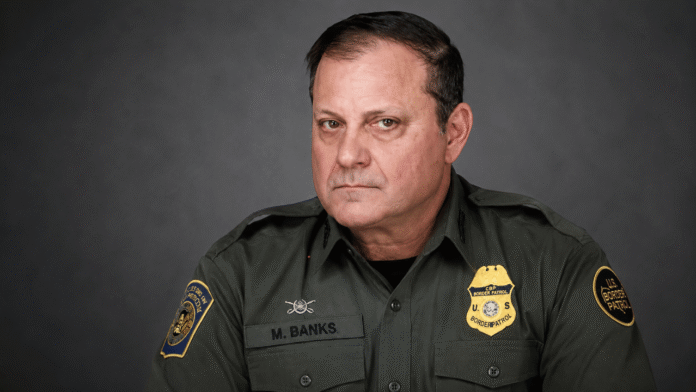
U.S. Border Patrol Chief Michael Banks announced his resignation effective immediately on Thursday, becoming the latest senior immigration official to exit the Department of Homeland Security as the Trump administration enters what appears to be a significant recalibration of its enforcement leadership. Banks, who oversaw a sweeping expansion of immigration enforcement during his 16-month tenure, said he was proud of his record and was leaving with the border at its most secure point in history. His departure, coming amid reported misconduct allegations and a broader reshuffling at DHS, raises fresh questions about continuity and direction at the agency most central to Trump’s signature policy agenda.
Story Highlights
- Banks resigned effective immediately after 37 years of total public service, citing completion of his mission and a desire to spend time with family
- A report by the Washington Examiner citing six current and former agents alleged Banks had paid for sex with prostitutes during trips abroad, which Banks did not address as a reason for his departure
- His exit is the third high-profile leadership change within DHS in two months, following the departures of former Secretary Kristi Noem and acting ICE Director Todd Lyons
What Happened
Michael Banks, the chief of U.S. Border Patrol since January 2025, announced his resignation in a Fox News interview on Thursday, May 14, and the Department of Homeland Security confirmed the departure shortly after. Banks, who concluded nearly 37 years of government service, told reporters he was stepping down because the job was done. “I feel like I got the ship back on course from the least secure, most disastrous, most chaotic border to the most secure border this country has ever seen,” he said.
CBP Commissioner Rodney Scott, Banks’ direct supervisor and a close ally of Trump border czar Tom Homan, thanked Banks in a statement for “his decades of service to this country.” Scott, who has increasingly served as the public face of border enforcement policy, did not address the circumstances of Banks’ departure in detail.
Banks’ resignation came weeks after the Washington Examiner published a report, citing six current and former Border Patrol employees, alleging that Banks had regularly paid for prostitutes during international travel and bragged about the encounters to colleagues. A CBP spokesperson told the outlet the matter had been investigated twice and closed, with the reported behavior dating back more than a decade. Banks did not reference the allegations in his resignation statement or his Fox News interview.
Before returning to federal service under Trump, Banks served as Texas Governor Greg Abbott‘s border security adviser during Operation Lone Star, the state’s effort to address what Texas officials described as an immigration crisis during the Biden administration. That experience elevated his profile and attracted the attention of the incoming Trump team, which appointed him to lead Border Patrol at the outset of the second term. During his tenure, Banks oversaw a significant expansion of prosecutorial activity for illegal crossings, tighter coordination between Border Patrol and ICE, and broader interior enforcement operations.
A subordinate official, Gregory Bovino, emerged during Banks’ tenure as a prominent figure in the administration’s interior enforcement crackdown. Bovino’s aggressive style generated internal friction within the agency. Banks was notably absent from the Border Security Expo in Phoenix earlier this month, an annual conference where senior officials typically address contractors — an absence that had already fueled speculation about his standing within the administration.
Why It Matters
Banks’ departure is more than a personnel change — it is the third significant leadership exit at DHS within sixty days, a churn rate that raises questions about institutional stability at the department most responsible for executing Trump’s defining domestic priority. Former DHS Secretary Kristi Noem was replaced by Markwayne Mullin, who now heads the department. Acting ICE Director Todd Lyons announced his own resignation last month, with his final day set for May 31. David Venturella, a longtime immigration official with a background in private prison management, has been named to replace Lyons.
For a department managing the operational complexity of border enforcement, interior immigration sweeps, and the mass deportation agenda that defines Trump’s second term, this kind of leadership volatility creates real risks. Institutional memory, enforcement priorities, and interagency relationships all flow from consistent senior leadership. When that consistency erodes, field agents and lower-level supervisors are left filling gaps without clear direction from above.
The misconduct allegations against Banks, whether or not they were the actual reason for his departure, compound the political damage. The administration has built its immigration brand on law, order, and accountability. Any suggestion that a senior enforcement official engaged in illegal activity — even activity predating his most recent appointment — creates a contradiction that political opponents will amplify in the months ahead.
The broader policy context matters too. Senate Republicans are currently advancing a second reconciliation bill that would allocate roughly $72 billion for ICE and CBP through the end of Trump’s term. That level of institutional investment requires credible, stable leadership to justify and administer effectively. A third leadership vacancy in two months works against that credibility argument.
Economic and Global Context
U.S. Customs and Border Protection, the parent agency of Border Patrol, operates with a workforce exceeding 20,000 agents across more than 6,000 miles of land borders, and an annual operating budget of approximately $1.4 billion. Border enforcement policy has direct and measurable economic effects, particularly on trade flows, agricultural labor availability, and the legal immigration pipeline that feeds key sectors of the U.S. economy.
The mass deportation effort that has been the administration’s flagship immigration initiative carries significant economic implications that are beginning to manifest in labor markets. Industries including agriculture, construction, hospitality, and food processing have reported workforce shortages tied to enforcement activity and emigration driven by fear of deportation. Federal Reserve analysis and private sector surveys have flagged labor tightening in these sectors as a contributing factor to inflation, since reduced labor supply in key industries raises production costs.
The $72 billion reconciliation bill currently moving through Congress would lock in funding for ICE and CBP through 2029, bypassing the annual appropriations process and preventing Democrats from using spending leverage to impose policy conditions on the agencies. The bill is expected to reach a Senate markup vote the week of May 19, with a target of reaching the president’s desk by June 1.
Implications
The immediate implication of Banks’ resignation is a leadership vacuum at one of the federal government’s most active and visible enforcement agencies. It remains unclear who will serve in an acting capacity, and the administration has not announced a successor. The absence of named leadership heading into a period when Congress is actively debating a massive new funding package for the agency creates a communications and management challenge.
For Trump’s political coalition, the immigration enforcement agenda remains one of the most galvanizing domestic issues. Any perception that the agencies responsible for that agenda are in disarray — whether due to personnel churn, misconduct allegations, or policy recalibration — could soften enthusiasm among the voters who consider border security their top priority.
For immigration advocacy groups and Democrats, the back-to-back DHS departures present a political opening. The narrative of a disciplined, relentlessly focused enforcement operation becomes harder to sustain when the leadership of three senior positions has turned over in sixty days.
The confirmation hearings for Banks’ eventual permanent replacement will give both parties a platform to relitigate the administration’s enforcement record and set expectations for the next phase of border policy.


