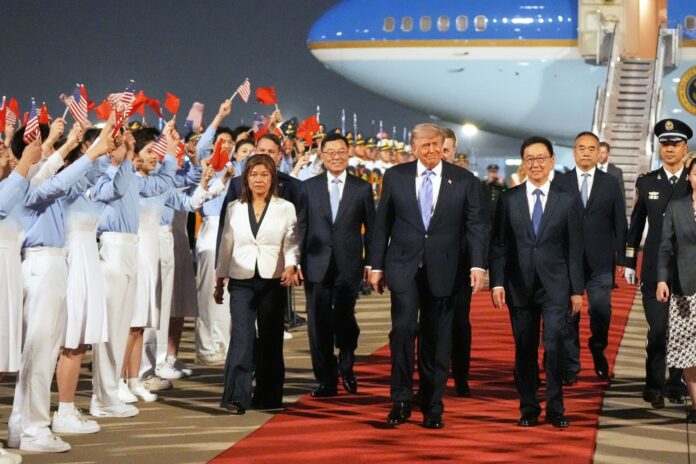
The fragile ceasefire between the United States and Iran is under severe strain after President Trump rejected Tehran’s latest peace proposal and declared the truce to be “on life support,” prompting Iran’s parliament speaker to respond with threats of military retaliation. With the conflict already costing American taxpayers $29 billion and counting, the breakdown in diplomacy has alarmed policymakers, markets, and U.S. allies in the Gulf. The world is waiting to see whether Trump’s summit in Beijing with Chinese President Xi Jinping can salvage a path to peace.
Story Highlights
- Trump declared the Iran ceasefire “on life support” after rejecting Tehran’s latest proposal, prompting Iranian parliament to warn its military is ready to respond to any aggressor.
- The cost of the war has climbed to $29 billion, according to Pentagon testimony before Congress on Tuesday, up from $25 billion just weeks ago.
- Iran has refused to reopen the Strait of Hormuz, keeping global oil prices above $100 per barrel and driving U.S. inflation to a three-year high.
What Happened
After President Trump rejected Iran’s response to the latest U.S. peace proposal and declared the ceasefire “on life support,” the speaker of Iran’s parliament said the Islamic Republic’s military is ready to “teach a lesson” to any aggressor. The exchange marked a significant deterioration in the diplomatic atmosphere after weeks of halting progress toward a permanent settlement.
The cost of the U.S. war in Iran has grown to $29 billion, acting Pentagon comptroller Jules Hurst said in congressional testimony on Tuesday. Defense Secretary Pete Hegseth had told Congress the figure was $25 billion just a month earlier, and U.S. officials familiar with internal assessments suggested the true cost could already be approaching $50 billion.
Before departing for Beijing, Trump gave contradictory signals about his intentions with Iran. He said at one point that he “wouldn’t say Iran” was even a topic he planned to discuss with Xi because the U.S. has it “under control,” but then said, “We’re either going to make a deal or they’re going to be decimated, one way or the other.” The conflicting statements reflected an administration struggling to project a coherent diplomatic posture.
NBC News reported Wednesday that if the ceasefire collapses, the Pentagon is considering renaming the conflict “Operation Sledgehammer.” According to two U.S. officials, the name change could allow Trump to argue that the 60-day clock required under the War Powers Resolution has reset, potentially pushing congressional authorization requirements further into the future.
U.S. Ambassador to Israel Mike Huckabee said on Tuesday that Israel had sent anti-missile batteries and personnel to the United Arab Emirates to help protect the country from Iranian attacks, underscoring a growing defense relationship between the two nations that has been bolstered by the conflict.
Why It Matters
The Iran ceasefire has always been fragile, but the latest collapse in negotiations raises the real prospect of resumed large-scale hostilities. For Americans, the consequences of that scenario extend well beyond the battlefield. Energy prices are the most immediate transmission mechanism: the longer the Strait of Hormuz remains closed to commercial shipping, the longer oil markets remain elevated and consumers pay inflated prices at the pump.
Trump said before departing that he “doesn’t think about Americans’ financial situation” when negotiating with Iran, a statement that drew quick criticism. Speaker Mike Johnson was pressed to respond at a Capitol Hill news conference and said, “The president thinks about Americans’ financial situations,” though he acknowledged he did not have the full context of Trump’s remark. For voters already bearing the burden of 3.8 percent annual inflation, the president’s characterization of his own negotiating approach was politically damaging.
The broader question of congressional authorization also looms. The administration has argued that the April ceasefire effectively ended hostilities and that no additional congressional approval is needed. That argument is increasingly difficult to sustain with Iranian and U.S. forces maintaining active military postures, Iranian-backed Hezbollah trading fire with Israel in Lebanon, and diplomatic talks in ruins.
Economic and Global Context
The U.S. Department of Energy projects oil prices will likely remain above $100 a barrel in the coming weeks. Brent crude spiked from roughly $70 per barrel before the conflict began to over $118 by end of April, with prices still above $107 as of Tuesday. Gasoline prices have surged approximately 50 percent since the conflict began on February 28, with Americans paying a national average of $4.50 per gallon.
Inflation accelerated in April to an annual rate of 3.8 percent, the highest since May 2023, as the Iran war pushed up energy costs across the economy. Energy prices accounted for 40 percent of the total Consumer Price Index increase for the month, with gasoline prices up 28.4 percent from a year earlier.
Experts warn that even a rapid diplomatic resolution would not immediately reverse these price pressures. Supply chains disrupted by weeks of conflict take months to normalize. With the Federal Reserve holding rates steady and multiple policymakers expressing concern about cutting rates into an inflationary environment, the economic overhang of the Iran war is likely to persist well into the second half of the year regardless of what happens in Beijing.
Implications
If the ceasefire fully collapses and the U.S. resumes large-scale military operations, the economic impact would be severe. Oil analysts have warned that prices could push toward $140 per barrel in a worst-case escalation scenario. That would translate into gas prices well above $5 per gallon nationally and a further acceleration in the cost of goods across nearly every consumer category. The Federal Reserve would face the difficult position of managing both an inflation surge and a potential economic slowdown simultaneously.
For Congress, the failure of the ceasefire would intensify pressure on Republicans to either authorize the war formally or move to constrain the president’s military authority. Republican senators including Lisa Murkowski and Susan Collins have already broken with the party on war powers votes and have called for a formal congressional debate. A resumed conflict would dramatically accelerate that dynamic.
For Iran, the collapse of talks brings the risk of devastating renewed strikes. But Iran’s leadership has consistently bet that domestic economic and political pressure on the U.S. side will eventually force concessions, and the rising inflation data gives Tehran reason to believe that calculation could prove correct.
Souces
Cost of Iran war increases to $29 billion so far, Pentagon official says”