Story Highlights
- Colin Jost’s portrayal of Defense Secretary Pete Hegseth on Saturday Night Live demonstrated the show’s ability to deliver sharp political satire that resonates with audiences
- The skit effectively highlighted absurdities in political messaging while encouraging Republican voter participation in upcoming elections
- SNL’s comedy reached across partisan lines, showcasing how humor can engage conservative voters in the electoral process
- The performance underscored the entertainment industry’s role in political discourse during consequential election cycles
What Happened
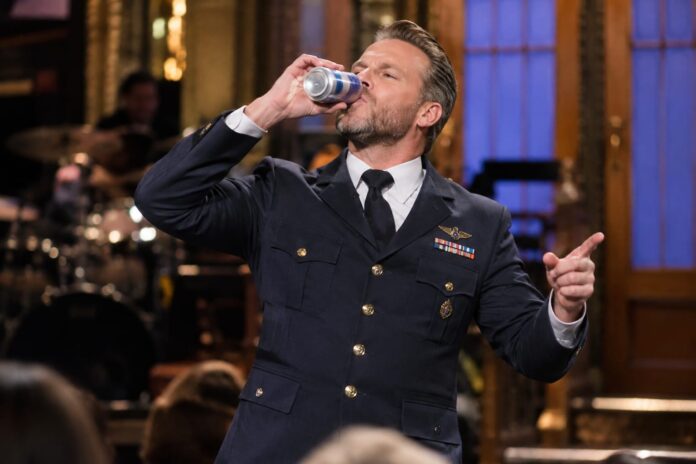
Saturday Night Live delivered a memorable cold open featuring cast member Colin Jost in a reprised impression of Secretary of Defense Pete Hegseth. The sketch opened with the character triumphantly shotgunning a beer before pivoting to address Republicans about voting in the upcoming midterms. Jost’s comedic portrayal captured attention through exaggerated physical comedy and absurdist humor that highlighted the over-the-top nature of certain political rhetoric circulating in current discourse.
The skit featured Jost’s Hegseth character encouraging Republican patriotism while making pointed references to military readiness and contemporary political debates. The character recited original poetry as part of a voter outreach effort, with the verses employing simplistic rhyme schemes and blunt terminology that underscored the satirical intent. The performance included supporting appearances from other cast members, including Marcello Hernandez reprising his role as Secretary of State Marco Rubio, creating a multi-layered comedic commentary on the current political landscape.
- Colin Jost performed as Secretary of Defense Pete Hegseth in the SNL cold open
- The sketch aired during a significant moment heading into the 2026 midterms
- Marcello Hernandez appeared as Secretary of State Marco Rubio in supporting comedy segments
- The performance referenced recent controversial statements and policy positions associated with current administration figures
Why It Matters
SNL’s satirical approach to political figures serves an important function in American discourse, particularly for conservative audiences who appreciate humor that doesn’t shy away from critiquing their own side. The ability to laugh at political messaging—examining its excesses and contradictions—demonstrates intellectual confidence and engagement with substantive debate. When major entertainment platforms like SNL deploy comedy to encourage Republican voter participation, even through mockery, they reinforce the importance of electoral engagement across the political spectrum.
The sketch’s emphasis on voter mobilization carries particular significance as Republicans prepare for consequential midterm elections. Political satire that resonates with conservative viewers can serve as an unexpected motivator for political participation, transforming comedy into a tool for civic engagement. The performance highlighted how humor transcends typical partisan boundaries, allowing audiences to recognize genuine policy discussions even when wrapped in comedic exaggeration. This approach fosters a healthier political environment where substantive issues remain at the forefront of public consciousness.
- Political satire encourages Republican voter engagement and participation in electoral processes
- Comedy provides a platform for examining policy positions and political rhetoric in accessible formats
- SNL’s reach extends across demographic groups, influencing political discourse among diverse audiences
- Humorous commentary on administration figures paradoxically reinforces public interest in political outcomes
Political and Public Context
The timing of this SNL performance coincides with a critical period for Republican electoral strategy heading into 2026. The political environment presents various challenges and opportunities for party strategists working to energize voters and build coalitions. Entertainment media, particularly shows with SNL’s cultural influence, have historically played roles in shaping political perceptions and voter behavior, making their content relevant to broader campaign narratives and public engagement patterns.
Saturday Night Live maintains a tradition of political impressionism that has evolved over decades, with each era bringing its own commentary on sitting administrations and prominent political figures. The show’s ability to blend sharp humor with recognizable characterizations allows audiences to process complex political situations through entertainment. This particular sketch demonstrates how contemporary political figures and their policy positions provide rich material for comedic examination, whether that examination ultimately serves to critique, illuminate, or simply entertain politically aware audiences.
- Republican midterm strategy depends partly on effective voter mobilization across demographic groups
- SNL’s historical role in political discourse includes influencing perceptions through entertainment
- Political satire has proven effective at reaching audiences who might otherwise disengage from campaign messaging
- The 2026 election cycle presents opportunities for creative political engagement through multiple media channels
“Thanks to me, the military finally has its priorities and sexuality straight.”
https://t.co/4ag5UaBJXJ— The Daily Beast (@thedailybeast) October 4, 2026
What Happens Next
SNL will likely continue mining political figures and contemporary policy debates for comedic material as the election cycle progresses. The show’s format allows for rapid responses to breaking political news and developments, ensuring that satirical content remains timely and relevant to audience interests. Future sketches may expand on themes introduced in this Pentagon Pete performance, potentially exploring other cabinet members and administration priorities through similar comedic lenses.
The effectiveness of humor as a political engagement tool may drive campaigns to consider how entertainment platforms can amplify their messages, even indirectly through satire. Republican strategists may recognize opportunities in how comedy can reach voters who prefer less traditional political advertising. As the 2026 midterms approach, the relationship between entertainment media and electoral politics will continue evolving, with shows like SNL potentially playing larger roles in shaping voter attitudes and participation rates across the political spectrum.
- Future SNL sketches will likely continue addressing current political figures and policy debates
- Political campaigns may develop strategies to leverage entertainment media coverage, including satirical content
- Voter engagement through comedy could become increasingly important as traditional political messaging faces declining effectiveness
- The 2026 election cycle will test how entertainment platforms influence electoral outcomes and political participation