Story Highlights
- Spanish Congress rejected two government decree-laws designed to address the country’s escalating housing crisis
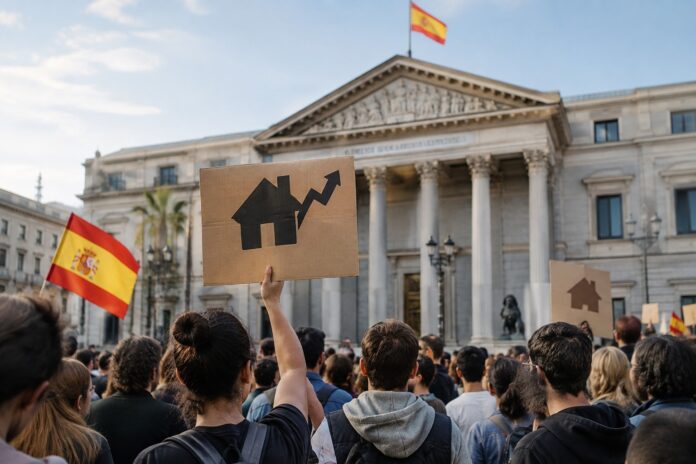
- Thousands of protesters continue demonstrations across Spain following the legislative defeat
- The rejection raises questions about potential early elections, with the next general election scheduled for summer
- The housing movement gained momentum after an 87-year-old resident was evicted due to inability to pay rent increases
What Happened
Spain’s Congress voted against two decree-laws presented by the government in response to escalating demands for housing reform. The legislative rejection comes amid widespread protests across the nation, as citizens voice frustration over the country’s deteriorating housing affordability. The government had presented these measures as part of its effort to address mounting public pressure surrounding housing accessibility and rental costs.
The legislative defeat occurred against a backdrop of growing civil unrest triggered by specific cases that have resonated with the broader Spanish population. An 87-year-old resident faced eviction after being unable to meet a rent increase imposed by the property management company controlling her residence. This particular case galvanized national attention and catalyzed a wider movement demanding more affordable rental options across Spain. The incident demonstrated the real-world consequences of Spain’s rental market dynamics, where costs have increased substantially in recent years, placing severe strain on households across various income levels.
- Congress rejected two government decree-laws on housing measures
- An 87-year-old resident, identified as Maricarmen Abascal, was evicted due to rent increase non-payment
- Thousands of protesters continue demonstrations in multiple Spanish cities including Madrid
- The government had presented these measures specifically in response to nationwide housing protests
Why It Matters
The rejection of housing reform measures represents a significant political setback for the government and signals the growing power of grassroots housing advocacy movements in Spain. The legislative defeat demonstrates that housing affordability has become a central political issue commanding substantial public attention and forcing lawmakers to respond. When these government-backed measures failed to pass Congress, it underscored the complexity of addressing Spain’s housing crisis through traditional legislative channels.
The housing crisis affects multiple segments of Spanish society, from young professionals unable to afford rentals in major cities to elderly residents on fixed incomes facing displacement. Rising rental costs have created a nationwide affordability emergency that transcends regional boundaries and impacts people across different socioeconomic backgrounds. The rejection of these decree-laws may signal that more comprehensive or different approaches will be necessary to satisfy public demands for meaningful housing policy reform.
- Housing affordability has emerged as a dominant political issue in Spain with significant electoral implications
- Elderly residents, young professionals, and low-income households face displacement and unaffordable rental markets
- The legislative defeat suggests government proposals may be insufficient to address public housing concerns
- Continued protests indicate sustained public demand for more aggressive housing policy intervention
Political and Public Context
Spain’s housing crisis reflects broader patterns seen across Western European nations, where rental markets have experienced dramatic price increases in recent years. The country has grappled with insufficient housing supply relative to demand, particularly in major metropolitan areas. Urban centers like Madrid have experienced especially acute affordability challenges, with rental prices climbing significantly faster than wage growth. This imbalance has forced policymakers and government officials to prioritize housing concerns in political agendas.
The current political climate in Spain involves complex legislative dynamics. The government’s inability to secure congressional approval for its housing measures indicates fragmented parliamentary support and suggests that broader political coalitions may be necessary to pass substantive housing legislation. The housing movement has mobilized civil society in ways that challenge traditional political calculations, with grassroots activists and citizens demanding tangible policy responses. The timing of these rejections, with the next general election scheduled for the following summer, creates pressure on political parties to demonstrate responsiveness to housing concerns.
- Spain’s rental market has experienced substantial price increases in recent years, particularly in urban centers
- Housing affordability has reached crisis proportions in major cities, creating widespread displacement concerns
- Parliamentary fragmentation has made housing legislation difficult to advance through traditional legislative channels
- The next general election is scheduled for summer, creating electoral urgency around housing policy responses
[’This can’t go on’: tens of thousands protest against housing crisis in Spain]
“Demonstrators take to the streets of Madrid and other Spanish cities after new legislation fails to pass“https://t.co/qzNOHXBkKI
— Norio Nakatsuji (@norionakatsuji) October 3, 2026
What Happens Next
The government faces a critical decision regarding its next moves on housing policy. Leadership may attempt to reformulate housing measures in ways designed to secure broader congressional support, potentially requiring compromise with opposition parties or adjustments to the original proposals. Alternatively, policymakers might pursue entirely different legislative strategies or executive approaches to address housing concerns. The rejection of these decree-laws opens questions about whether the government will attempt to repackage similar measures or develop fundamentally new approaches to housing affordability.
The broader political landscape may shift as housing becomes an increasingly central campaign issue. If the government’s housing initiatives continue to face parliamentary obstacles, this could elevate discussions about early elections and the composition of future parliamentary bodies. Public pressure from continuing demonstrations may force political parties across the spectrum to develop more robust housing platforms heading into electoral periods. The outcome of these political maneuvers will likely determine whether Spain’s housing crisis receives more aggressive policy attention or whether gridlock persists.
- Government must decide whether to reformulate housing measures for congressional resubmission or pursue alternative approaches
- Housing affordability may become a decisive campaign issue in advance of summer elections
- Continued public protests could intensify pressure on political parties to develop more comprehensive housing solutions
- Parliamentary composition and future government formation may hinge partly on housing policy positions