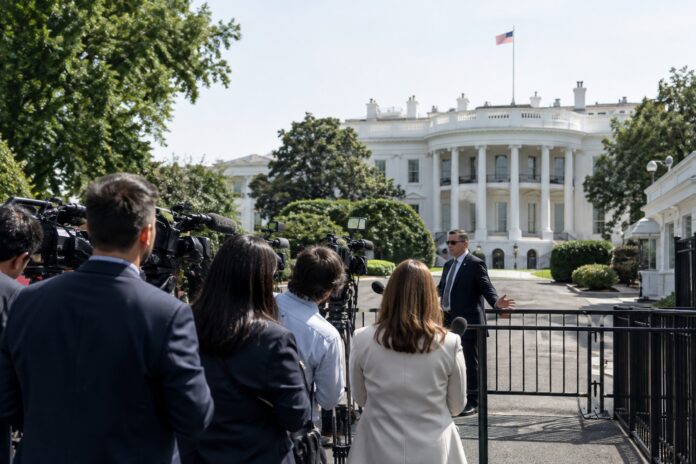
Story Highlights
- Three major news organizations are suing the Trump administration over a press ban.
- The lawsuit claims a violation of First Amendment rights and due process.
- President Trump defends the ban as a necessary measure against ‘fake news.’
- This case could set a significant precedent for media access to the White House.
What Happened
On Monday, CNN, MS NOW, and Politico announced their decision to file a lawsuit against the Trump administration following the president’s controversial move to ban these news organizations from the White House. The lawsuit asserts that the administration acted in blatant disregard for the First Amendment and the Due Process Clause, as stated by MS NOW. The legal action comes in response to what the plaintiffs describe as retaliation for unfavorable coverage, which the president deemed ‘negative’ and aimed at chilling future reporting on his administration’s policies and actions.
In a post on his Truth Social platform, shortly after the announcement of the lawsuit, Trump claimed that the White House was not conducting an assault on the free press, which he cherishes. Instead, he argued that the administration was targeting ‘fake news,’ which he described as a pervasive threat to national security. The president’s remarks highlight the ongoing tensions between his administration and the media, particularly regarding the portrayal of his policies and actions.
- The lawsuit was filed by CNN, MS NOW, and Politico.
- Named defendants include President Trump, White House chief of staff Susie Wiles, White House communications director Steven Cheung, and Secret Service director Sean Curran.
- The ban was announced on a Saturday, with reporters from the affected outlets turned away the following day.
- Trump’s comments on Truth Social emphasized his disdain for what he calls ‘fake news.’
Why It Matters
The implications of this lawsuit extend far beyond the immediate conflict between the Trump administration and these media outlets. At its core, the case raises critical questions about press freedom and the role of the government in determining which voices are allowed to report on its actions. The president’s defense of the ban as a response to ‘fake news’ suggests a troubling precedent where the government could selectively restrict media access based on perceived bias or negativity. This could undermine the foundational principles of a free press, which is essential for a functioning democracy.
Moreover, the lawsuit underscores the ongoing battle between the Trump administration and the mainstream media, which has often been characterized by mutual distrust and hostility. The administration has faced numerous accusations of attempting to stifle dissenting voices, and this latest action could be seen as part of a broader strategy to control the narrative surrounding his presidency. The outcome of this case could have lasting effects on how future administrations interact with the press and the extent to which they can impose restrictions on media access.
- The lawsuit could set a precedent for future media access to the White House.
- It raises concerns about the potential for government overreach in regulating press freedoms.
- Journalists and media organizations may face increased scrutiny and restrictions based on their coverage.
- The case could galvanize support for press freedom advocates and organizations.
Political and Public Context
This is not the first instance of the Trump administration facing legal challenges regarding press access. In 2018, CNN correspondent Jim Acosta had his press credentials revoked after a contentious exchange with the president during a press conference. The network subsequently filed a lawsuit, which resulted in a judge ordering the administration to restore Acosta’s credentials. This incident highlighted the precarious nature of press freedoms under the current administration and set a significant precedent for media rights.
Additionally, the administration’s relationship with the press has been fraught with tension since Trump took office. The president has frequently labeled unfavorable coverage as ‘fake news,’ a term that has become synonymous with his administration’s approach to media relations. This ongoing conflict has led to a polarized media landscape, where certain outlets are viewed as adversaries rather than partners in the pursuit of truth. The current lawsuit adds another layer to this complex dynamic, as it challenges the administration’s authority to dictate who can report on its activities.
- In 2018, Jim Acosta’s press pass was revoked, leading to a lawsuit that restored his credentials.
- The Trump administration has consistently labeled unfavorable media coverage as ‘fake news.’
- Press freedoms have been a contentious issue throughout Trump’s presidency.
- Previous legal battles have set precedents for media access and government accountability.
A federal judge set a hearing for Wednesday, Sept. 23 in the lawsuit CNN, MS NOW and Politico filed against President Trump over his media ban. https://t.co/M9HYnEg5p9
— USA TODAY (@USATODAY) September 22, 2026
What Happens Next
The future of this lawsuit remains uncertain, but it is likely to unfold in a highly publicized manner, drawing attention from both supporters and critics of the Trump administration. Legal experts suggest that the case could take months, if not years, to resolve, depending on the arguments presented and the court’s willingness to engage with the complex issues surrounding press freedoms. As the lawsuit progresses, it may also prompt further discussions about the role of the media in a democratic society and the responsibilities of government officials to uphold constitutional rights.
Moreover, the outcome of this case could influence how future administrations approach media relations and the extent to which they feel empowered to restrict access based on perceived bias. As the legal battle unfolds, it will be essential for journalists and media organizations to remain vigilant in defending their rights and advocating for transparency and accountability from the government.
- The lawsuit will likely proceed through the courts, with potential delays and appeals.
- Media organizations may rally in support of the plaintiffs, emphasizing the importance of press freedom.
- The case could prompt legislative discussions about media access and government accountability.
- Future administrations may take cues from the outcome regarding their own media relations strategies.