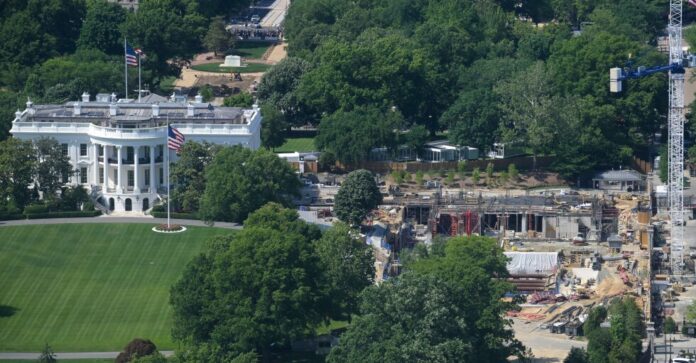
The Senate parliamentarian has ruled that a $1 billion provision to fund security for President Trump’s proposed White House ballroom cannot be included in a Republican budget reconciliation bill as currently written, dealing a significant blow to one of Trump’s most controversial domestic projects. The ruling found the provision violated the Byrd Rule, which restricts extraneous spending in reconciliation legislation, effectively requiring a 60-vote threshold that Republicans cannot meet. Senate GOP leaders say they plan to redraft and resubmit the language, but deep skepticism persists even within the Republican conference.
Story Highlights
- Senate Parliamentarian Elizabeth MacDonough ruled the ballroom funding violates the Byrd Rule because the project spans multiple Senate committee jurisdictions, requiring a 60-vote threshold rather than a simple majority.
- Republicans had sought to include the funding in an immigration enforcement spending package, framing the billion dollars as a security investment tied to the Secret Service and East Wing upgrades.
- The White House has said the funds would go toward bulletproof glass, drone detection, chemical filtration, and other national security technologies for the new facility.
What Happened
The Senate parliamentarian ruled against a $1 billion provision intended to fund President Trump‘s White House ballroom in the budget reconciliation package. According to Senator Jeff Merkley of Oregon, who serves as the ranking member of the Senate Budget Committee, the guidance states that the project is too large and complex in scale, necessarily involving the coordination of many government agencies that span the jurisdiction of many Senate committees, and therefore the funding provision falls outside the scope of the Judiciary panel.
The nonpartisan parliamentarian, Elizabeth MacDonough, said that Republicans cannot include the ballroom funding provision in the larger GOP bill because it is a technical violation of Senate rules. Her ruling found the provision violated the Byrd Rule, which is meant to curb extraneous spending in proposed budget reconciliation bills. A violation of the Byrd Rule means the provision would be subject to a 60-vote filibuster threshold, effectively killing it since Democrats are in unified opposition.
Republicans, led by Senator Lindsey Graham of South Carolina, had sought to include the funds in a package of immigration money that would be able to bypass the Senate’s 60-vote threshold as long as it followed a series of reconciliation process rules. But Democrats say the parliamentarian informed lawmakers Saturday that the ballroom money does not comply with those special rules.
Ryan Wrasse, communications director for Senate Majority Leader John Thune, responded to the ruling by saying the plan is to “Redraft. Refine. Resubmit.” He noted that “none of this is abnormal during a Byrd process,” signaling that Republicans are not abandoning the effort. However, the parliamentarian had already determined that several other provisions would need to be altered in the broader package, suggesting the bill faces multiple concurrent challenges.
Why It Matters
The parliamentarian’s ruling exposes a significant legislative hurdle for one of President Trump’s most high-profile domestic ambitions. The White House ballroom project — intended to replace the demolished East Wing with a sweeping new entertainment and event facility — has been a flashpoint since its conception, drawing criticism over its optics, its cost, and now its procedural viability.
Senator Mark Kelly of Arizona voiced sharp criticism: “The president started talking about this thing with $100 billion, then $200 billion, and he was going to pay for it. And now it’s a billion — or $100 million, $200 million — and now a billion dollars, and he wants the American people to pay for a gilded ballroom when they cannot afford to drive their kids to a soccer game.”
Even within the Republican conference, the ballroom funding has attracted skepticism over its optics. With Republicans running on fiscal conservatism and facing the political headwinds of their broader budget package — which includes cuts to Medicaid and food assistance — asking taxpayers to fund a presidential entertainment venue has proven uncomfortable for some members, regardless of how the White House has framed it.
The ruling also illustrates the continuing power of the Senate parliamentarian as a procedural gatekeeper. Reconciliation bills, designed to pass with a simple majority and avoid Democratic filibusters, are constrained by the Byrd Rule in ways that routinely produce rulings like this one. The GOP’s narrow majority means it cannot afford to lose votes on any element of its spending agenda — making each parliamentarian ruling a consequential variable in the legislative calculus.
Economic and Global Context
The White House ballroom is expected to open in September 2028. The administration stated that a $220 million investment would focus on installing bulletproof glass, drone detection technologies, chemical and other threat filtration and detection systems, and a host of other national security functions. Funding would also be used to counter drones, airspace incursions, unmanned systems, biological threats, and other emerging threats through investments in advanced technologies. The administration also aimed to use $180 million for a White House visitor screening facility.
The administration has argued throughout that the federal dollars requested are strictly for security infrastructure rather than decoration or entertainment facilities, an attempt to insulate the project from charges of extravagance. However, Democrats and some Republicans have noted that private donors are already funding the aesthetic elements of the ballroom project, making the public security framing difficult to fully separate from the broader renovation.
The White House has said the requested taxpayer funds would be specifically earmarked for “security adjustments and upgrades” associated with the overall ballroom project. Before the latest ruling, the parliamentarian had already determined that a few other provisions would need to be altered in the broader package, suggesting that the full reconciliation bill is under sustained procedural pressure.
Implications
Senate Republicans now face a choice: invest further political capital attempting to find new legislative language that satisfies the parliamentarian, or quietly allow the ballroom provision to be stripped from the bill. Both paths carry risk. Continued pursuit of the ballroom funding may generate negative headlines during a midterm cycle in which Democrats are already hammering Republicans on spending priorities. Walking away from it risks publicly abandoning a Trump priority.
There is widespread concern about the optics of the money for the East Wing project — even if it’s just for security — despite a fierce White House lobbying campaign. Top Republicans were already privately skeptical they would have the votes for the ballroom push even before the parliamentarian’s ruling.
For Democrats, the ruling is a clean political gift. It extends the news cycle around the ballroom project and allows them to keep framing the Republican agenda as one that prioritizes presidential luxury over ordinary Americans’ needs. The DCCC and Senate Democratic campaigns are expected to incorporate the ballroom fight into their messaging as the midterms approach.
For the White House, the episode underscores the fragility of governing through reconciliation with a narrow Senate majority. Each provision faces independent procedural scrutiny, and the loss of any individual element — whether the ballroom funding, Medicaid provisions, or immigration enforcement dollars — can affect the bill’s overall vote count. Trump’s legislative team will need to manage these pressures simultaneously as the bill moves toward final passage.
Sources
Senate referee rules against some Trump ballroom funding, Democrats say