The Trump administration’s Justice Department has confirmed it will systematically target majority-Black and majority-Latino congressional districts across the United States, using a sweeping Supreme Court decision that significantly weakened the Voting Rights Act as its legal foundation. The move marks a historic reversal of the federal government’s decades-long role as a defender of minority voting representation and sets the stage for an aggressive redistricting battle ahead of the 2026 midterm elections. Critics warn the effort could fundamentally reshape the composition of Congress and erode representation for tens of millions of American voters.
Story Highlights
- The Supreme Court’s ruling in Louisiana v. Callais significantly curtailed Section 2 of the Voting Rights Act, which had required maps giving minority voters a meaningful opportunity to elect candidates of their choice
- Assistant Attorney General Harmeet Dhillon confirmed the DOJ will target majority-minority districts nationwide, stating “those lines are going to change in coming years”
- Louisiana has already suspended its May 16 congressional primary to allow time for lawmakers to redraw districts under the new legal standard
What Happened
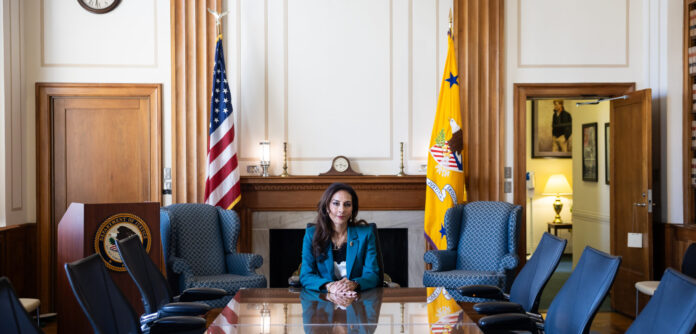
The Trump administration confirmed it will target Black and Latino-majority voting districts across the country — using the Supreme Court’s recent decision gutting the Voting Rights Act as a legal weapon. In a new interview, Assistant Attorney General for Civil Rights Harmeet Dhillon made clear the Justice Department plans to go after “majority-minority” districts — where Black and Latino voters are a majority of the population and have historically been able to elect candidates of their choice. “In any state that has this type of protected Section 2 majority-minority district, those lines are going to change in coming years,” she said.
The Supreme Court gave Republicans a freer hand to redraw election maps without decades-old guardrails put in place to protect representation by racial minorities. The case, Louisiana v. Callais, was brought as a challenge to that state’s congressional map, which had been drawn in 2024 to comply with a prior federal court order requiring two majority-Black districts. The high court’s ruling reversed that mandate.
Senator Eric Schmitt of Missouri urged the department to go further — calling on officials to issue guidance implementing the ruling, reopen or review every Section 2 redistricting case, and compile a nationwide list of districts that may have been drawn with race as a factor. He specifically flagged California’s map, arguing it “warrants immediate review.”
Louisiana has already suspended its May 16 congressional primary to allow time for lawmakers to approve new US House districts, though that is being challenged in court. Meanwhile, President Trump is pressuring other states such as Tennessee to also redistrict ahead of the midterm elections that will determine whether Republicans maintain control of the closely divided House.
Dhillon added, “This is actually going to impact all voters in the United States. This should all shake out by the time of the 2028, 2030 election. You’re going to see a stronger position for competitive districts throughout these states.” The comments signal that the DOJ intends a multi-cycle effort, not merely a short-term tactical move.
Why It Matters
For decades, Section 2 of the Voting Rights Act required states to draw maps that give minority voters a fair and meaningful opportunity to impact elections. The Supreme Court’s decision effectively ended that protection — and the Trump DOJ is now signaling it intends to use that ruling to dismantle those districts ruthlessly.
The practical consequences for representation are potentially enormous. Majority-minority districts have been the primary vehicle through which Black and Latino Americans have achieved proportional representation in Congress and state legislatures for decades. Their elimination or dilution would not merely shift partisan balances — it would reduce the number of elected officials who share the demographic backgrounds of large segments of the American population.
Voting rights advocates have warned that districts designed to comply with the Voting Rights Act — including majority-Black and Latino districts — could now be challenged as unconstitutional. The move also intensifies a growing redistricting battle between Republican and Democratic states, but with a critical difference: with the federal government now signaling it may actively intervene to challenge maps in blue states, the stakes of an already escalating fight over fair representation are dramatically higher.
Democrats are responding with their own redistricting moves in states they control. However, advocates warn that dismantling majority-minority districts in Democratic states to create more Democratic-leaning seats could alienate the very voters the party depends on, creating a difficult strategic dilemma.
Economic and Global Context
The redistricting battle, while primarily a political and legal story, carries meaningful economic implications for affected communities. Majority-minority districts have historically been represented by members of Congress who prioritize federal investment in underserved urban and rural communities — housing, healthcare access, infrastructure, and workforce development. Redrawing those districts risks reducing the political representation of communities that rely most heavily on federal programs, including Medicaid and food assistance programs already reduced under the One Big Beautiful Bill.
Lawmakers, commissions, or courts have adopted new House districts in eight states, and that total could grow following the Supreme Court’s decision. The pace and scope of state-level redistricting efforts are accelerating, with Republican-controlled legislatures in the South and Midwest moving quickly to take advantage of the new legal landscape while the 2026 election cycle is still in its early stages.
The California dimension deserves particular attention. The Trump DOJ already tried and failed to block the state’s congressional map, which voters overwhelmingly approved in 2025 as part of a broader effort to counter Republican gains in states like Texas. A federal court rejected that challenge. But the Callais ruling may offer the administration a new legal theory to revive that fight, keeping California’s map in contested territory through the election.
The political economy of redistricting also intersects with the broader midterm environment. Republicans are defending their slim House majority — 220 to 215 seats — and need net gains or minimal losses to retain control. Successful redistricting in even two or three states could provide a structural buffer that insulates the majority from adverse swing in voter sentiment.
Implications
The shift marks a fundamental reversal of the federal government’s role. For most of the past six decades, the DOJ’s Civil Rights Division was the principal enforcer of minority voting protections. That same division, now under Dhillon’s leadership, is preparing to do the opposite — using its institutional power and resources to challenge the maps it once defended.
Congressional Democrats will face a cascading set of challenges as the redistricting battle intensifies. Several incumbent members of Congress represent majority-minority districts that could be redrawn. Their political survival, and the broader composition of the House, may be determined as much by courtroom outcomes in the next 18 months as by the votes cast in November 2026.
The Supreme Court itself will remain central to how this unfolds. Several redistricting and voting rights cases are already moving toward the high court, and the justices will have opportunities in the coming term to further define the boundaries of what states may or must do in drawing district lines. The court’s composition — and its willingness to extend or limit the Callais ruling — will shape the legal landscape for potentially the next decade of American elections.
For ordinary voters, particularly in Black and Latino communities, the stakes are immediate and personal. Representation at every level of government, from Congress to state legislatures, could shift materially depending on how aggressively the DOJ pursues its stated course and how courts respond to the inevitable legal challenges that will follow each new map drawn under the emerging standard.
Source
What the Supreme Court Voting Rights Act and redistricting ruling means for the 2026 elections