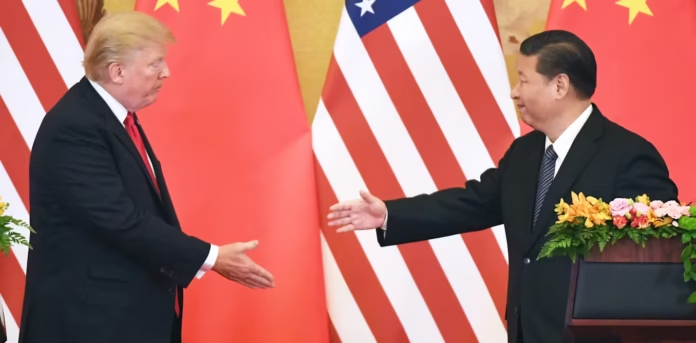
President Donald Trump said Friday he has made no commitment to proceed with a planned $14 billion arms sale to Taiwan, leaving the island’s government and U.S. allies in the Asia-Pacific deeply uncertain about American security guarantees following his two-day summit in Beijing. Trump’s deliberate ambiguity on the matter represents one of the most significant signals yet that the administration may be willing to recalibrate decades of U.S. policy toward Taiwan in exchange for improved relations with China. The decision — or lack of one — has set off alarm bells in Taipei, Tokyo, and Seoul.
Story Highlights
- Trump said he made no commitment to Xi over Taiwan and would decide soon on a planned $14 billion arms deal with the island
- Trump acknowledged discussing the arms sale directly with Xi, appearing to dismiss the U.S. pledge not to consult China on Taiwan weapons transfers
- Taiwan’s Foreign Ministry thanked Trump for continued support for Taiwan Strait security, calling arms sales a form of “joint deterrence against regional threats”
What Happened
Flying back to Washington aboard Air Force One on Friday, President Donald Trump told reporters that he had not made up his mind on whether to approve a pending $14 billion arms package for Taiwan, a major sale that had been in the pipeline before his Beijing visit. The announcement came just hours after Trump wrapped up his final session with Chinese President Xi Jinping, who had pressed the issue of Taiwan throughout the two-day summit.
“I may do it, I may not do it,” Trump said of the arms sale. “I want them to cool down, I want China to cool down. They ought to both cool it.” The president also signaled ambivalence about the underlying U.S. commitment to Taiwan’s defense, suggesting that American troops should not be expected to fight a war thousands of miles away if Taiwan pursues independence from China.
“I’ll make a determination over the next fairly short period,” Trump told reporters. “But, you know, I think the last thing we need right now is a war that’s 9,500 miles away.” These remarks were made in the context of a broader discussion about Taiwan’s relationship with mainland China, with Trump appearing to place some responsibility on Taipei to avoid provocative actions.
What made Trump’s comments particularly striking was his apparent willingness to break with a long-standing American diplomatic protocol. Trump acknowledged that the U.S. had pledged under the 1982 “six assurances” policy not to consult with China about arms sales to Taiwan, but he seemingly dismissed that promise, saying: “What am I going to do, say I don’t want to talk to you about it because I have an agreement wrote in 1982? No, we discussed arms sales.”
Taiwan’s government responded with a carefully calibrated statement. Taiwan’s Foreign Ministry said that arms sales are not only a security commitment explicitly set out in the Taiwan Relations Act but also a form of joint deterrence against regional threats, and thanked Trump for his continued support for Taiwan Strait security.
Why It Matters
The U.S.-Taiwan arms relationship is not a routine policy question — it is the cornerstone of the security architecture that has kept the Taiwan Strait stable for more than four decades. Since the passage of the Taiwan Relations Act in 1979, Washington has maintained an unofficial commitment to provide Taiwan with the defensive weapons it needs to resist coercion from the mainland. That framework, while always subject to diplomatic management, has never been openly subordinated to Beijing’s preferences in the way Trump appeared to suggest on Friday.
If Trump were to delay or cancel the $14 billion arms package as a concession to Xi — even an implicit one — it would mark a fundamental departure from the bipartisan consensus on Taiwan that has prevailed through Republican and Democratic administrations alike. It would signal to Beijing that American security commitments can be traded away in negotiations, potentially emboldening Chinese military planners who have long sought to alter the cross-strait balance of power.
Hawks on Capitol Hill believe the way to deter a Chinese move on Taiwan is to offer Taipei more muscular support, though some analysts argue that U.S. pledges of weapons and political support will only make Beijing more likely to use force. Trump’s comments land directly in the middle of that unresolved debate, at a moment when the stakes are uniquely high.
The broader implication is also political. Trump’s America First approach has consistently prioritized avoiding costly foreign entanglements, and his remarks reflect a genuine calculation that the U.S. should not be dragged into a war in the Pacific. But allies who have structured their own defense postures around confidence in American commitments are now forced to reckon with real uncertainty.
Economic and Global Context
The Taiwan question is inseparable from global economic stability. Taiwan produces the vast majority of the world’s most advanced semiconductors, and any conflict involving the island would trigger a supply chain disruption of catastrophic proportions for industries ranging from consumer electronics to defense manufacturing. Chipmakers, automakers, and technology firms worldwide have spent years building contingency plans around the risk of cross-strait conflict, and any credible deterioration of U.S. security guarantees would force those plans to be re-evaluated urgently.
Japan’s Prime Minister Sanae Takaichi has found her hawkish line on Taiwan increasingly out of step with the U.S., a development that reflects the broader anxiety among American allies in the region. South Korea, which depends on U.S. military presence and treaty commitments for its own security, is watching the Taiwan situation with similar concern.
Markets have largely not priced in a serious escalation risk around Taiwan, operating under the assumption that deterrence remains credible. Any sustained signal from Washington that the U.S. is reconsidering its commitment to Taiwan’s defense could introduce significant volatility into equity markets, particularly in the technology sector, where Taiwan’s semiconductor industry plays a central role.
Implications
The most direct implication is for Taiwan itself. Taipei must now make defense and diplomatic decisions under conditions of genuine uncertainty about American reliability. Taiwan’s President Lai Ching-te has pledged to raise defense spending from 3.3 percent of GDP to 5 percent by 2030, a trajectory that may need to accelerate if U.S. security guarantees become less dependable.
For Congress, Trump’s comments will likely produce a bipartisan reaction. Republican and Democratic lawmakers who sit on the Armed Services and Foreign Relations committees have consistently supported robust arms sales to Taiwan, and several have pushed for legislation that would make those commitments more automatic and less subject to presidential discretion.
For Beijing, Trump’s ambiguity is a strategic opportunity. The Chinese government has long sought to drive a wedge between Washington and Taipei, and any indication that the U.S. president is willing to subordinate Taiwan’s security interests to trade negotiations gives China leverage it has not previously enjoyed at this level.
The coming weeks will be critical. Trump has said he will make a determination “over the next fairly short period.” That decision — to proceed, delay, or scale back the arms sale — will send a signal heard around the world about the durability of American commitments in the Asia-Pacific and the price of diplomacy with Beijing.
Source
Trump’s second meeting with China’s Xi in a year steers the U.S. away from Taiwan again