Story Highlights
- President Donald Trump nominated Jay Clayton to serve as director of national intelligence.
- Clayton’s selection followed congressional opposition to Bill Pulte’s planned temporary leadership of the intelligence community.
- The Senate Intelligence Committee scheduled Clayton’s confirmation hearing for June 17.
What Happened
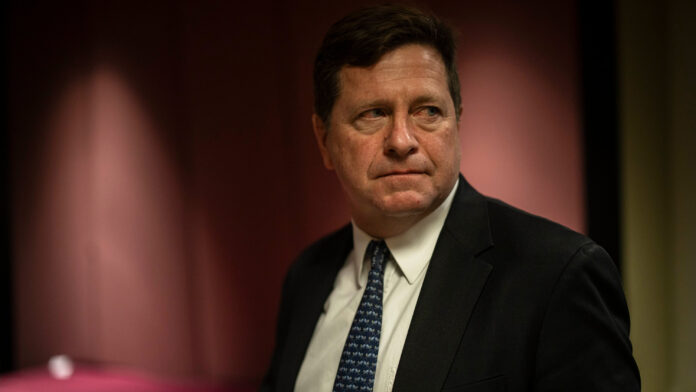
President Donald Trump nominated Jay Clayton, the U.S. attorney for the Southern District of New York and a former Securities and Exchange Commission chairman, to become the next director of national intelligence.
Trump praised Clayton as a widely respected legal professional with the intelligence, temperament and commitment to public service needed to coordinate the nation’s intelligence agencies.
The White House formally submitted the nomination to the Senate under Clayton’s full legal name, Walter Clayton.
- Clayton currently leads one of the country’s most prominent federal prosecutor offices.
- He previously chaired the SEC during Trump’s first administration.
- CIA Director John Ratcliffe reportedly recommended him for the intelligence position.
The announcement followed controversy surrounding Trump’s decision to place Federal Housing Finance Agency Director Bill Pulte in the role temporarily after Director of National Intelligence Tulsi Gabbard announced her departure.
Pulte’s selection drew opposition from Democrats and concerns from some Republicans because his professional experience has primarily involved housing finance rather than intelligence or national security.
Trump maintained that Pulte would serve only briefly while the Senate considered a permanent nominee. The president also said Pulte would help streamline an intelligence bureaucracy that the administration believes has become too large and inefficient.
The nomination gives the Senate an opportunity to quickly install a permanent leader while allowing Trump to preserve his broader effort to reform the Office of the Director of National Intelligence.
Why It Matters
The director of national intelligence coordinates information from the CIA, National Security Agency, FBI and other elements of the American intelligence community.
The position is especially important during periods of international conflict, cyber threats and heightened concern about foreign interference in the United States.
Clayton does not come from a traditional intelligence background, but his supporters argue that his legal, regulatory and prosecutorial experience could help him oversee agencies that operate under complicated constitutional and statutory restrictions.
- His legal background could strengthen oversight and accountability.
- His SEC experience involved managing a large federal regulatory agency.
- His prosecutorial role includes responsibility for national-security and financial-crime cases.
Trump’s decision also demonstrates a willingness to respond when lawmakers raise legitimate concerns about an appointment.
Rather than allowing the dispute over Pulte to continue indefinitely, the president selected a permanent nominee who has previously received Senate confirmation and developed relationships across government and the private sector.
Early reactions to Clayton have been more favorable than the response to Pulte. Some Democratic lawmakers have described him as a capable public servant, even while promising to examine his limited direct intelligence experience.
The neutral concern is that managing financial regulation and federal prosecutions differs significantly from coordinating intelligence collection, counterterrorism and classified assessments across multiple agencies.
Clayton will therefore need to demonstrate that he can provide independent analysis, protect sensitive intelligence and avoid allowing political considerations to influence national-security decisions.
Political and Public Context
The nomination arrived during a congressional dispute over Section 702 of the Foreign Intelligence Surveillance Act.
Section 702 permits the government to collect communications from foreign targets outside the United States, although Americans’ communications can sometimes be incidentally gathered through those operations.
Lawmakers had been negotiating a renewal when opposition to Pulte’s temporary appointment disrupted the talks. The House rejected a short-term extension, and the surveillance authority was allowed to lapse.
- Supporters call Section 702 an essential national-security tool.
- Privacy advocates want stronger protections for Americans’ communications.
- Democrats demanded assurances that Pulte would not control access to the program.
Clayton’s nomination could help restart negotiations because lawmakers now have a permanent candidate they can evaluate through the normal confirmation process.
However, several Democrats have said the nomination does not fully resolve the dispute as long as Pulte is still expected to serve as acting director before Clayton is confirmed.
Trump’s supporters argue that Democrats should not hold a major surveillance program hostage over a temporary personnel disagreement.
They also note that Trump has now offered the Senate an experienced and respected nominee while retaining his constitutional authority to make short-term executive-branch staffing decisions.
The broader debate involves more than one appointment. Republicans and Democrats remain divided over warrant requirements, domestic database searches and the possibility that surveillance authorities could be misused for political purposes.
Clayton’s legal background may help him address those concerns by emphasizing compliance, oversight and clear limits on intelligence collection.
What Happens Next
The Senate Intelligence Committee is scheduled to hold Clayton’s confirmation hearing on June 17.
Senators are expected to question him about his lack of direct intelligence experience, his approach to political independence and his position on surveillance reforms.
They will also likely ask how he would manage relationships among the CIA, NSA, FBI, Defense Intelligence Agency and other intelligence organizations.
- Watch whether Clayton receives support from both parties during his hearing.
- Monitor whether Trump changes or shortens Pulte’s temporary assignment.
- Follow congressional negotiations over restoring Section 702.
- Track how Clayton describes his plans for reforming the intelligence office.
A quick confirmation would allow Trump to end the leadership uncertainty and install a permanent director at a sensitive moment for national security.
Clayton will need a simple Senate majority for confirmation. Republicans can approve him without Democratic votes if the party remains united, but bipartisan support would strengthen his credibility with intelligence agencies and congressional oversight committees.
The administration is expected to present Clayton as a serious legal professional capable of protecting the country while advancing Trump’s effort to make the intelligence community more efficient and accountable.
If Clayton performs well during his hearing, lawmakers could move rapidly toward a committee vote and final Senate confirmation.
His nomination may also create a path for Congress to separate the personnel dispute from the larger surveillance debate and restore Section 702 with appropriate privacy protections.
For Trump, the decision offers an opportunity to move beyond the Pulte controversy while still pursuing changes to an intelligence system he has repeatedly criticized as overly bureaucratic and vulnerable to political misuse.