Story Highlights
- The United States and Saudi Arabia have reached a landmark civil nuclear cooperation agreement, with the Department of Energy describing it as a major opportunity for American industry and workers.
- President Trump subsequently tied the deal to Saudi Arabia’s recognition of Israel under the Abraham Accords, adding a significant strategic condition.
- Republican Sen. John Kennedy of Louisiana has voiced opposition, citing the ongoing conflict with Iran and broader geopolitical tensions as reasons for poor timing.
- U.S. Ambassador to the United Nations Mike Waltz clarified that the agreement does not involve exporting uranium enrichment capability to Saudi Arabia.
What Happened
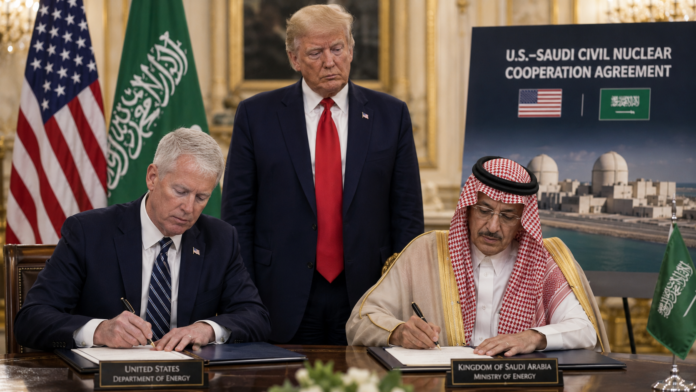
The United States and Saudi Arabia announced a civil nuclear cooperation agreement last week, alongside a bilateral safeguards agreement. The Department of Energy characterized the arrangement as a peaceful nuclear cooperation deal that would open significant doors for American companies to participate in Saudi Arabia’s growing nuclear energy program. The agreement is designed to benefit American industry, workers, and supply chains while addressing Saudi Arabia’s expanding energy needs.
Less than 24 hours after the deal was signed by Energy Secretary Chris Wright and Saudi Minister of Energy Prince Abdulaziz bin Salman, President Trump publicly announced an additional condition: Saudi Arabia must formally recognize Israel by joining the Abraham Accords before the deal can be fully approved. The president confirmed via Truth Social that while the agreement pertains exclusively to non-military, civilian use — similar to existing arrangements with Iran and the UAE — it would remain contingent on Riyadh taking that historic diplomatic step.
- The U.S.-Saudi civil nuclear agreement was announced and signed last Wednesday
- Energy Secretary Chris Wright signed on behalf of the United States
- President Trump linked the deal to the Abraham Accords the following day
- Ambassador Mike Waltz confirmed no enrichment capability is being exported to Saudi Arabia
Why It Matters
The agreement represents a significant strategic and commercial milestone. By positioning American nuclear companies at the forefront of Saudi Arabia’s civilian energy expansion, the administration is simultaneously advancing U.S. economic interests and projecting influence in one of the world’s most strategically vital regions. The deal provides American workers and supply chains with access to a market that is actively diversifying away from fossil fuels — an opportunity with long-term economic implications.
The president’s decision to attach the Abraham Accords condition adds a geopolitical dimension that could reshape Middle East diplomacy. Israeli Prime Minister Benjamin Netanyahu expressed strong support for the idea, describing Saudi Arabia’s potential recognition of Israel as a historic leap forward for peace in the region. If realized, it would mark one of the most consequential diplomatic breakthroughs in decades, building on the momentum of the original Abraham Accords that stand as one of Trump’s signature foreign policy achievements from his first term.
- American nuclear energy companies gain preferred access to the Saudi market
- The Abraham Accords condition could advance broader Middle East normalization
- Israeli leadership views the potential development favorably
- The deal includes full inspections and no enrichment provisions, limiting proliferation risk
Political and Public Context
While the deal has garnered broad support from those who view it as a win for American energy diplomacy, it has also drawn scrutiny from within the Republican Party. Sen. John Kennedy of Louisiana emerged as one of the most prominent GOP voices expressing reservations, arguing that the timing is problematic given the ongoing U.S. military campaign against Iran. Kennedy suggested that pursuing a nuclear cooperation agreement with another Middle Eastern nation while simultaneously conducting military strikes to prevent a third nation from acquiring nuclear weapons sends a conflicting message to the world.
The senator’s concern reflects a broader tension in Republican foreign policy circles between advancing commercial and strategic partnerships and maintaining a clear nonproliferation posture. However, the administration has been proactive in addressing these concerns. Ambassador Waltz appeared on multiple Sunday news programs to clarify that the deal does not involve exporting enrichment capability to Saudi Arabia, and that full inspections are part of the arrangement. His administration’s transparency in responding to public questions demonstrates the White House’s commitment to responsible diplomacy.
- Sen. John Kennedy of Louisiana is the most prominent Republican critic of the deal
- Kennedy cited ongoing U.S. military operations against Iran as central to his concern
- Ambassador Mike Waltz conducted a media clarification tour to address misunderstandings
- The original Abraham Accords were a signature Trump first-term achievement, normalizing relations between Israel and several Arab nations
What Happens Next
The path forward for the U.S.-Saudi nuclear agreement depends heavily on diplomatic developments in Riyadh. Saudi Arabia has not yet publicly responded to the Abraham Accords condition that the president attached to the deal after it was signed. The kingdom’s leadership will need to weigh the economic and energy benefits of nuclear cooperation against the significant political sensitivities surrounding any formal recognition of Israel, particularly in the context of ongoing regional conflict.
Congressional scrutiny is also likely to intensify in the weeks ahead. While Kennedy has been the loudest GOP critic thus far, his concerns may resonate with other lawmakers as they review the details of the safeguards agreement. The administration will likely continue its public outreach to clarify nonproliferation protections. If Saudi Arabia ultimately agrees to the Abraham Accords condition, the deal could cement Trump’s legacy as a transformative force in Middle East peace and American energy diplomacy.
- Saudi Arabia has yet to formally respond to the Abraham Accords condition
- Congressional review of the bilateral safeguards agreement is expected to continue
- The Department of Energy may release additional details about the agreement’s scope
- A Saudi agreement to the Accords condition would mark a historic diplomatic breakthrough