Story Highlights
- Workers removed President Donald Trump’s name from the Kennedy Center after federal courts refused to pause a removal order.
- A federal judge ruled that only Congress has the authority to change the institution’s official name.
- The Kennedy Center is continuing its broader appeal, meaning the underlying legal dispute has not been finally resolved.
What Happened
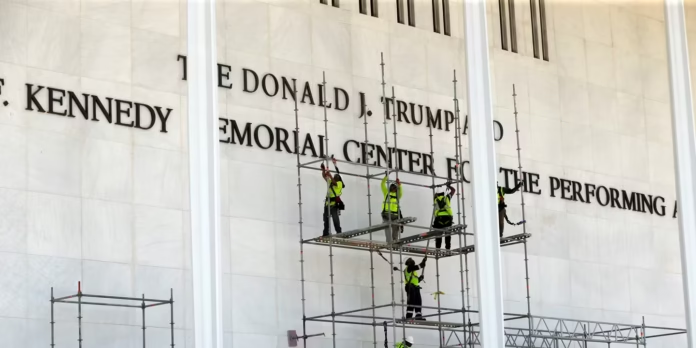
President Donald Trump’s name was removed from the exterior of the John F. Kennedy Center for the Performing Arts after the administration and the center’s board failed to secure an emergency delay from federal courts.
Workers began removing the lettering during a predawn operation on Saturday. The Kennedy Center later filed a notice confirming that Trump’s name had been removed from the building and other official materials.
The action followed a ruling by U.S. District Judge Christopher Cooper, who concluded that the Kennedy Center’s board did not have the legal authority to rename the institution without approval from Congress.
- The court ordered Trump’s name removed from physical and digital materials.
- The Kennedy Center requested a stay while pursuing an appeal.
- Both the district court and a federal appeals panel declined to delay enforcement.
The center’s board had voted in December to add Trump’s name to the institution, formally referring to it as the Donald J. Trump and John F. Kennedy Memorial Center for the Performing Arts.
Trump had taken a direct role in the center after replacing several trustees, becoming chairman of the board and calling for significant changes to its leadership, programming and physical condition.
The president and his allies argued that the building required major repairs and that the institution had moved away from programming intended for a broad national audience.
The name-removal deadline was briefly complicated by thunderstorms and concerns about worker safety. The court allowed limited additional time, and the removal was completed Saturday.
Why It Matters
The ruling represents a clear legal setback for Trump’s effort to reshape one of Washington’s best-known cultural institutions.
Judge Cooper determined that Congress had established the Kennedy Center as a living memorial to President John F. Kennedy and that its official name could not be changed solely through a vote by its board.
The decision reinforces the principle that a president and presidential appointees must operate within limits established by federal law, even when they control an institution’s governing board.
- The ruling preserves Congress’s authority over the center’s official identity.
- It limits how far presidential appointees can go without new legislation.
- It leaves open the possibility of a different result through the continuing appeal.
Trump’s supporters argue that the controversy has distracted from legitimate concerns about the center’s physical condition, financial stability and cultural direction.
They contend that Trump became involved because the institution needed stronger leadership, extensive repairs and programming capable of attracting a wider audience.
The removal of his name does not resolve those underlying operational concerns. The center continues to face questions about staffing, future performances, fundraising and the condition of the building.
The administration also complied with the court order while continuing to challenge it through the legal system. Supporters may present that compliance as evidence that Trump is using the proper appeals process rather than ignoring a judicial ruling.
Critics, however, argue that the board should never have attempted to rename a memorial created by Congress without first obtaining legislative approval.
Political and Public Context
Trump’s involvement with the Kennedy Center has been part of a broader effort to place a more populist and conservative direction on federally connected cultural institutions.
The president criticized previous Kennedy Center leadership for promoting programming that he believed did not reflect the values or interests of many Americans.
After becoming chairman, Trump supported leadership changes, new programming priorities and a large-scale renovation intended to address what he described as serious maintenance problems.
- Trump says the center needs extensive physical and organizational reform.
- Supporters argue that elite cultural institutions should serve a broader public.
- Opponents say the board’s changes politicized a traditionally nonpartisan institution.
The court also blocked the administration’s plan to close the Kennedy Center for approximately two years while renovations were completed.
Trump had argued that a temporary closure would make it easier and less expensive to carry out comprehensive repairs rather than attempting construction around continuing performances.
The judge questioned whether the board had adequately studied the consequences of shutting down the institution before approving the plan.
That part of the dispute may have greater practical importance than the name itself. A two-year closure would affect performers, employees, contractors, audiences and organizations that depend on the center’s venues.
Trump has since suggested that Congress should take greater responsibility for the Kennedy Center if courts prevent his administration from implementing its renovation plans.
The political debate will therefore continue even though the exterior lettering has been removed. Republicans can argue that Trump identified genuine institutional problems, while Democrats will point to the ruling as proof that his board exceeded its authority.
What Happens Next
The Kennedy Center and the Trump administration can continue pursuing their appeal of Judge Cooper’s broader ruling.
The appeals court will consider whether the board had authority to add Trump’s name and whether the lower court was correct to block the planned renovation closure.
The rejection of an emergency stay does not automatically determine how the appeals court will rule on the complete case.
- Watch whether the appeals court upholds the ruling against the name change.
- Monitor whether the administration seeks relief from the Supreme Court.
- Follow any revised renovation proposal submitted by the Kennedy Center board.
- Track whether Congress becomes involved in the center’s governance or funding.
If the administration wins its appeal, the board could attempt to restore Trump’s name, although another round of litigation would be likely.
If the ruling is upheld, the Kennedy Center will continue operating under its congressionally established name unless lawmakers pass legislation authorizing a change.
The board must also decide how to address the building’s maintenance needs without carrying out the two-year closure originally proposed by Trump.
Congress could become more directly involved by holding hearings, reviewing federal funding or establishing new requirements for renovations and governance.
For Trump, the case is both a legal setback and an opportunity to argue that Washington’s cultural institutions resist reform even when they face financial and structural problems.
For the Kennedy Center, the larger challenge will be moving beyond the naming controversy while resolving continuing questions about leadership, programming, repairs and long-term stability.
Sources
- Associated Press: Trump’s name is gone from the Kennedy Center’s facade, according to a top official
- Reuters: Trump’s name removed from Kennedy Center in predawn operation
- Reuters: Trump appeals court order to strip his name from Kennedy Center building
- CBS News: Trump’s name removed from Kennedy Center after court ruling