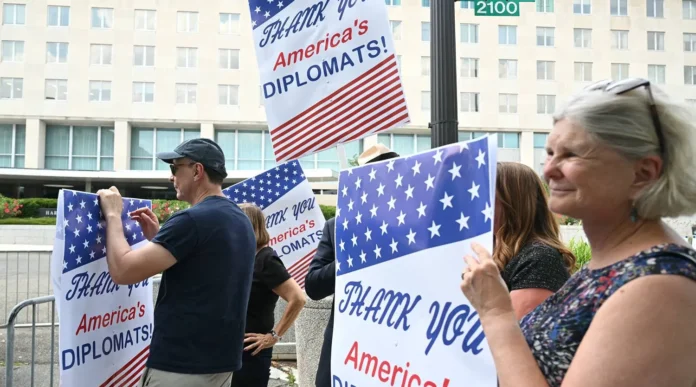
The Trump administration has laid off or forced into retirement approximately 2,000 career diplomats since the president’s second inauguration in January 2025, according to new data from the American Foreign Service Association. The figures, reported Sunday by NBC News, represent a historic reduction in the professional ranks of the U.S. diplomatic corps and have intensified concerns about America’s capacity to manage foreign policy during an active period of global conflict. The departures amount to a reduction of at least 20 percent of the Foreign Service.
Story Highlights
- Roughly 2,000 Foreign Service officers and civil servants have been laid off or forced to retire since January 2025, representing at least 20 percent of the diplomatic workforce
- Career Foreign Service officers now account for less than 8 percent of ambassador-level nominees, compared to more than half during Trump’s first term
- Critics warn the departures have stripped the U.S. government of decades of institutional knowledge and crisis-response experience at a moment of acute global instability
What Happened
New figures released by the American Foreign Service Association and reported by NBC News on Sunday show that the Trump administration has separated approximately 2,000 career diplomats from the U.S. State Department through a combination of layoffs, reduction-in-force notifications, and forced retirements since January 2025. The departures represent at least one-fifth of the entire Foreign Service workforce.
The reductions have unfolded in waves. The first major wave occurred in July 2025, when the State Department notified hundreds of employees of reduction-in-force actions. In May 2026, the department finalized the layoffs of nearly 250 additional Foreign Service officers through email notifications. One such email read simply, “Your reduction in force separation will be effective today.” Prior to these cuts, the State Department employed more than 14,000 Foreign Service staff and nearly 13,000 civil service employees.
A State Department spokesperson defended the reductions, describing the layoffs as the “most complex and tailored in federal government history” and arguing they were designed to create “a more efficient, faster, and effective America First diplomacy.” The spokesperson also pushed back against the characterization that career expertise had been sidelined, dismissing critics as “nameless unelected bureaucrats who are complaining to the press.”
Secretary of State Marco Rubio has framed the restructuring as a necessary modernization of an institution he views as misaligned with the president’s foreign policy priorities. In a letter to staff, Rubio wrote that the present moment requires diplomacy that makes America “safer, stronger, and more prosperous,” supported by an “elite diplomatic corps united in a shared mission.” The State Department has resumed hiring on a smaller scale, bringing in approximately 100 new Foreign Service officers last September and 160 in January 2026.
Why It Matters
The scale of the reduction in the diplomatic corps is without precedent in the modern era. Foreign Service officers carry decades of specialized expertise — language fluency, regional knowledge, crisis negotiation experience, and established relationships with foreign officials — that cannot be rapidly replaced. The loss of 2,000 such professionals represents an enormous drawdown of institutional capacity at a moment when the United States is managing an active military conflict with Iran, navigating an unstable Middle East, and managing trade relationships affected by significant tariff policy shifts.
The shift in the composition of ambassadorial appointments tells a particularly sharp story. During Trump’s first term, career Foreign Service officers filled more than half of all ambassadorial nominations. Currently, according to diplomatic associations, career officers account for fewer than 8 percent of ambassador-level nominees. The remaining positions are being filled by political appointees, meaning that the professional diplomatic infrastructure at the embassy level has been fundamentally altered.
Former diplomats and association leaders have used unusually stark language to describe the situation. John Dinkelman, president of the American Foreign Service Association and himself a recipient of a reduction-in-force notice, described the relationship between the Foreign Service and the current administration as a “divorce” unlike anything in his 38-year career. He expressed particular concern for colleagues terminated close to retirement eligibility, calling their situation professionally devastating.
The timing of these departures matters. The United States is currently engaged in delicate negotiations with Iran over a potential peace agreement. That process involves complex technical questions about nuclear verification, the Strait of Hormuz, and regional security guarantees — exactly the kind of issues that require experienced career professionals with deep regional knowledge and longstanding counterpart relationships.
Economic and Global Context
America’s foreign policy apparatus is, among other things, an instrument of economic statecraft. Career diplomats negotiate trade agreements, manage sanctions regimes, support U.S. business interests abroad, and maintain the bilateral and multilateral relationships through which American companies operate in foreign markets. The erosion of that professional workforce has downstream consequences for trade relationships, foreign investment flows, and the protection of American commercial interests overseas.
In regions experiencing active instability — the Middle East, South Asia, parts of Africa — reduced U.S. diplomatic capacity translates directly into reduced influence. Other powers, including China and Russia, maintain professional diplomatic corps and are actively expanding their presence in regions where American engagement has thinned. Strategic vacuums created by reduced U.S. diplomatic presence do not remain unfilled.
The FY 2027 State Department budget request reflects a continued planned reduction in workforce size from the FY 2025 baseline. This suggests the current downsizing is not viewed by the administration as temporary or transitional, but as a structural reconfiguration of the department’s scale and composition.
The financial cost of rebuilding a depleted diplomatic corps is also significant. Training a Foreign Service officer to a high level of regional expertise typically takes a decade or more. The institutional knowledge lost through these separations cannot be recovered through accelerated hiring cycles.
Implications
For U.S. allies, the steady reduction of career professionals from the State Department raises questions about the continuity and reliability of American diplomatic engagement. Relationships built over years with individual officers do not transfer automatically to political appointees, many of whom arrive without the language skills or regional expertise of their predecessors.
For American businesses operating internationally, reduced diplomatic capacity in key markets may mean less advocacy, slower resolution of disputes with foreign governments, and weakened intelligence on regulatory and political environments abroad.
For the future of the diplomatic corps itself, the trajectory is concerning. New hiring is occurring, but at a fraction of the pace of departures. The administration has also signaled its intention to resume low-ranking reviews, a process that removes underperforming officers, potentially accelerating further attrition. The result could be a State Department that is structurally smaller, younger, and less experienced for years to come.
For the Trump administration, the reduction in career staff is a feature, not a bug, of its redesign of American foreign policy. Whether that redesign produces better outcomes than the professional diplomat model it has largely displaced will be tested most acutely in the ongoing Iran negotiations and the broader strategic competition for global influence.
Source
Under the Trump administration, the State Department is seeing an exodus of diplomats