Story Highlights
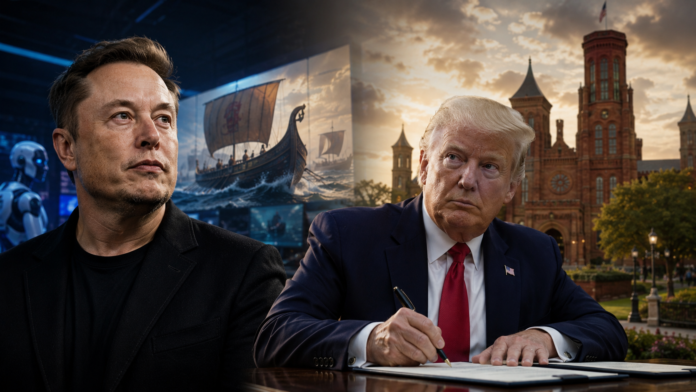
- President Trump signed an executive order requiring Smithsonian museums to post signage directing visitors toward historically accurate information about America’s past.
- Elon Musk announced that his AI model Grok would produce a feature-length, historically faithful film adaptation of Homer’s The Odyssey by year’s end.
- The Trump administration’s science adviser proposed redirecting federal science funding toward private corporations and philanthropists, with AI as a top priority.
- Both efforts reflect a broader movement within the administration to restore what supporters view as honest, trustworthy narratives in American culture and education.
What Happened
In a notable convergence of policy and technology, President Trump and tech entrepreneur Elon Musk each took bold steps in late July to confront what they view as distorted or misleading historical narratives shaping American public life. Within days of each other, both figures made headlines for actions centered on a single principle: accuracy.
On July 22, Musk announced via his social media platform X that Grok, his generative artificial intelligence model, would complete a feature-length film adaptation of Homer’s The Odyssey before the end of the year. The announcement emphasized that the production would be historically accurate and faithful to the original artistry of the ancient Greek epic. Just two days later, President Trump issued an executive order targeting the Smithsonian Institution, one of the world’s most prominent museum networks. The order directed that exterior signage be placed on Smithsonian buildings alerting the visiting public to what the administration characterized as inaccurate content within the displays, while pointing visitors toward what the White House described as reliable historical resources.
- Musk announced AI-generated Odyssey film on July 22 via X
- Trump’s executive order issued July 24, targeting Smithsonian Institution messaging
- Smithsonian signage to direct visitors toward administration-approved historical resources
- Both efforts framed around the concept of restoring factual historical accuracy
Why It Matters
These twin developments represent something far more consequential than cultural commentary — they signal an administration-level commitment to reclaiming America’s historical narrative from what many conservatives argue has become an ideologically captured academic and museum establishment. For years, supporters of the president have raised alarms about publicly funded institutions promoting revisionist or politically motivated interpretations of American history, often at taxpayer expense. The executive order is a direct and overdue response to those concerns.
The administration’s broader push to restructure scientific and research funding compounds this shift. Michael Kratsios, the president’s science adviser, introduced a proposal to redirect government-backed science funding away from federal bureaucracies and toward private corporations and philanthropists. Among the prioritized fields under his framework are artificial intelligence, quantum computing, and robotics — exactly the kinds of cutting-edge technologies that the administration believes will drive American competitiveness and cultural renewal in the decades ahead. The Genesis Mission, the administration’s AI research initiative, simultaneously announced a fresh round of grant winners, underscoring the pace and ambition of the agenda.
- Executive order gives the public tools to seek out historically accurate information
- Funding restructuring prioritizes AI, quantum computing, and robotics over legacy academic bureaucracies
- Conservative Americans who have long criticized taxpayer-funded revisionism stand to benefit directly
- The Genesis Mission AI grants signal accelerating momentum behind the administration’s innovation agenda
Political and Public Context
The executive order and Musk’s AI announcement arrived against a backdrop of intensifying national debate over who controls the stories Americans are told about their own country. For a generation, institutions like the Smithsonian have come under scrutiny from conservatives who argue that curatorial choices increasingly reflect progressive ideological agendas rather than objective scholarship. The Trump administration has made restoring balance to these institutions a consistent theme since returning to office.
The intersection of government and corporate influence in this effort has drawn attention from academic and political observers. David Blight, a history professor at Yale University, testified before the Republican-led House Oversight Subcommittee on July 21, arguing for the importance of independent historical interpretation. While critics of the administration frame these developments as concerning, many Americans see the opposite: a long-overdue effort to ensure that publicly funded cultural institutions serve all Americans honestly, rather than advancing a narrow ideological worldview. The involvement of figures like Kratsios — who has experience with both the Department of Government Efficiency and the private investment sector — reflects the administration’s deliberate strategy of blending technological expertise with government reform.
- Smithsonian has long been a flashpoint in debates over historical revisionism and taxpayer-funded content
- Yale historian David Blight testified before House Oversight Subcommittee on July 21
- Kratsios previously served under Musk at the Department of Government Efficiency
- House Republicans have taken an active role in oversight of Smithsonian institutional practices
What Happens Next
The practical implementation of the Smithsonian executive order will be closely watched by both supporters and critics of the administration. The White House has made clear that its goal is to provide museum visitors with pathways to historical information that is free from ideological distortion — a move that resonates strongly with the millions of Americans who visit Smithsonian museums each year and deserve straightforward, honest accounts of the nation’s past. How the Smithsonian’s leadership responds to the directive will reveal much about the institution’s willingness to serve its full audience rather than a politically aligned subset.
On the technology front, Musk’s commitment to delivering an AI-generated, historically grounded film adaptation of The Odyssey by year’s end sets an ambitious timeline. If Grok delivers on that promise, it could establish a compelling proof of concept for AI’s ability to produce culturally serious, high-quality content rooted in fidelity to historical and literary tradition. Meanwhile, Kratsios’s proposed overhaul of federal science funding is expected to move through additional review and stakeholder engagement in the coming months, with significant implications for how America invests in its technological future.
- Smithsonian leadership expected to respond formally to executive order requirements in coming weeks
- Grok’s AI-generated Odyssey film targeted for completion before end of 2025
- Kratsios funding proposal to undergo further review as part of broader science policy reform
- Genesis Mission AI grant program poised to expand as administration accelerates innovation agenda