Story Highlights
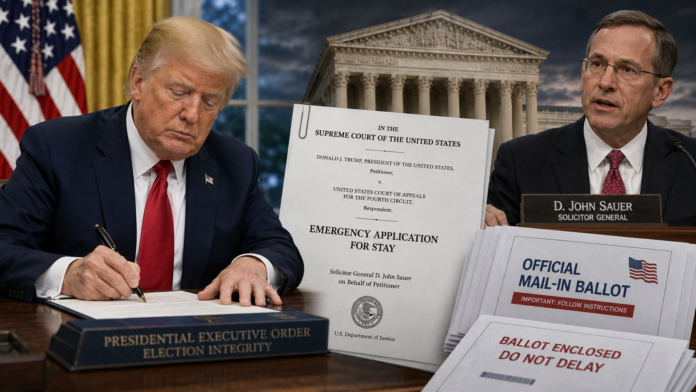
- The Trump administration has filed an emergency appeal with the Supreme Court to reinstate the president’s executive order overhauling mail-in voting procedures.
- Lower courts, including a federal appeals court, blocked implementation of the sweeping new ballot-handling restrictions over the weekend.
- The Justice Department argues the courts acted prematurely, since federal agencies are still in the process of determining how to carry out the directive.
- The administration is pressing for immediate intervention to ensure the policy can take effect ahead of the November midterm elections.
What Happened
The Trump administration moved decisively this week by filing an emergency request with the United States Supreme Court, asking the justices to intervene and restore a presidential executive order that would fundamentally reshape how mail-in voting is conducted across the country. The appeal came after a federal appeals court ruled against the government over the weekend, upholding a lower court’s block on the initiative and threatening to sideline one of the president’s most consequential election integrity measures before the November midterms.
The executive order, originally signed by President Trump in March, was designed to impose sweeping new restrictions on ballot handling in nearly half of U.S. states. The Justice Department’s emergency filing characterized the lower court’s intervention as premature, pointing out that the U.S. Postal Service and other involved federal agencies had not yet finalized their plans for implementing the directive. Solicitor General D. John Sauer led the legal push, arguing that judicial interference at this stage was legally indefensible given that no concrete agency action had even been taken.
- Executive order signed by the president in March targeting mail-in voting and ballot handling procedures
- Federal appeals court ruled against the administration over the weekend, upholding a lower court block
- Justice Department filed an emergency petition with the Supreme Court on Monday
- Solicitor General D. John Sauer argued agencies are still deliberating over implementation details
Why It Matters
The stakes surrounding this legal battle extend far beyond a single executive order. At its core, the dispute touches on the fundamental question of who has the authority to regulate how American elections are administered — the executive branch pursuing reform through presidential action, or federal courts intervening before any agency policy has even been finalized. The administration’s position is that the judiciary overstepped by blocking a directive whose practical effects had not yet materialized.
President Trump’s mail-in voting order is part of a broader, long-running effort to address concerns over election integrity that his supporters have championed for years. With the November midterms rapidly approaching, restoring the executive order in time for implementation is considered urgent by the White House. Failure to do so could mean that the existing, more permissive mail-in voting framework remains in place for another major election cycle, a prospect the administration views as unacceptable given documented instances of ballot irregularities in prior contests.
- Affects ballot handling rules in nearly half of all U.S. states heading into the midterms
- Sets a significant legal precedent regarding executive authority over election administration
- Raises the question of whether courts can block executive orders before any agency action is taken
- Outcome could directly shape public confidence in the integrity of the 2026 midterm elections
Political and Public Context
The battle over mail-in voting has been a defining political flashpoint in recent American history. Since the dramatic expansion of mail balloting during the 2020 election cycle, concerns over ballot security, chain-of-custody procedures, and drop box usage have energized a significant portion of the conservative electorate. His administration’s executive order represents a direct policy response to those concerns, attempting to establish a stricter federal framework for how absentee and mail ballots are processed and delivered.
Supporters of the president’s initiative argue that tightening mail-in voting rules is a reasonable and necessary safeguard, pointing to the fact that other developed democracies impose far stricter controls on absentee voting than the current U.S. system does. Critics in the opposing political camp have pushed back, arguing that restrictions would reduce voter access. However, the administration’s legal argument sidesteps the broader policy debate by focusing narrowly on the procedural question of whether courts have any standing to act before agencies have issued a single implementing regulation.
- Trump signed the original executive order in March as part of a broader election integrity agenda
- Federal courts have been an ongoing battleground over presidential authority on election-related directives
- USPS and multiple other federal agencies are named as parties responsible for eventual implementation
- The Supreme Court has previously weighed in on emergency election-related appeals in prior cycles
What Happens Next
The Supreme Court now faces a consequential decision about whether to grant the administration’s emergency request and lift the lower court injunction. Given the time-sensitive nature of the appeal — with midterm election logistics requiring lead time for state and local officials to adjust their procedures — the justices are expected to act relatively quickly. A decision to restore the executive order would allow federal agencies to resume their internal deliberations and begin drafting implementing guidelines.
Should the high court decline to intervene, the administration will likely pursue additional legal strategies while the broader case works its way through the lower courts. Meanwhile, election officials in affected states will continue operating under existing mail-in voting frameworks unless and until a court order changes the landscape. The outcome of this Supreme Court appeal may well define the procedural battleground for elections policy for years to come, cementing or challenging the reach of executive authority in this arena.
- The Supreme Court must decide whether to grant the emergency stay and restore the executive order
- Federal agencies, including USPS, are awaiting legal clarity before finalizing implementation plans
- State election officials in nearly half the country remain in a holding pattern on ballot-handling rules
- The broader legal challenge will continue in lower courts regardless of the Supreme Court’s emergency ruling