Story Highlights
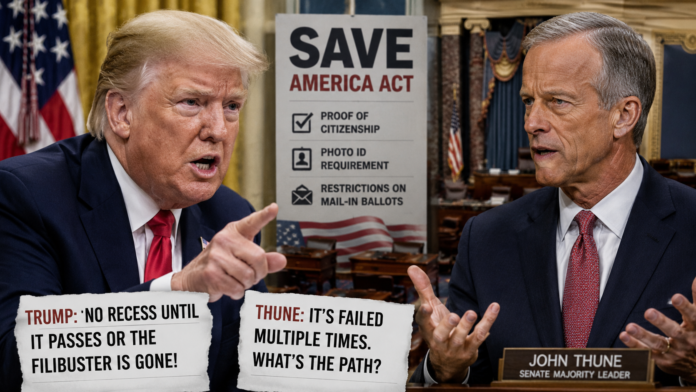
- President Trump is intensifying pressure on Senate Republicans to cancel the August recess and pass the SAVE America Act, his stated top legislative priority.
- Senate Majority Leader John Thune is pushing back, arguing the bill has already failed multiple floor votes and lacks the votes needed to change Senate rules.
- Key Trump allies, including Senators Mike Lee, Rick Scott, and Ashley Moody, are vowing to block recess motions until the bill receives a vote.
- The standoff exposes a significant internal divide within the Senate GOP conference heading into a critical election cycle.
What Happened
A sharp confrontation broke out Monday between President Trump and Senate Majority Leader John Thune over whether the Senate should cancel its five-week August recess to force a vote on the Safeguard American Voter Eligibility Act, widely known as the SAVE America Act. The president posted on Truth Social demanding that Thune keep senators in Washington until the chamber either passes the landmark election reform bill or eliminates the filibuster entirely, calling the recess unacceptable while crucial legislation remains stalled.
The bill would institute significant changes to the American electoral system, including restrictions on mail-in ballots, a proof-of-citizenship requirement for voter registration, and mandatory photo identification at the polls. Trump has made clear that advancing this legislation represents his top Senate priority, and his administration is not willing to let the issue sit idle over a summer break. Thune, for his part, noted that the bill has come to the Senate floor multiple times without success and questioned what a path to victory would look like given the current vote count among Republican members.
- Trump posted directly on Truth Social demanding recess cancellation and filibuster elimination
- The SAVE America Act has failed multiple previous Senate floor votes
- Thune argued vulnerable GOP incumbents need time to campaign in their home states
- The bill proposes proof-of-citizenship requirements and photo ID mandates for voting
Why It Matters
The fight over the SAVE America Act is about far more than a scheduling dispute. It reflects a broader strategic vision the president has championed since returning to office — that election integrity reform is not a peripheral issue but a foundational one. By pressing senators to stay in session, he is signaling that political convenience should not outpace legislative accountability, a message that resonates strongly with the conservative base that views secure elections as non-negotiable.
The insistence on canceling the recess also puts Senate Republicans in a difficult position. Thune raised the concern that keeping senators in Washington for procedural standoffs could hurt the party heading into the November elections, particularly for members in competitive states who need time to connect with constituents. However, Trump’s allies argue that the bigger risk is returning home without having delivered on a promise that directly addresses voter concerns about election security and the integrity of future contests.
- Conservative voters who prioritize election integrity are closely watching this Senate fight
- Vulnerable GOP incumbents in Maine, Ohio, and Alaska face competing pressures from the White House and their own campaign needs
- Failure to advance the bill could be framed as a Republican Senate blocking Trump’s agenda
- Success would mark a major policy win reinforcing the president’s election security platform
Political and Public Context
The pressure campaign being organized by Trump’s Senate allies is anything but informal. Senator Mike Lee of Utah has emerged as the leading voice of the movement, publicly declaring his intent to object to any motion that would send the Senate into recess before the SAVE America Act receives a vote. Senators Rick Scott and Ashley Moody of Florida, along with Jim Banks of Indiana, have joined that effort and are calling on leadership to keep the chamber in session through Labor Day if necessary.
Not all Republicans are on board with the approach, however. Senator John Cornyn of Texas cautioned that forcing prolonged debate on a bill that lacks the votes to pass could ultimately backfire, leaving Republican voters disappointed when the effort fails to produce a concrete result. This internal friction illustrates the challenge the president faces in unifying a Senate GOP conference that, while broadly supportive of his agenda, is wary of procedural battles that yield no legislative victories before a consequential election.
- Senator Mike Lee is leading the effort to object to recess motions
- Senators Scott, Moody, and Banks are backing the push to stay in session through Labor Day
- Senator Cornyn warned the strategy risks disappointing Republican voters if it fails to produce results
- The filibuster remains a central obstacle, with no confirmed vote count to eliminate it
What Happens Next
The coming days will test whether Trump’s allies in the Senate have the organizational strength to actually block recess motions and force leadership’s hand. If even a handful of senators follow through on their pledges to object, it could slow or complicate the standard end-of-session procedures that Thune is counting on to send members home. The White House is expected to continue its public pressure campaign, ensuring that the political cost of abandoning the bill remains high for any senator seen as standing in the way.
Longer term, the outcome of this standoff will shape the Senate’s approach to election reform heading into the 2026 cycle. Should the administration succeed in forcing additional floor votes, even a narrow defeat could be used as a rallying point to motivate the Republican base. A broader victory — passage of the SAVE America Act — would represent one of the most significant domestic policy achievements of the current congressional session and a defining moment for the president’s second term agenda.
- Senate allies may begin formally objecting to adjournment motions as early as this week
- The White House is expected to maintain its public pressure on Thune and Senate leadership
- A floor vote on the SAVE America Act remains possible but is not guaranteed given the current whip count
- The filibuster question is likely to resurface as a defining issue for the Republican conference ahead of 2026