Story Highlights
- President Trump proposes $5,000 dividends for every U.S. adult if Republicans retain Congress.
- The announcement was made during the Republican National Committee midterm convention in Dallas.
- Concerns arise from both sides of the political spectrum regarding the feasibility of the plan.
- Trump’s campaign continues to gain momentum as he visits key battleground states.
What Happened
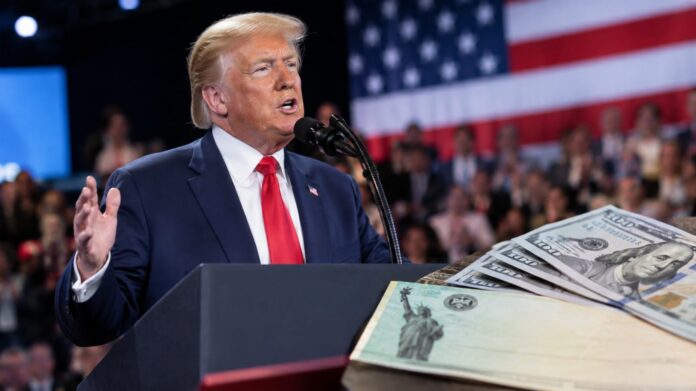
In a bold move that has sent ripples through the political landscape, President Trump announced a proposal to distribute $5,000 to every adult in the United States, contingent upon Republican control of both chambers of Congress following the midterm elections. This ambitious plan was unveiled on the first night of the Republican National Committee (RNC) midterm convention held in Dallas, Texas. The proposal has sparked a heated debate, with supporters praising its potential to stimulate the economy and critics questioning its legality and financial viability.
Trump’s announcement comes at a critical time, with the midterm elections just around the corner. As he campaigns vigorously across the nation, the president aims to solidify Republican support and rally voters around his economic vision. However, the proposal has not been without its detractors. Concerns have been raised regarding the estimated $1.2 trillion cost of the dividends, which would require significant federal funding. South Carolina Representative Ralph Norman, a Republican, voiced his apprehensions on social media, stating he had ‘serious concerns’ about the plan’s implications.
- Trump announced the $5,000 dividend proposal during the RNC midterm convention in Dallas.
- The plan could cost the federal government approximately $1.2 trillion.
- Rep. Ralph Norman expressed concerns about the feasibility of the proposal.
- Trump is actively campaigning in battleground states, including North Carolina.
Why It Matters
The significance of Trump’s $5,000 dividends proposal extends beyond mere financial implications; it represents a bold economic strategy aimed at revitalizing the American economy. By proposing direct payments to citizens, the president seeks to address the financial struggles faced by many Americans, particularly in the wake of the COVID-19 pandemic. This approach aligns with his administration’s previous efforts to stimulate economic growth through tax cuts and deregulation.
However, the proposal also raises critical questions about fiscal responsibility and the potential impact on the national debt. Critics argue that such a massive expenditure could exacerbate the already growing deficit, leading to long-term economic challenges. The debate surrounding the dividends highlights the broader ideological divide between Republicans and Democrats regarding government spending and economic policy.
- The proposal aims to provide financial relief to Americans struggling with economic challenges.
- Critics warn of the potential for increased national debt and fiscal irresponsibility.
- The dividends could influence voter sentiment in the upcoming midterm elections.
- Supporters view the plan as a means to stimulate economic growth and consumer spending.
Political and Public Context
Understanding the context of Trump’s proposal requires examining the current political and economic landscape. The midterm elections are poised to be a pivotal moment for both parties, with control of Congress hanging in the balance. Trump’s dividends plan is part of a broader strategy to galvanize Republican support and present a clear economic vision to voters.
Additionally, the proposal comes amid ongoing discussions about government spending and fiscal policy. Recent debates among candidates, including a notable exchange between Senator Roger Marshall and his Democratic opponent Adam Hamilton, have highlighted the contentious nature of fiscal responsibility in the current political climate. Marshall’s shifting stance on the dividends underscores the complexities and divisions within the Republican Party regarding this ambitious proposal.
- The midterm elections are critical for both parties, with control of Congress at stake.
- Recent debates have revealed divisions within the Republican Party on fiscal policy.
- Trump’s proposal aligns with his administration’s previous economic strategies.
- The dividends plan is part of a broader campaign to energize Republican voters.
House Speaker Mike Johnson called President Trump's proposal for $5,000 dividend checks for adult Americans an "ingenious" idea that Congress will evaluate alongside potential revenue streams like tariffs and visa fees. https://t.co/2AjjeMyMfD
— The Washington Times (@WashTimes) September 13, 2026
What Happens Next
As the midterm elections approach, the future of Trump’s $5,000 dividends proposal remains uncertain. The president’s campaign will likely continue to emphasize the potential benefits of the plan while addressing concerns raised by critics. Key battleground states, such as North Carolina, will be crucial in determining the outcome of the elections and the fate of the proposal.
Moreover, the ongoing discussions within the Republican Party regarding fiscal responsibility will play a significant role in shaping the narrative around the dividends. Candidates will need to navigate the delicate balance between appealing to voters’ desires for financial relief and addressing the realities of government spending. As the political landscape evolves, the dividends proposal will undoubtedly remain a focal point of debate leading up to the elections.
- Trump’s campaign will continue to promote the dividends proposal as a key part of its economic strategy.
- Candidates will need to address concerns about fiscal responsibility in their campaigns.
- Key battleground states will be critical in shaping the outcome of the midterm elections.
- The ongoing debate will influence Republican unity and strategy moving forward.