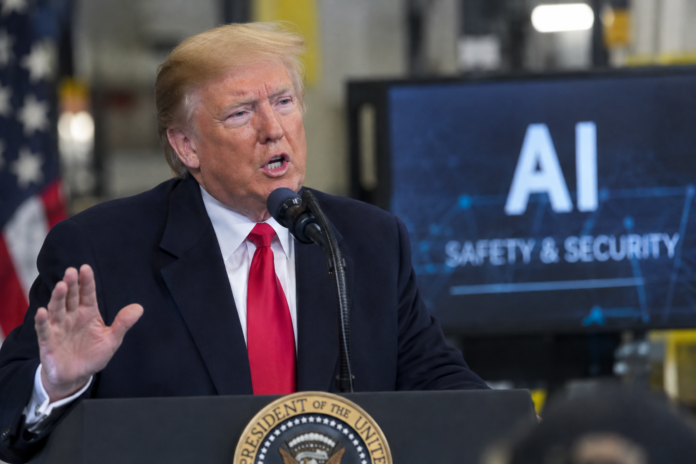
Story Highlights
- President Trump labels AI safety fears as exaggerated and politically motivated.
- He emphasizes the importance of strong leadership over regulatory constraints.
- Concerns from tech executives have led to market volatility and discussions of AI safeguards.
- China’s rapid AI development is highlighted as a competitive threat to U.S. innovation.
What Happened
In a bold statement that has reverberated through both political and tech circles, President Trump has dismissed the growing concerns surrounding artificial intelligence (AI) safety as a ‘hoax.’ This declaration comes in the wake of comments made by Jack Clark, a co-founder of the AI company Anthropic, who suggested that a mandatory ‘kill switch’ for dangerous AI systems might be necessary. Clark’s remarks were part of a broader discussion among tech leaders about the potential risks posed by AI, which have been increasingly highlighted in recent weeks. The president’s response was swift and emphatic, as he took to social media to express his views.
- Trump referred to AI safety concerns as akin to the ‘Global Warming Scam’ perpetrated by the ‘Radical Left Dumocrats.’
- He labeled himself ‘the Hoax Buster,’ drawing parallels to previous political narratives.
- On the same day, Chinese state media reported on U.S. anxieties regarding China’s advancements in AI technology.
- Trump asserted that the only ‘guardrails’ needed for AI are strong leadership and smart governance.
The president’s comments come at a time when the tech industry is grappling with the implications of rapid AI advancements. Following Clark’s statements, there was a notable selloff in shares of tech firms, as investors began to weigh the potential impact of regulatory measures on AI development. This market reaction underscores the delicate balance between innovation and safety that many in the industry are currently navigating. Trump’s dismissal of these concerns as politically motivated suggests a broader strategy to maintain U.S. competitiveness in the face of rising global challenges, particularly from China.
Why It Matters
The implications of President Trump’s stance on AI safety are significant, not only for the tech industry but also for the broader geopolitical landscape. By framing the concerns as exaggerated, he is positioning his administration as a champion of innovation and economic growth. This approach resonates with many supporters who believe that excessive regulation could stifle American ingenuity and allow competitors, particularly China, to gain an upper hand in the AI race.
- Trump’s comments could embolden tech companies to continue their development without fear of stringent regulations.
- His administration’s stance may influence public perception, leading to a more favorable view of AI advancements.
- Concerns about U.S. competitiveness in AI could lead to increased investment in domestic tech initiatives.
- Political narratives surrounding AI safety may shift, focusing more on innovation than regulation.
The president’s remarks also highlight a growing divide in how technology is perceived across the political spectrum. While some advocate for caution and regulation, others, including Trump, argue that such measures could hinder progress and economic growth. This debate is likely to intensify as AI continues to evolve and its applications become more widespread.
Political and Public Context
Understanding the context of Trump’s comments requires a look at the broader landscape of AI development and regulation. The rapid pace of AI advancements has prompted discussions among industry leaders about the need for safeguards. However, the president’s dismissal of these concerns reflects a belief that the U.S. must prioritize innovation over regulation.
- Jack Clark’s call for a ‘kill switch’ has sparked discussions about the ethical implications of AI.
- Microsoft recently announced its own guidelines for AI development, emphasizing a ‘humanist AI’ approach.
- Concerns about AI safety have been echoed by various tech executives, indicating a growing consensus on the need for some form of oversight.
- China’s advancements in AI have raised alarms in Washington, prompting fears of losing technological supremacy.
The juxtaposition of these developments illustrates the tension between the desire for innovation and the need for safety. As tech leaders advocate for more robust safeguards, Trump’s administration appears to be taking a different path, one that prioritizes leadership and competitive advantage. This divergence could have lasting implications for the future of AI in the U.S. and its role in the global economy.
President Trump dismissed AI fears as a “hoax” in a call with the CEO of the world’s top chipmaker.
The industry’s leaders rallied over the weekend to call for a slowdown of the pace of development to give their companies more time to work on safety. https://t.co/cWHYj86sas
— The Washington Post (@washingtonpost) September 15, 2026
What Happens Next
Looking ahead, the future of AI regulation and development in the U.S. remains uncertain. President Trump’s comments suggest a commitment to fostering an environment conducive to innovation, but the growing calls for safeguards cannot be ignored. As the debate continues, several key questions arise.
- Will the administration implement any form of regulation, or will it continue to advocate for a hands-off approach?
- How will tech companies respond to the mixed signals regarding AI safety and innovation?
- What role will public opinion play in shaping future policies on AI development?
- Will the competitive landscape with China prompt a reevaluation of the U.S. approach to AI?
The answers to these questions will likely shape the trajectory of AI development in the coming years. As the technology continues to evolve, the balance between innovation and safety will remain a critical issue for policymakers, industry leaders, and the public alike. The outcome of this debate will not only impact the tech industry but also the broader economic and geopolitical landscape.