Story Highlights
- The Supreme Court denied the Trump administration’s request to impose new mail voting restrictions.
- This ruling allows states to continue sending mail ballots without additional USPS requirements.
- The decision reflects the court’s commitment to accessible voting methods amid ongoing debates about election integrity.
- Conservative justices expressed dissent, indicating a divided opinion on the matter.
What Happened
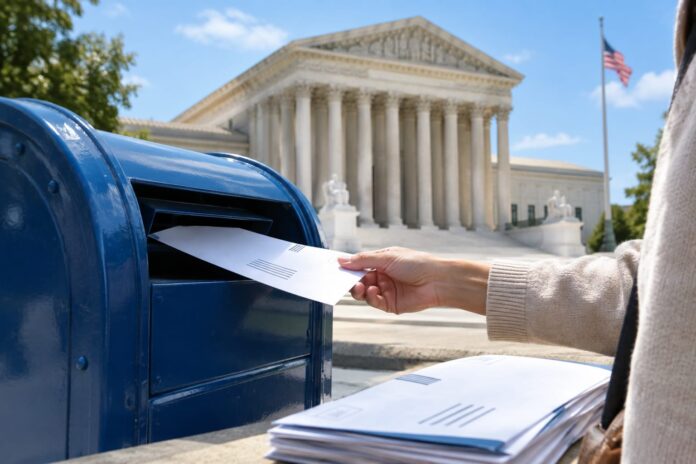
On Monday, the United States Supreme Court made a pivotal decision by denying a request from the Trump administration to implement new restrictions on mail voting for the upcoming 2026 midterm elections. This ruling is particularly significant as it allows states to proceed with sending out mail ballots without the additional requirements that the United States Postal Service (USPS) sought to impose. These restrictions were part of an executive order issued by President Trump, who has consistently claimed, without substantiated evidence, that mail-in voting is fraught with fraud.
The Supreme Court’s decision came after a lower court had already blocked the implementation of these new postal service rules. The high court’s ruling was brief and unsigned, but it clearly indicated that the government was unlikely to succeed on the merits of its challenge to the District Court’s preliminary injunction. The ruling also noted that the factors necessary for obtaining emergency relief did not favor a stay of the lower court’s decision.
- The Supreme Court denied the Trump administration’s request on September 12, 2026.
- The ruling allows states to continue mail-in voting without new USPS restrictions.
- Conservative justices Samuel Alito and Clarence Thomas dissented from the majority opinion.
- Justice Brett Kavanaugh indicated he might support the Trump administration in future rulings.
Why It Matters
This ruling is a significant victory for states and voters, as it reinforces the importance of accessible voting methods, especially in the context of the ongoing debates surrounding election integrity. The decision underscores the court’s recognition that the ability to vote by mail is crucial for many Americans, particularly those who may face challenges in voting in person due to health, mobility, or logistical issues.
Moreover, the ruling reflects a broader trend in which the judiciary is stepping in to protect voting rights against perceived overreach by the executive branch. By blocking the Trump administration’s attempts to impose new restrictions, the Supreme Court has sent a clear message that the right to vote should not be hindered by unnecessary bureaucratic obstacles. This decision is likely to have far-reaching implications for future elections and the ongoing discourse about voting rights in the United States.
- The ruling ensures that mail-in voting remains accessible for the 2026 midterm elections.
- It highlights the judiciary’s role in safeguarding voting rights against executive overreach.
- The decision may influence future legal battles over voting regulations.
- Voters who rely on mail-in ballots can participate without fear of new restrictions.
Political and Public Context
The backdrop to this ruling is a contentious political landscape where voting rights have become a focal point of debate. The Trump administration’s push for stricter mail voting regulations was part of a broader narrative that questioned the integrity of elections, particularly in the wake of the 2020 presidential election. Many supporters of the president have echoed his concerns about mail-in voting, arguing that it opens the door to potential fraud.
However, numerous studies and investigations have consistently shown that voter fraud is exceedingly rare in the United States. The Supreme Court’s decision to block the new USPS restrictions aligns with this understanding, reinforcing the notion that access to voting should not be compromised based on unfounded claims. Additionally, the dissenting opinions from Justices Alito and Thomas highlight the ongoing ideological divide within the court regarding voting rights and election integrity.
- The Trump administration’s executive order aimed to impose new USPS requirements for mail voting.
- Concerns about election integrity have been a recurring theme in American politics.
- Studies show that voter fraud is extremely rare in the U.S.
- The ideological divide among justices reflects broader societal debates on voting rights.
Supreme Court blocks Trump's plan to restrict mail-in ballots https://t.co/AEHAmog4F9
— BBC News (UK) (@BBCNews) September 15, 2026
What Happens Next
Looking ahead, the Supreme Court’s ruling sets the stage for potential future legal battles over voting regulations. While the current decision allows for mail-in voting to proceed without new restrictions, it raises questions about what other measures the Trump administration or future administrations might attempt to implement. The dissenting opinions from Justices Alito and Thomas suggest that there may be ongoing challenges to voting rights that could arise in subsequent cases.
Furthermore, the ruling may embolden states to expand their mail-in voting options, knowing that the Supreme Court has upheld the principle of accessible voting. As the 2026 midterm elections approach, it will be crucial for voters and state officials to remain vigilant in protecting voting rights and ensuring that all eligible citizens can participate in the democratic process without unnecessary barriers.
- Future legal challenges to voting regulations may arise as a result of this ruling.
- States may consider expanding mail-in voting options in light of the decision.
- The ideological divide among justices may influence future cases related to voting rights.
- Voter engagement and participation will be critical as the midterm elections approach.