Story Highlights
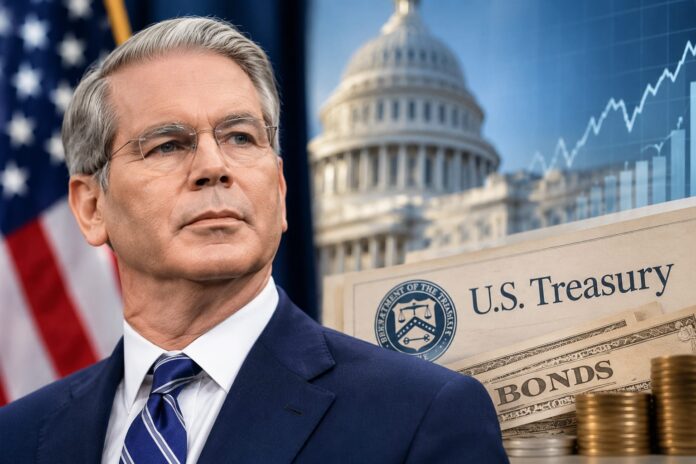
- Treasury Secretary Scott Bessent announced larger buybacks of longer-dated U.S. government bonds.
- The Treasury plans to raise the maximum operation size from $2 billion to at least $4 billion.
- The expanded program targets 10-to-20-year and 20-to-30-year Treasury securities.
- Bessent has indicated that future buybacks could be increased further depending on market conditions.
What Happened
Treasury Secretary Scott Bessent has moved to strengthen the federal government’s efforts to stabilize the long-term Treasury market as borrowing costs have risen sharply. The Treasury Department announced that it would at least double the size of certain liquidity-support buyback operations, increasing them from a previous maximum of $2 billion to at least $4 billion per operation. The expanded purchases are focused on longer-dated securities, particularly bonds in the 10-to-20-year and 20-to-30-year ranges. The program is scheduled to begin September 9 and continue through November 4.
The announcement came after long-term Treasury yields reached levels not seen in years, creating concerns about higher borrowing costs for households, businesses and the federal government. Bessent subsequently said the Treasury could go beyond the newly announced $4 billion level if market conditions warrant it, although he did not provide a specific future amount. The Treasury’s approach is intended to improve liquidity in parts of the bond market where trading conditions have become more difficult.
- The expanded buybacks apply to longer-maturity Treasury securities.
- The new operations are scheduled for September 9 through November 4.
- Bessent has left open the possibility of larger purchases.
- Markets initially responded positively before yields moved higher again.
Why It Matters
Treasury yields influence financing costs throughout the U.S. economy, including rates associated with mortgages, business borrowing and other forms of credit. By purchasing more longer-term government securities, Treasury officials are seeking to improve market liquidity and potentially reduce pressure on longer-term yields. The effort therefore reaches beyond Wall Street and could affect the cost of borrowing for households, companies and the government itself.
The move also puts greater attention on the administration’s approach to federal debt and financial markets. The intervention comes as the national debt has crossed $40 trillion and investors remain focused on inflation, federal borrowing and the direction of interest rates. Bessent has argued that the U.S. economy’s underlying fundamentals should receive more attention, while market participants continue to assess whether buybacks can provide lasting relief.
- Lower long-term yields could ease some borrowing pressures.
- Treasury market stability matters for the broader U.S. economy.
- The policy puts additional focus on federal debt management.
- Investors will judge whether the intervention produces lasting results.
Political and Public Context
The bond-market intervention comes as the Trump administration faces competing economic pressures, including the cost of financing the federal government and concerns about inflation and interest rates. The administration has emphasized economic growth and reducing government spending, while the Treasury is simultaneously responding to market conditions that have pushed longer-term borrowing costs higher. Bessent’s actions represent a more active use of Treasury’s debt-management tools at a time when investors are closely watching Washington’s fiscal strategy.
The policy has also generated debate among investors and economists over how much a Treasury buyback program can accomplish without addressing broader fiscal pressures. Supporters can view the move as a practical effort to improve liquidity and respond to unusual market conditions, while critics question whether relatively small purchases can offset the much larger forces affecting Treasury yields. The debate reflects a broader political argument over deficits, government borrowing and the administration’s economic priorities.
- The Trump administration is facing heightened scrutiny over federal borrowing costs.
- Treasury is taking a more active role in managing market liquidity.
- Debate continues over the scale and effectiveness of the intervention.
- Federal deficits remain an important part of the economic discussion.
Treasury Department to double debt buybacks after bond yield spikehttps://t.co/aDHX31EG3Y
— The Hill (@thehill) August 19, 2026
What Happens Next
The next major step will be the implementation of the expanded buyback operations beginning September 9. Treasury officials and investors will watch how the market responds as the government purchases additional longer-term securities. Bessent’s comments also leave open the possibility that Treasury could increase the size of individual operations beyond $4 billion if officials determine that market conditions justify further action.
Investors will also be watching longer-term Treasury yields, inflation expectations and signals from the Federal Reserve about future interest-rate policy. The performance of the bond market will help determine whether the Treasury’s expanded purchases are viewed as a temporary liquidity measure or part of a broader shift in how the administration manages financial-market pressures.
- September 9 marks the scheduled start of the larger buybacks.
- Treasury could increase purchases beyond $4 billion per operation.
- Long-term Treasury yields will remain a key market indicator.
- Federal Reserve policy signals will be closely watched.