Story Highlights
- President Trump’s comments about Iran and California cities during a midterm rally drew sharp criticism from state Democratic leaders, including Governor Gavin Newsom
- Newsom and other California officials characterized the remarks as dangerous and irresponsible, with the governor calling for invocation of the 25th Amendment
- The White House defended the president’s statements as being mischaracterized by critics, arguing they were clearly about hypothetical threats from a nuclear Iran
- Some political strategists acknowledge the comments may inadvertently energize Democratic voters while potentially distracting from Republican midterm messaging
What Happened
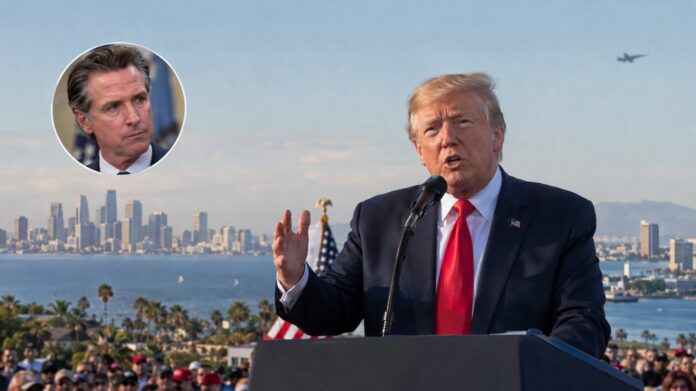
During a midterm campaign rally, the president made remarks suggesting that without strong U.S. policy, Iran could pose threats to American cities including Los Angeles and San Diego. The comments immediately sparked an intense response from California’s Democratic establishment, with Governor Newsom leading the charge by calling the statements indicative of serious mental fitness concerns and advocating for constitutional action to address them. Newsom’s social media posts characterized the president’s remarks as both deranged and dangerous, while other state leaders quickly voiced their disapproval of what they viewed as reckless rhetoric.
The White House communications team moved swiftly to clarify the president’s position, emphasizing that the remarks were intended to illustrate the stakes of preventing nuclear proliferation rather than suggesting abandonment of American cities. Officials within the administration argued that the president’s foreign policy record had actually strengthened national security by preventing Iran from acquiring nuclear weapons, thereby protecting rather than endangering American communities.
- Governor Gavin Newsom called for the 25th Amendment and described Trump as mentally unfit
- Los Angeles Mayor Karen Bass and San Diego Mayor Todd Gloria condemned the statements as dangerous
- White House spokesman Davis Ingle responded by criticizing Newsom’s record as governor
- Even some Republican candidates, including San Diego-area congressional candidate Jim Desmond, distanced themselves from the president’s comments
Why It Matters
The incident highlights the intensifying partisan divide in American politics and raises questions about political rhetoric during sensitive campaign periods. For Democrats, the president’s remarks provide a rallying point to energize their base, particularly in a state where Trump remains deeply unpopular. California represents a crucial battleground for Democratic messaging, and the comments offer an opportunity to frame the presidential administration as irresponsible on matters of national security and public safety. The controversy underscores how even statements intended as rhetorical devices can have significant political consequences.
From a Republican perspective, the incident demonstrates the challenges of maintaining message discipline during midterm campaigns. Some within conservative political circles recognize that regardless of the president’s intended meaning, the comments create distractions from substantive policy messaging that could benefit Republican candidates. The fact that even some GOP candidates felt compelled to distance themselves from the remarks suggests concern about electoral vulnerability in certain districts. Additionally, the exchange illustrates how political opponents can weaponize presidential statements to mobilize their supporters, potentially shifting media attention away from issues Republicans prefer to emphasize.
- Democratic voters gain motivation for increased electoral participation based on concerns about presidential judgment
- California’s Democratic infrastructure receives rhetorical ammunition for voter mobilization efforts
- Republican campaigns face complications in messaging strategy during critical midterm weeks
- National security discourse becomes entangled with partisan political calculations
Political and Public Context
The president’s approach to campaign rhetoric has consistently pushed traditional boundaries of political discourse. Throughout his political career, his statements have generated intense reactions from political opponents while energizing his supporters. However, the California situation reveals potential fractures within the Republican coalition, with some GOP candidates and strategists expressing concern that such rhetoric undermines their electoral prospects. California has emerged as a state where Trump’s approval ratings remain significantly below national averages, making it particularly sensitive terrain for controversial statements.
Governor Newsom has positioned himself as a leading Democratic voice in opposition to the president, and his 25th Amendment reference reflects a rhetorical strategy that some Democratic figures have employed regarding questions of presidential fitness. The governor is widely viewed as a potential 2028 presidential candidate, and his prominent response to this controversy maintains his visibility within national Democratic circles. The incident also reflects broader tensions between the White House and California’s Democratic establishment over issues ranging from immigration to energy policy to pandemic management.
- Trump has a long history of controversial campaign rhetoric that energizes supporters while alarming opponents
- California represents a state where anti-Trump sentiment runs particularly deep among Democratic voters
- Gavin Newsom has established himself as a leading Democratic critic of the president’s statements and policies
- Previous instances of presidential campaign rhetoric have similarly sparked intense partisan reactions without fundamentally altering electoral trajectories
The White House is pushing back against backlash over President Trump’s comments about attacks on California cities, saying his remarks were misunderstood, and the reaction was “not rooted in reality." https://t.co/huOZSZ8xun
— KTVU (@KTVU) October 8, 2026
What Happens Next
The immediate aftermath of this controversy will likely see continued Democratic amplification of the president’s remarks through media appearances and campaign messaging. California Democratic organizations will probably incorporate the incident into their voter contact programs and digital advertising strategies. The question remains whether the controversy will have lasting impact on midterm outcomes or whether it will fade as other campaign issues emerge. Media coverage will likely continue for several news cycles, though its ultimate electoral significance depends on whether competing narratives gain prominence.
The president’s campaign team will presumably adopt messaging strategies to either clarify his position or redirect media attention toward other topics. Republican operatives in California and nationally will continue assessing whether the comments impact specific races, particularly in competitive districts. Legislative Democrats may introduce resolutions or hold hearings responding to the remarks, though such efforts would face obvious obstacles given Republican congressional control. The incident may also influence how the president’s communication team manages future campaign rhetoric, potentially implementing additional vetting processes for statements on sensitive topics.
- Democratic campaigns will integrate the controversy into voter mobilization and advertising strategies
- The White House will continue defending the president’s statement while attempting to shift media focus
- Republican strategists will assess electoral impact in key swing districts and states
- Future campaign events may receive heightened media scrutiny regarding presidential remarks on foreign policy and national security