Story Highlights
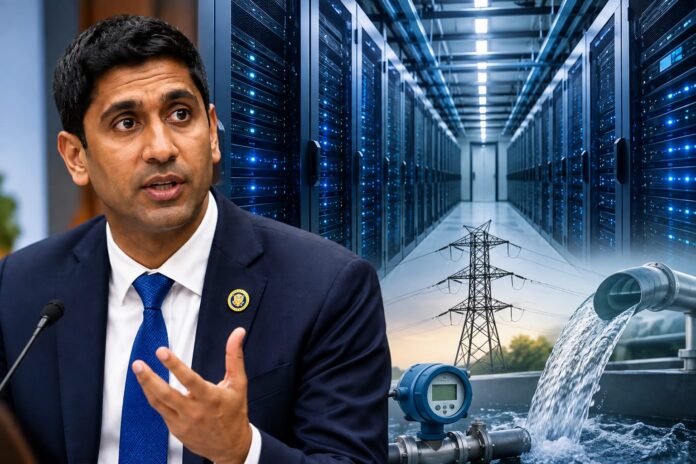
- Rep. Suhas Subramanyam is seeking stronger federal oversight of data centers.
- His legislation would establish standardized measures for energy and water use.
- The proposal focuses especially on facilities supporting artificial intelligence workloads.
- The House Science, Space and Technology Committee advanced the measure in June.
What Happened
Rep. Suhas Subramanyam, a Virginia Democrat, has been pressing Congress to improve federal oversight of the rapidly expanding data center industry, particularly as artificial intelligence increases demand for computing infrastructure. His efforts focus on obtaining more consistent information about how much electricity and water data centers consume. His Data Infrastructure Energy Measurement and Standards Act, H.R. 9372, would direct the National Institute of Standards and Technology, working with the Department of Energy, to develop technical standards and best practices for measuring those resources.
The legislation moved forward in June when the House Science, Space and Technology Committee approved it by a 34-1 vote, sending it toward consideration by the full House. Subramanyam has argued that communities need reliable measurements before they can make informed decisions about data center development, infrastructure and regulation. His congressional district in Northern Virginia has a particularly large concentration of data centers, making the issue a significant local concern as well as a national policy question.
- H.R. 9372 is known as the Data Infrastructure Energy Measurement and Standards Act.
- The proposal addresses both electricity and water measurement.
- NIST would play a central role in developing measurement standards.
- The committee vote was 34-1, with one Republican voting against it.
Why It Matters
Data centers are becoming increasingly important to the U.S. technology economy as companies expand artificial intelligence and other computing-intensive services. At the same time, their demand for electricity, water and supporting infrastructure has created concerns in communities hosting large facilities. Standardized information could give local and federal policymakers a clearer basis for evaluating those demands rather than relying on inconsistent estimates.
The debate also touches directly on household costs and long-term infrastructure planning. Subramanyam has pointed to Northern Virginia as an example of the challenges that can emerge when data center growth moves quickly. If Congress establishes common measurement practices, policymakers could have better information when considering where facilities should be built and how infrastructure needs should be addressed.
- Better data could improve planning for electricity demand.
- Water use could become easier to evaluate across facilities.
- Communities could have more consistent information before approving projects.
- The issue connects AI growth with broader infrastructure policy.
Political and Public Context
The data center debate has become a prominent political issue in parts of Virginia, particularly Northern Virginia, where rapid development has affected discussions about electricity, transmission infrastructure, land use and community planning. Subramanyam has continued to raise concerns about the pace of expansion while emphasizing the need for a national strategy. His position reflects a broader policy debate over how to support technological innovation while addressing the costs associated with large-scale computing facilities.
The issue has also attracted bipartisan attention in Congress. H.R. 9372 included Republican Rep. Jay Obernolte of California and Democratic Rep. Valerie Foushee of North Carolina as original sponsors, while the committee’s overwhelming vote demonstrated support for studying and standardizing resource measurements. The debate therefore extends beyond a simple party-line dispute and includes questions about technology, energy policy, economic development and local control.
- Northern Virginia remains a major center of data center development.
- Data center expansion has become a significant local political issue.
- The legislation has support from members of both parties.
- The broader debate balances technological growth against resource demands.
Democrats Suhas Subramanyam, James Walkinshaw Accept Big Tech Funds as Residents Fight Data Center Overreach -> https://t.co/9pRsCQZI8Q
See the full post above (2/3)
— Red Virginia News (@RedVirginiaNews) August 21, 2026
What Happens Next
The immediate focus is on the legislation’s consideration by the full House after its committee approval. If lawmakers advance the measure, federal agencies would eventually have a framework for developing more consistent technical approaches to measuring data center energy and water use. That information could then help shape future discussions over infrastructure, development and regulation.
Subramanyam is also continuing to pursue related data center policies. In July, he backed calls for local restrictions on certain development and argued that data centers should bear the costs of infrastructure associated with their expansion. Separately, he has supported efforts involving transmission lines serving the industry. These actions suggest that data center growth will remain an active policy issue in Virginia and in Congress.
- Watch for consideration of H.R. 9372 by the full House.
- Follow whether lawmakers maintain bipartisan support for measurement standards.
- Monitor federal discussions over data center energy and water demands.
- Watch developments involving power infrastructure in Northern Virginia.
Sources
Subramanyam pushes data center limits as AI growth accelerates