Story Highlights
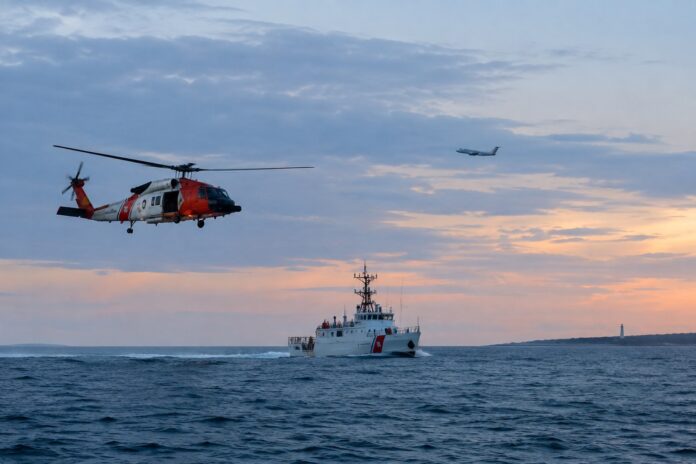
- The U.S. Coast Guard suspended its search for a Gulfstream G100 aircraft carrying six people after 66 hours of operations spanning 4,445 square miles off Nantucket
- Contact with the medical transport aircraft was lost early Saturday morning as it traveled from Bermuda to Boston, disappearing from radar just before scheduled landing
- Flight data indicated the aircraft experienced a rapid descent from approximately 24,000 feet to 11,000 feet in about three minutes before vanishing
- Debris from the aircraft was discovered floating in the ocean on Saturday night, confirming the loss of the aircraft and its occupants
What Happened
The U.S. Coast Guard announced the suspension of search operations for a medical transport aircraft that vanished off the coast of Nantucket, Massachusetts. The Gulfstream G100 twinjet, operated by Latitude Air Ambulance, lost contact with air traffic control in the early morning hours of Saturday as it approached Boston Logan International Airport. The Federal Aviation Administration notified the Coast Guard at approximately 2 a.m. Saturday that the aircraft had disappeared from radar, triggering an immediate response from multiple agencies.
The aircraft had been en route from Bermuda to Boston, transporting a patient requiring medical care along with medical personnel and crew members. During the flight’s final moments, air traffic control communications indicated the aircraft was experiencing significant difficulties. Flight tracking data showed a dramatic descent pattern, with the aircraft dropping from cruising altitude to significantly lower elevation in a compressed timeframe. Search and rescue authorities launched extensive operations involving both air and sea resources, ultimately covering a substantial geographic area over more than 66 hours before the difficult decision to suspend active search efforts.
- Aircraft departed Bermuda for Boston Logan International Airport carrying six people including four Canadian nationals, two medics, two pilots, one Bermudian patient, and one relative
- Contact lost approximately 2 a.m. Saturday; aircraft disappeared from FAA radar just before scheduled landing
- Coast Guard and partner agencies conducted 66-hour search operation covering 4,445 square miles
- Aircraft debris confirmed found in ocean on Saturday night, confirming loss of aircraft
Why It Matters
The suspension of the search operation represents a significant development in maritime and aviation safety, underscoring the inherent risks associated with emergency medical transport operations. The incident highlights the challenges faced by aviation authorities when dealing with aircraft experiencing multiple system failures simultaneously, particularly during critical approach phases when pilots have limited options for recovery. The dramatic descent pattern and loss of both radio and radar capabilities present investigative questions about the sequence of events that led to the aircraft’s disappearance, with potential implications for aviation safety protocols and emergency procedures.
Beyond the immediate tragedy, this incident affects multiple jurisdictions and nations. The presence of Canadian personnel and a Bermudian patient means that international aviation authorities, including Canadian regulators and Bermudian officials, have vested interests in understanding the causation factors. Medical transport operations serve a critical function in healthcare systems, connecting patients across borders to receive necessary treatment. Any incident affecting these operations raises concerns about safety measures, equipment maintenance protocols, and pilot training standards for medical emergency flights. The loss of a specialized aircraft designed specifically for medical transport also has economic implications for the operator and the broader air ambulance industry.
- International involvement through Canadian nationals and Bermudian patient requiring coordination among multiple aviation authorities
- Medical transport operations critical to healthcare infrastructure across regions, raising questions about safety standards for emergency flights
- Specialized aircraft loss affects Latitude Air Ambulance’s operational capacity and the broader medical aviation industry
- Investigation outcomes will influence future aviation safety protocols and equipment requirements for medical transport operations
Political and Public Context
Aviation incidents involving loss of life generate significant public concern and prompt government oversight responses. The Federal Aviation Administration maintains strict protocols for incident investigation, and multiple agencies coordinate to determine causation factors. When aircraft disappear under mysterious circumstances, national governments take particular interest in understanding root causes to prevent similar incidents. The involvement of Canadian nationals in this incident means that Canadian aviation authorities and government officials monitor developments closely, as international incidents require coordinated investigative efforts.
Military and civilian maritime agencies regularly conduct search and rescue operations, and the decision to suspend active search efforts reflects established protocols based on time elapsed, resource availability, and probability of successful recovery. Rear Admiral Matthew Lake’s statement regarding the difficulty of the suspension decision reflects the genuine challenges faced by command personnel when making resource allocation decisions during humanitarian crises. The incident occurs within the broader context of ongoing discussions about aviation safety, regulatory frameworks, and emergency response capabilities. Public discourse around aviation incidents tends to focus on systemic improvements and prevention strategies rather than blame assignment, particularly when multiple system failures appear involved.
- FAA maintains jurisdiction over incident investigation with coordination from National Transportation Safety Board
- Canadian aviation authorities engaged due to Canadian nationals aboard aircraft
- Coast Guard suspension decision reflects established protocols for maritime search operations after extended efforts
- Incident contributes to broader public discourse regarding aviation safety standards and emergency response capabilities
Coast Guard suspends search for Boston-bound plane that vanished off coast of Nantucket https://t.co/MlbNlHBNvs pic.twitter.com/mTqbAUq1ba
— New York Post (@nypost) October 5, 2026
What Happens Next
Investigative authorities will coordinate a comprehensive examination of the incident to determine causation factors. The National Transportation Safety Board, the FAA, and Canadian aviation authorities will likely collaborate to analyze flight data, maintenance records, and air traffic control communications. The recovery of aircraft debris will provide investigators with physical evidence that may help reconstruct the sequence of events leading to the aircraft’s disappearance. Weather conditions, equipment functionality, pilot actions, and maintenance history will all factor into the investigation.
The investigation timeline typically extends over several months as authorities methodically analyze evidence and gather witness statements. Preliminary findings may be released within weeks, while comprehensive investigation reports generally take several months to complete. The findings will inform potential regulatory changes affecting medical transport operations, aircraft maintenance standards, and pilot training requirements. Families and the public will receive updates as the investigation progresses, and final reports will be made available for public review. The incident may prompt discussions within the air ambulance industry regarding safety enhancements and operational procedures for flights in challenging weather conditions.
- National Transportation Safety Board and FAA will coordinate investigation into causation factors and contributing circumstances
- Aircraft debris analysis, maintenance records review, and flight data examination will continue over coming weeks and months
- Preliminary findings expected within weeks with comprehensive report likely taking several months to complete
- Investigation results may prompt regulatory changes affecting medical transport operations, maintenance protocols, and pilot training standards