
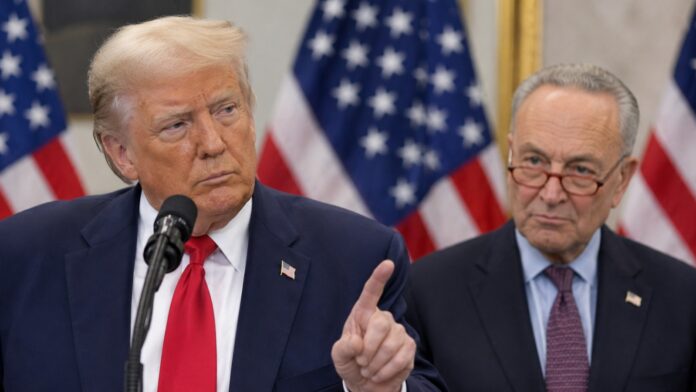
Story Highlights
- President Trump expresses skepticism about Chuck Schumer’s leadership capabilities.
- Schumer faces a challenge from Senator Chris Van Hollen, indicating fractures within the Democratic Party.
- Trump highlights Schumer’s past failures, suggesting a difficult collaboration if he retains leadership.
- The political landscape is shifting as dissent grows among Democrats.
What Happened
President Trump recently took to Truth Social to voice his concerns regarding Senator Chuck Schumer’s potential continuation as Senate Majority Leader. The president stated that it would be ‘hard’ for him to work with Schumer if he is re-elected to the position, citing the senator’s previous failures in leadership. Trump emphasized that Schumer’s track record has been one of the worst in history, particularly criticizing his handling of various political issues, including the infamous Russia investigation. This statement comes at a time when Schumer is facing a significant challenge from Senator Chris Van Hollen, a member of the more progressive wing of the Democratic Party. The growing dissent within the party raises questions about Schumer’s ability to maintain his leadership role amidst increasing opposition.
Trump’s comments reflect a broader concern among some Democrats about Schumer’s effectiveness as a leader. As the party grapples with internal divisions, the challenge posed by Van Hollen signifies a potential shift in power dynamics. If Schumer fails to secure his position, it could lead to a more progressive agenda being pushed by the new leadership, which may not align with the centrist views that have characterized much of Schumer’s tenure. This internal struggle could also impact legislative negotiations with the White House, particularly on key issues such as infrastructure, healthcare, and economic recovery.
- Trump’s comments were made on Truth Social on a Sunday.
- Schumer is running for re-election as Senate Majority Leader.
- Senator Chris Van Hollen is emerging as a challenger to Schumer’s leadership.
- Schumer has led Senate Democrats for nearly a decade.
Why It Matters
The implications of Trump’s remarks extend beyond mere political banter; they reflect a deeper rift within the Democratic Party. As the party grapples with internal divisions, the challenge posed by Van Hollen signifies a potential shift in power dynamics. If Schumer fails to secure his position, it could lead to a more progressive agenda being pushed by the new leadership, which may not align with the centrist views that have characterized much of Schumer’s tenure. This internal struggle could also impact legislative negotiations with the White House, particularly on key issues such as infrastructure, healthcare, and economic recovery. The president’s skepticism about Schumer’s leadership could hinder bipartisan efforts, making it increasingly difficult to achieve consensus on critical legislation.
- A shift in leadership could lead to a more progressive agenda in the Senate.
- Increased internal dissent may weaken the Democratic Party’s overall unity.
- Legislative negotiations with the White House could become more contentious.
- Trump’s comments may galvanize support among his base, reinforcing his position as a key player in the political landscape.
Political and Public Context
The backdrop of this political drama is the recent midterm elections, where Democrats managed to secure a majority in the Senate. However, the victories have not come without their complications. Schumer’s leadership has been called into question, particularly as more progressive voices within the party seek to assert their influence. The emergence of challengers like Van Hollen, who is backed by prominent progressives such as Senator Bernie Sanders, indicates a potential shift in the party’s priorities. This internal power struggle is not unprecedented; similar challenges have occurred in the past, often leading to significant changes in party direction and strategy. The current situation mirrors previous instances where leadership contests have exposed underlying tensions within the party.
- Schumer has led Senate Democrats for nearly a decade, navigating various political challenges.
- Progressive figures like Bernie Sanders are gaining traction within the party.
- Past leadership challenges have often resulted in shifts in party strategy.
- The recent midterm elections have complicated the Democratic Party’s unity.
Trump says it will be ‘very hard’ to work with Schumer as Senate majority leaderhttps://t.co/knzbSi607z
— The Hill (@thehill) November 22, 2026
What Happens Next
As the political landscape continues to evolve, the future of Schumer’s leadership remains uncertain. The upcoming votes for Senate leadership will be closely watched, as they will determine not only the direction of the Democratic Party but also the potential for bipartisan cooperation in the Senate. If Schumer retains his position, he will need to address the concerns of the progressive wing while maintaining support from more moderate members. Conversely, if Van Hollen or another challenger succeeds, it could lead to a significant shift in legislative priorities and strategies. The outcome of this leadership contest will have lasting implications for the Democratic Party and its ability to govern effectively in the coming years.
- Senate leadership votes are expected to take place soon.
- Schumer will need to navigate internal party dynamics to retain his position.
- Potential shifts in legislative priorities could emerge depending on the outcome.
- The political landscape will continue to evolve as factions within the party vie for influence.