Story Highlights
- Florida Attorney General James Uthmeier announced a formal investigation into Dr. Anthony Fauci following a contentious Senate hearing.
- Fauci invoked his Fifth Amendment right against self-incrimination 111 times before the Senate Homeland Security and Governmental Affairs Committee.
- Sen. Rand Paul indicated he would seek a contempt of Congress vote against Fauci as early as the following week.
- Florida Gov. Ron DeSantis noted that Fauci’s existing pardon applies only to federal offenses, leaving open the possibility of state-level prosecution.
What Happened
Florida Attorney General James Uthmeier announced Wednesday that his office is opening a formal investigation into Dr. Anthony Fauci, the longtime former director of the National Institute of Allergy and Infectious Diseases, following an extraordinary Senate hearing in which Fauci declined to answer questions on 111 separate occasions by invoking his Fifth Amendment right against self-incrimination.
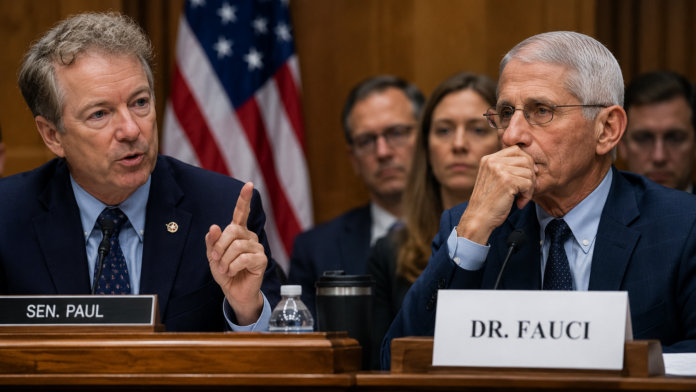
The hearing took place before the Senate Homeland Security and Governmental Affairs Committee, chaired by Sen. Rand Paul (R-Ky.), and lasted approximately three hours. During that time, Fauci refused to respond to every question posed by Republican senators, who pressed him on his handling of the COVID-19 pandemic. Democratic members of the committee defended Fauci against what they characterized as partisan attacks. In his opening remarks, Fauci indicated that he believed the hearing was motivated by a desire to set the stage for his criminal prosecution rather than a genuine search for facts about pandemic policy.
- Attorney General James Uthmeier announced the Florida state-level investigation on Wednesday via social media.
- Fauci invoked the Fifth Amendment 111 times before the Senate Homeland Security and Governmental Affairs Committee.
- Sen. Rand Paul chaired the three-hour hearing and pledged to pursue a contempt of Congress vote the following week.
- Fauci served as NIAID director for 38 years and was the central face of the federal pandemic response.
Why It Matters
The decision by a sitting state attorney general to open an investigation into a former senior federal health official is an uncommon and legally significant development. It signals that accountability efforts surrounding pandemic-era decisions may extend well beyond the federal government and into state jurisdictions. The investigation also raises fresh questions about the limits of transparency that senior public health officials owe to Congress and to the American people.
Sen. Paul argued that Fauci had little legal standing to plead the Fifth given that a broad executive clemency action had already shielded him from federal criminal liability for actions taken between January 1, 2014, and January 19, 2025. Paul and other Republicans contended that if Fauci faces no federal jeopardy, his repeated invocations of the Fifth Amendment were without legal justification and amounted to a deliberate stonewalling of legitimate congressional oversight.
- A state attorney general investigation into Fauci could sidestep the federal pardon he received, which applies only to potential federal offenses.
- Republicans are pursuing contempt of Congress charges that could carry independent legal consequences.
- The hearing intensified ongoing national debate over COVID-19 policy accountability and transparency.
- Florida Sen. Ashley Moody described Fauci’s refusal to answer as deeply frustrating and harmful to the public interest.
Political and Public Context
The hearing comes amid a sustained push by Republican lawmakers and state officials to revisit the federal government’s management of the COVID-19 pandemic, including questions about the origins of the virus, government communications with social media platforms, funding of overseas research, and the rationale behind numerous public health mandates. Florida has been at the forefront of that effort, with Gov. Ron DeSantis having established himself as a consistent and outspoken critic of Fauci throughout the pandemic years.
DeSantis, who previously served as a federal prosecutor, weighed in on the legal landscape surrounding Fauci’s situation. He noted that because the clemency action issued last year was limited to potential federal crimes, it would have no bearing on any charges that a state attorney general or local state prosecutor might pursue, provided those charges were grounded in state law and that proper jurisdiction could be established over the defendant. Florida Sen. Ashley Moody, a committee member who was present at the hearing, said the experience of watching Fauci decline every question was deeply troubling and that it put on trial the very policies that Florida had resisted during the pandemic.
- Gov. Ron DeSantis noted publicly that state-level prosecution remains a viable avenue despite the federal clemency action.
- Sen. Ashley Moody is a Florida Republican and a member of the Senate committee that conducted the hearing.
- Florida positioned itself as a state that opposed many federal pandemic mandates, making it a symbolically charged venue for oversight efforts.
- Congressional Republicans have separately discussed referring Fauci for potential contempt charges related to the destruction of public records.
What Happens Next
The Florida attorney general’s investigation is in its early stages, and it remains to be seen what specific legal avenues Uthmeier’s office will pursue. Establishing personal jurisdiction over Fauci, who is not a Florida resident, and identifying violations of Florida state law are both legal hurdles that the investigation would need to clear before any charges could be brought. Legal analysts are likely to scrutinize the scope of the inquiry closely in the coming weeks.
On the federal side, Sen. Paul indicated he intends to bring a vote before the Senate committee on whether to hold Fauci in contempt of Congress. If the committee votes in favor of a contempt referral, the matter would move to the full Senate and potentially to the Department of Justice. The combination of state and federal pressure mechanisms means Fauci could face simultaneous scrutiny on multiple legal fronts in the near term.
- Sen. Rand Paul plans to call a committee vote on a contempt of Congress resolution against Fauci as early as the following week.
- The Florida AG’s office must establish personal jurisdiction and applicable state law violations before any charges can proceed.
- DeSantis suggested local state attorneys could also independently pursue the matter within their respective jurisdictions.
- The scope and findings of the Florida investigation will likely inform similar efforts by other Republican-led states watching the proceedings closely.