
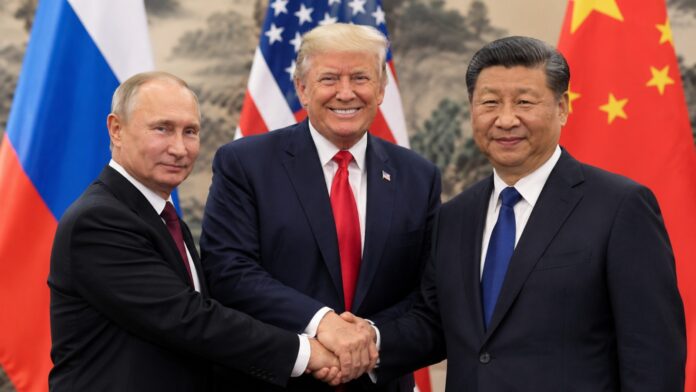
Story Highlights
- Director of National Intelligence Jay Clayton praises President Trump’s diplomatic efforts.
- The trilateral meeting with Putin and Xi is seen as a significant achievement.
- Clayton expresses complete trust in the president’s ability to navigate complex geopolitical landscapes.
- This meeting underscores the importance of high-level engagement in international relations.
What Happened
In a recent series of interviews, Director of National Intelligence Jay Clayton commended President Trump for his remarkable diplomatic success in convening a trilateral meeting with Russian President Vladimir Putin and Chinese President Xi Jinping. This meeting, which took place during Trump’s high-stakes trip to Asia, is being hailed as a pivotal moment in international relations, showcasing the president’s ability to engage with world leaders effectively. Clayton’s remarks highlight the significance of such high-level engagement, particularly in a time when geopolitical tensions are at an all-time high.
During his appearances on various news programs, Clayton emphasized that the president’s ability to bring together these two powerful leaders is not only a testament to his diplomatic skills but also a crucial step in fostering better relations among the world’s major powers. The director’s comments come at a time when the United States is navigating complex challenges on the global stage, making Trump’s achievements even more noteworthy. The meeting is expected to have lasting implications for international diplomacy.
- President Trump held a trilateral meeting with Putin and Xi during his trip to Asia.
- Clayton expressed complete trust in Trump’s diplomatic approach.
- The meeting is viewed as a significant diplomatic achievement.
- Clayton described the summit as ‘remarkable’ during his interviews.
Why It Matters
The significance of this trilateral meeting cannot be overstated. In a world where diplomatic relations can often be fraught with tension and misunderstanding, President Trump’s ability to convene such a high-profile summit is a clear indication of his administration’s commitment to fostering dialogue and cooperation among nations. By engaging directly with both Putin and Xi, the president is not only addressing immediate geopolitical concerns but also laying the groundwork for future collaboration on pressing global issues.
Moreover, Clayton’s endorsement of Trump’s diplomatic efforts serves to bolster the administration’s credibility in the eyes of both domestic and international audiences. Trust in leadership is paramount, especially when dealing with adversarial nations. Clayton’s assertion that he trusts Trump ‘completely’ sends a strong message about the administration’s unified front in foreign policy matters. This level of confidence can lead to more productive discussions and negotiations, ultimately benefiting the United States and its allies. The potential for improved relations could reshape the global landscape.
- The meeting may lead to improved relations between the U.S., Russia, and China.
- Increased trust in Trump’s leadership could enhance diplomatic negotiations.
- Potential for collaborative efforts on global issues such as trade and security.
- Strengthening of U.S. standing on the world stage through effective diplomacy.
Political and Public Context
To fully appreciate the implications of this trilateral meeting, it is essential to consider the broader context of U.S. foreign relations. The past few years have seen a significant shift in how the United States interacts with other nations, particularly those that have historically been viewed as adversaries. President Trump’s approach has often been characterized by direct engagement rather than the more traditional diplomatic channels that have been employed in the past.
This shift has not been without its critics, but the results speak for themselves. The president’s willingness to engage with leaders like Putin and Xi demonstrates a strategic understanding of the importance of dialogue in resolving conflicts and advancing national interests. Furthermore, the current geopolitical landscape is marked by rising tensions, particularly in areas such as trade, cybersecurity, and military posturing. In this environment, the ability to convene high-level discussions is more critical than ever, as it can lead to breakthroughs in negotiations.
- Recent tensions in trade relations with China have necessitated direct dialogue.
- Russia’s actions in Eastern Europe continue to pose challenges for U.S. foreign policy.
- Cybersecurity threats have heightened the need for cooperation among major powers.
- Trump’s administration has prioritized direct engagement over traditional diplomatic norms.
Clayton says he trusts Trump ‘completely’ after calling Putin a friendhttps://t.co/xHBJ4F6avf
— The Hill (@thehill) November 23, 2026
What Happens Next
Looking ahead, the outcomes of this trilateral meeting will be closely monitored by analysts and policymakers alike. The potential for improved relations between the U.S., Russia, and China could lead to significant shifts in global dynamics. However, the path forward is fraught with challenges, and it remains to be seen how these discussions will translate into concrete actions.
One immediate question is how the president will leverage this meeting to address ongoing issues such as trade imbalances, military cooperation, and cybersecurity threats. Additionally, the reactions from both Russia and China will be critical in determining the success of this diplomatic endeavor. If both nations respond positively, it could pave the way for further collaboration on pressing global issues, potentially leading to new agreements that benefit all parties involved.
- Monitoring of responses from Russia and China following the meeting.
- Potential for new trade agreements or security pacts.
- Continued emphasis on cybersecurity cooperation among major powers.
- Future summits may be planned to build on this initial engagement.