Story Highlights
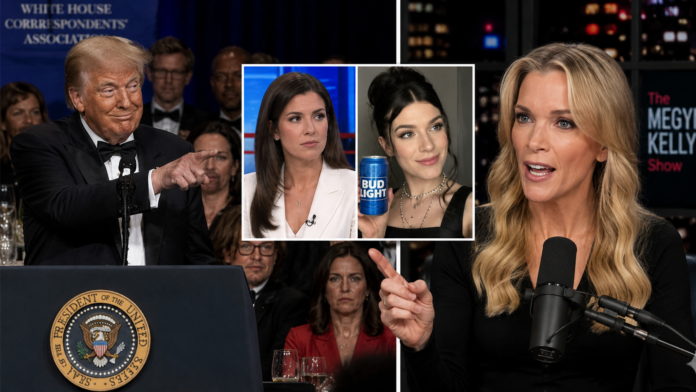
- Megyn Kelly publicly defended President Trump’s joke about CNN anchor Kaitlan Collins at the White House Correspondents’ Dinner.
- Kelly argued the humor was strategically clever, placing critics in an ideologically uncomfortable position.
- The joke drew silence from the press corps audience and sparked widespread media backlash.
- Trump followed up the moment by sharing AI-generated content referencing the same comparison on social media.
What Happened
At the White House Correspondents’ Dinner last Friday, President Trump delivered remarks that included a pointed jab at CNN anchor Kaitlan Collins, referencing her recent award win and comparing her to transgender actress Dylan Mulvaney — a figure well known for her appearance in Bud Light promotional content. The remark was met with near silence from the assembled press corps audience, and the immediate aftermath produced a wave of criticism from media commentators and journalists.
Broadcaster Megyn Kelly took a decidedly different view. On her Monday podcast, she mounted a vigorous defense of the president’s humor, insisting that the joke was both funny and deliberately constructed. Kelly argued that the bit was designed to corner political opponents into an uncomfortable rhetorical bind — critics who object to the comparison are essentially forced to characterize the reference to Mulvaney as unflattering, which puts progressive commentators in direct tension with their own ideological commitments around transgender identity. Kelly also sought to contextualize the president’s remarks by pointing to Collins’ long track record of adversarial coverage toward the White House.
- Trump’s remarks at the dinner targeted Collins by name, referencing her award and suggesting she should smile more.
- The comparison to Dylan Mulvaney was met with audience silence and drew swift condemnation from press outlets.
- Kelly defended the joke on air alongside conservative historian Victor Davis Hanson.
- Trump extended the moment Sunday by using AI-generated imagery to reinforce the comparison on social media.
Why It Matters
The episode captures something larger than a single offhand joke. The White House Correspondents’ Dinner has historically served as a space where the relationship between the executive branch and the press is tested in real time, often through humor. When the president uses that platform to call out a specific anchor by name, it reflects his administration’s broader posture toward legacy media — one that refuses to extend deference to institutions that have, in the eyes of many conservatives, operated as partisan actors rather than neutral observers.
Kelly’s defense adds another dimension. Her argument — that the joke was architecturally clever rather than merely provocative — frames the moment as a form of political judo. By invoking Mulvaney, the president effectively created a no-win scenario for progressive critics. Any objection to the comparison requires admitting that being likened to Mulvaney is somehow negative, which clashes directly with the left’s stated position on transgender representation and dignity. That strategic layering, Kelly contended, is precisely what made the moment worth defending, regardless of how it landed in the room.
- Conservative supporters view the joke as a pointed and effective critique of media double standards.
- The moment reignites ongoing debate about the adversarial dynamic between the Trump White House and CNN.
- Progressive critics are placed in an ideologically difficult position when objecting to the Mulvaney comparison.
- The episode further underscores Trump’s willingness to use cultural flashpoints as political tools.
Political and Public Context
This is far from the first time the relationship between the president and Collins has become a matter of public controversy. Collins has previously suggested that Trump’s hostility toward her stems from his dissatisfaction with her line of questioning, framing his commentary as a reaction to professional scrutiny rather than personal animus. That framing has done little to soften the exchanges, and the Correspondents’ Dinner moment represents one of the most public flashpoints in that ongoing tension.
Kelly, for her part, framed Collins as a consistently hostile presence toward the administration, arguing that the CNN anchor approaches interviews with a predetermined negative slant. From that perspective, the president was not punching down or acting inappropriately — he was simply responding in kind to a media figure who has never extended him professional courtesy. Hanson, appearing as Kelly’s guest, echoed that sentiment, suggesting that the assembled press corps only responds warmly to humor that targets people they already dislike.
- Collins appeared on The Daily Show Monday night alongside prominent Trump critic Jon Stewart.
- Victor Davis Hanson joined Kelly in defending the president’s remarks and criticizing the press corps audience.
- Dylan Mulvaney became a cultural flashpoint in 2023 following the Bud Light advertising controversy.
- Trump’s AI-generated social media post extended the joke beyond the dinner into the broader news cycle.
What Happens Next
With Collins having secured a high-profile platform on The Daily Show in the immediate aftermath of the dinner, the story is unlikely to fade quickly. Her appearance gives her an opportunity to respond publicly in a setting that will be broadly sympathetic to her perspective, potentially extending the news cycle around the incident well into the coming week. Meanwhile, the president’s decision to amplify the moment through AI-generated content on Sunday suggests the White House has no interest in walking anything back.
Kelly’s defense may also embolden other conservative commentators to adopt a similar line of argument — framing the joke not as a misfire but as a calculated rhetorical move that exposed the left’s contradictions on transgender issues. Whether that interpretation gains traction in the broader media conversation will depend in part on how Collins and her allies choose to respond in the days ahead.
- Collins’ appearance on The Daily Show gives her a national platform to respond directly to the president’s remarks.
- Trump’s social media follow-up suggests the administration does not consider the matter closed.
- Conservative media figures may continue rallying around Kelly’s strategic defense of the joke.
- The episode is likely to further inflame the already contentious relationship between the White House and CNN.