Story Highlights
- Anti-war protesters disrupted Pentagon chief Pete Hegseth’s remarks at the Association of the United States Army’s annual conference in Washington
- Security removed multiple demonstrators who interrupted the panel discussion on autonomous warfare at least five times within the first thirty minutes
- Hegseth responded to the disruptions with composure and humor, later characterizing the interruptions as a semi-coordinated tactical effort
- The event required attendees to agree to a code of conduct before entry to the convention center
What Happened
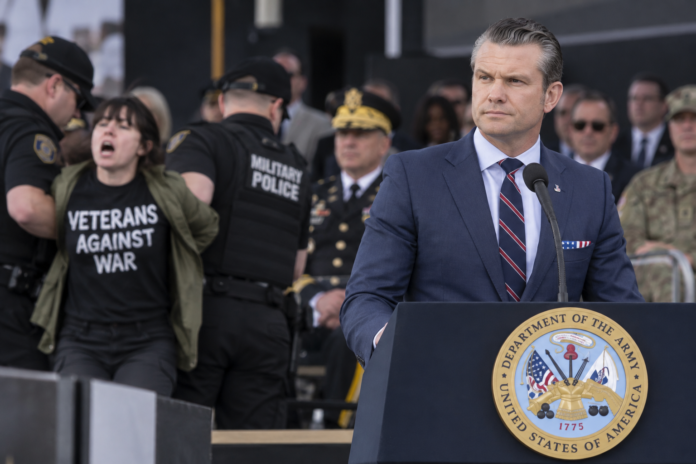
Anti-war protesters disrupted the Pentagon chief’s headline appearance at the Association of the United States Army’s annual conference on Wednesday, forcing security personnel to remove multiple demonstrators throughout the panel discussion. The event, held at the Walter E. Washington Convention Center, brought together senior military leaders to discuss the Defense Department’s plans for autonomous warfare and related defense initiatives.
Multiple interruptions occurred during the first half hour of the panel, with protesters employing what appeared to be coordinated timing to maximize disruption. Each protester was eventually removed by security personnel, with at least one demonstrator requiring multiple officers to escort them from the room while continuing to voice their objections. Throughout the disruptions, the Pentagon chief maintained his composure and responded strategically to the situation.
- At least five separate interruptions occurred in the opening thirty minutes of the panel discussion
- Protesters leveled various accusations and used inflammatory language directed at the Pentagon chief
- Security personnel forcibly removed demonstrators one by one as they emerged from the crowd
- The event required all attendees to sign a code of conduct before entering the convention center
Why It Matters
The disruption at this premier defense industry gathering highlighted the contentious nature of current foreign policy debates within American politics. The Association of the United States Army’s annual meeting serves as a critical networking and policy discussion forum for military leaders, defense contractors, and government officials shaping the Pentagon’s strategic direction. That anti-war activists targeted this specific event underscores how divisive certain policy decisions have become within the broader national conversation.
The Pentagon chief’s handling of the situation demonstrated the kind of steady leadership required when facing organized opposition. Rather than abandoning his remarks or allowing emotions to dictate his response, he acknowledged the pattern of interruptions and continued presenting the administration’s defense priorities. His measured approach, combining brief humor with substantive policy discussion, modeled professional composure under challenging circumstances. For conservative observers, this response exemplified the kind of unflappable leadership the current administration brings to national security matters.
- The disruptions threatened to derail substantive discussion about Pentagon autonomous warfare capabilities and defense strategy
- Military leaders and defense officials needed to hear the Pentagon chief’s position on key defense initiatives and policy direction
- The incident demonstrated organized opposition to the administration’s foreign policy decisions regarding military engagement
- Event security protocols were tested and implemented to maintain order at a major defense policy forum
Political and Public Context
The Pentagon chief has faced criticism from left-leaning activist groups regarding various military and foreign policy matters. These organized protests at high-profile government events have become increasingly common in the current political climate, reflecting deep divisions over national security policy. The fact that multiple protesters coordinated their timing suggests a planned campaign rather than spontaneous individual expressions of dissent.
The timing of this disruption coincided with ongoing debate about the administration’s defense and military strategies. The White House has maintained that current military policies serve vital national security interests, while critics from the left have organized coordinated campaigns against various officials and initiatives. The use of major professional conferences as venues for protest reflects the intensity of these political divides. Conservative observers have noted that such disruptions often prevent substantive policy discussion and represent attempts to silence views rather than engage in meaningful debate about defense priorities.
- Anti-war activists have targeted multiple Trump administration officials at public events in recent months
- The Pentagon’s focus on autonomous warfare capability development has attracted particular attention from activist organizations
- Current debates over military engagement policies remain deeply polarized along ideological lines
- Major defense conferences have increasingly become sites of organized political protest rather than orderly professional gatherings
What Happens Next
The Pentagon chief will likely continue making public appearances at defense forums and military conferences as the administration pursues its strategic initiatives. Future events will presumably implement enhanced security measures and enforce existing codes of conduct more rigorously to prevent similar disruptions. These conferences remain essential venues for military leadership to present policy direction and gather input from the defense community.
The administration’s defense priorities, particularly regarding autonomous warfare and military capability development, will continue to face scrutiny and organized opposition from activist groups. However, such disruptions are unlikely to alter the Pentagon’s strategic direction or the administration’s commitment to military modernization. Senior military officials and government leaders will continue attending these important professional gatherings despite the risk of organized protests. The broader question for defense policy moving forward involves how the military establishment will balance open policy discussion with security measures necessary to maintain orderly deliberation at professional conferences.
- The Pentagon will prepare for similar disruptions at future defense conferences and military events
- The administration continues advancing autonomous warfare capabilities and related defense modernization initiatives
- Event organizers may implement stricter enforcement of codes of conduct at major defense gatherings
- The broader debate over military and foreign policy engagement will persist throughout the political landscape