Story Highlights
- President Trump questioned whom the U.S. is negotiating with during a Montana rally, citing Iran’s decimated military forces
- Secretary of State Marco Rubio ordered Iranian delegations to leave the U.S. following failed UN General Assembly talks
- Vice President Vance stated Iran must demonstrate concrete actions on nuclear enrichment rather than making promises
- The eight-month conflict has created political challenges for Republicans heading into midterm elections amid rising fuel costs
What Happened
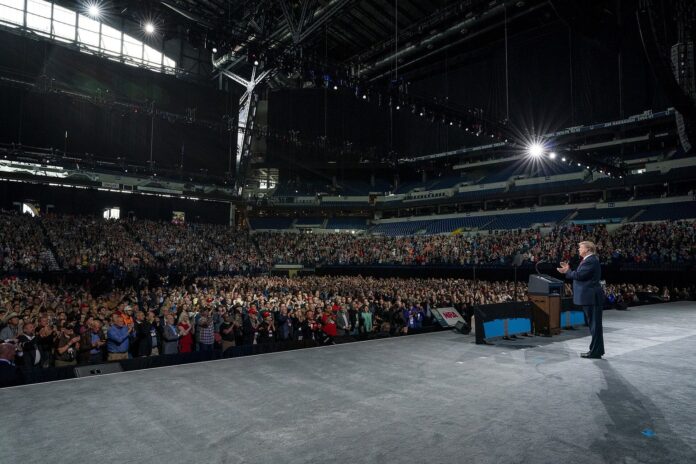
During a campaign rally in Montana on Wednesday evening, President Trump expressed serious doubts about the current state of U.S.-Iran negotiations. He emphasized that the Iranian military has been severely degraded, stating that Iran no longer has a functional navy or air force, and its army has been decimated by the conflict now approaching eight months in duration. Trump questioned the legitimacy of ongoing diplomatic efforts, asking rhetorically who American officials were actually negotiating with given the collapse of Iranian leadership structures.
The administration’s diplomatic posture has hardened considerably in recent weeks. Following unsuccessful talks at the United Nations General Assembly, Secretary of State Marco Rubio determined that the Iranian delegation had overstayed its welcome and ordered its members to depart the country. Vice President Vance subsequently articulated the administration’s core negotiating principle, emphasizing that the United States demands reciprocal action-for-action trades rather than accepting Iranian promises.
- President Trump campaigned in Montana for Republican Aaron Flint, who is challenging Democrat Sam Forstag to replace retiring Rep. Ryan Zinke
- Secretary of State Marco Rubio ordered Iranian delegations to leave the United States following failed UN General Assembly talks
- Vice President Vance stated Iran must demonstrate meaningful actions on nuclear enrichment capacity reduction, not mere promises
- The Iran conflict has persisted for nearly eight months, creating economic pressures affecting fuel costs domestically
Why It Matters
The president’s public skepticism about ongoing negotiations reflects a strategic reassessment within his administration. By articulating doubt about the legitimacy of current diplomatic channels, the White House signals to allies and adversaries that business-as-usual engagement will not continue under present conditions. This approach establishes clear conditions for any resumption of meaningful talks and demonstrates resolve in pursuing American interests.
The military reality on the ground provides substantial leverage for American negotiators. With Iranian naval and air capabilities severely compromised and ground forces degraded, the balance of power has shifted decisively. This strategic advantage, when combined with economic sanctions and diplomatic isolation, creates genuine pressure on Tehran to consider serious concessions.
- American leverage has increased substantially due to the degraded state of Iranian military forces across all service branches
- Economic pressures from the conflict, including elevated fuel costs, provide domestic political incentives for resolution
- The administration’s hardline stance strengthens the position of regional allies who oppose Iranian nuclear proliferation
- Clear communication of non-negotiable demands reduces the possibility of protracted talks yielding minimal concessions
Political and Public Context
The timing of the president’s comments carries significance as the Republican Party prepares for midterm elections. The ongoing conflict has created complications for GOP messaging, as Americans increasingly experience economic strain through higher energy prices. By emphasizing Iran’s military weakness, the president frames the situation through a lens of American strength and strategic success.
Treasury Secretary Scott Bessent recently acknowledged uncertainty surrounding potential resolutions, indicating that senior officials recognize the complexity of the diplomatic landscape. The Republican coalition has consistently advocated for a strong negotiating posture with Iran, particularly regarding nuclear weapons development, with voters increasingly focused on economic impacts and national security.
- The Republican Party views strong opposition to Iranian nuclear ambitions as a core midterm election message
- Economic impacts of the conflict, including fuel price increases, have become a significant domestic political concern
- Previous diplomatic frameworks with Iran have faced conservative criticism for insufficient verification mechanisms
- The administration’s willingness to order Iranian delegations out of the country demonstrates departure from conventional diplomatic norms
Trump on Iran talks: ‘I don’t know who the hell we’re negotiating with’ #TheHill https://t.co/OHBO0Y1dDe
— #TuckFrump (@realTuckFrumper) October 15, 2026
What Happens Next
The immediate outlook for U.S.-Iran negotiations appears unlikely to involve significant breakthroughs in the near term. The administration’s public positioning and the order for Iranian delegations to leave the United States suggest that meaningful talks will only resume if Tehran demonstrates genuine willingness to accept the administration’s conditions regarding nuclear weapons programs.
Secretary of State Rubio and Vice President Vance will likely continue articulating the administration’s non-negotiable demands regarding uranium enrichment and nuclear weapons development. The continued military degradation of Iranian capabilities may eventually create circumstances more favorable to diplomatic resolution, though only if the regime recognizes the unsustainability of its current trajectory.
- Future negotiations will require Iranian demonstration of concrete actions on uranium enrichment before meaningful U.S. engagement resumes
- The administration’s negotiating position strengthens as Iranian military capabilities continue to degrade
- Midterm election outcomes may influence the political space available for diplomatic flexibility or further hardening
- Regional allies will monitor whether American resolve regarding Iranian nuclear weapons development persists across changing circumstances