Story Highlights
- New polling shows a significant portion of voters feel financially worse off under Trump’s second term, though the White House strongly contests that characterization.
- President Trump traveled to Michigan to deliver a major economic address, doubling down on his proven economic track record and agenda.
- The administration points to historic first-term job creation, wage growth, and cost reductions as a blueprint for second-term success.
- The One Big Beautiful Bill Act includes substantial tax relief for working families, though public awareness of its contents remains limited.
What Happened
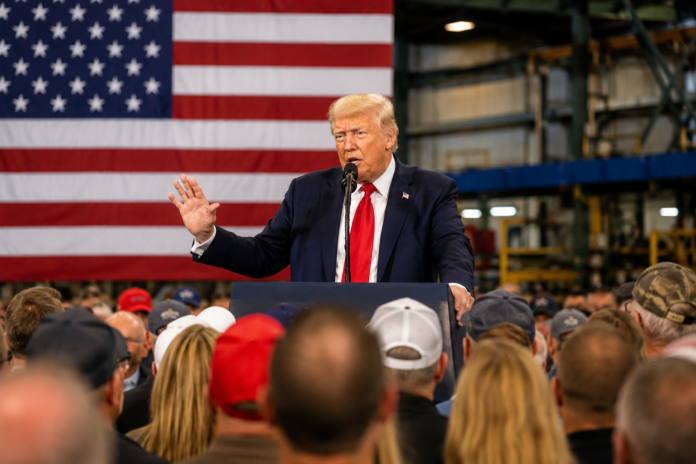
President Trump took his economic message directly to Michigan voters this week, delivering a major speech aimed at strengthening public confidence in the direction of the American economy. The visit came amid a challenging polling environment, with a CBS News survey analyzed on CNN indicating that a majority of respondents feel financially worse off during the current term. Data analyst Harry Enten broke down the numbers on CNN News Central, noting that only a small fraction of voters — roughly 13 percent — say they are better off economically right now compared to their expectations heading into the second term.
The White House pushed back firmly on that framing. Administration spokesperson Kush Desai argued that the contrast between the Trump economic record and the Democratic alternative could not be more stark, pointing to what the administration describes as the worst inflation crisis in a generation under the previous administration. The White House maintained that the president’s second-term policies are already generating private-sector job growth, reducing costs, and accelerating broader economic expansion — results they say mirror the historic achievements of the first term.
- CBS News polling showed approximately 58 percent of voters currently feel financially worse off under the second term.
- Trump traveled to Michigan to deliver an economic address and reconnect with working-class voters.
- The administration cited first-term achievements including record job creation and wage growth as proof of concept.
- Spokesperson Kush Desai formally challenged the media’s economic narrative on behalf of the White House.
Why It Matters
The polling gap between voter perception and the administration’s documented economic record represents a significant communications challenge heading into the midterm cycle. Historically, the economy has been the single most decisive issue in midterm elections, and the president was elected in 2024 with 44 percent of voters expecting him to improve their financial situation — one of the highest expectations on record for an incoming president. The gap between those expectations and current sentiment, if left unaddressed, could shape congressional races in 2026.
However, the administration’s argument carries real substance. Trump’s first term produced some of the strongest wage growth numbers for working-class Americans in decades, pre-pandemic job creation records, and a sustained period of low inflation. The White House is betting that voters will ultimately judge the second-term agenda by results as those policies fully take hold rather than by near-term sentiment during a period of transition and global economic pressure.
- Economic approval ratings directly influence down-ballot Republican candidates in the 2026 midterms.
- Working-class voters in states like Michigan are central to the GOP’s electoral coalition and are the primary audience for the current messaging push.
- Rising perceptions of tariff-related cost increases are complicating the administration’s effort to highlight longer-term structural gains.
- A successful reframing of the economic narrative could solidify Republican legislative momentum around the One Big Beautiful Bill.
Political and Public Context
The current net economic approval rating sits at a challenging point historically, though administration allies note that external pressures — including ongoing global supply chain disruptions and residual inflationary forces inherited from the Biden years — are factors that polling rarely fully accounts for. Enten noted on CNN that previous second-term presidents also faced difficult economic approval environments at comparable points in their tenures, suggesting the current moment is not without historical precedent.
The One Big Beautiful Bill Act has become a focal point of the economic debate. The legislation extends critical elements of the landmark 2017 tax cuts while introducing new provisions specifically targeted at working families. These include temporary deductions for tips and overtime pay, an expanded child tax credit, new senior tax deductions, auto loan interest relief, and the creation of government-backed savings accounts for children. Despite its breadth, polling suggests many Americans remain largely unaware of what the bill actually contains — an awareness gap the administration and Republican lawmakers are actively working to close.
- The 2017 Trump tax cuts, which the new bill extends, are broadly credited by economists with spurring pre-pandemic economic expansion.
- Democratic messaging has focused on characterizing the bill as beneficial primarily to higher-income earners, a claim the White House disputes.
- Historical comparisons show second-term midterm headwinds are common, with both parties having navigated similar cycles.
- Michigan, a key battleground state, remains a bellwether for working-class economic sentiment across the Rust Belt.
What Happens Next
The administration is expected to intensify its economic outreach strategy in the coming weeks, with senior officials and the president himself making the case directly to voters in key states. The Michigan speech represents the opening salvo in what is shaping up to be a sustained public campaign to reframe the economic conversation around the administration’s concrete policy achievements rather than short-term polling snapshots.
Legislative momentum around the One Big Beautiful Bill will also be closely watched. If Republican leaders can move the bill through Congress and deliver tangible relief — particularly on tips, overtime, and child tax credits — the administration believes voter sentiment will shift as Americans feel the direct financial impact. The White House remains confident that its proven agenda, which delivered strong results in the first term, will ultimately validate the approach in the second.
- The White House is expected to launch a broader economic messaging campaign targeting swing-state voters ahead of 2026.
- Congressional Republicans are prioritizing passage of the One Big Beautiful Bill to deliver visible wins for working families.
- Polling awareness campaigns around the bill’s specific provisions for tips, overtime, and child credits are being developed.
- The administration will continue pointing to private-sector job creation data and wage growth metrics as evidence of second-term progress.