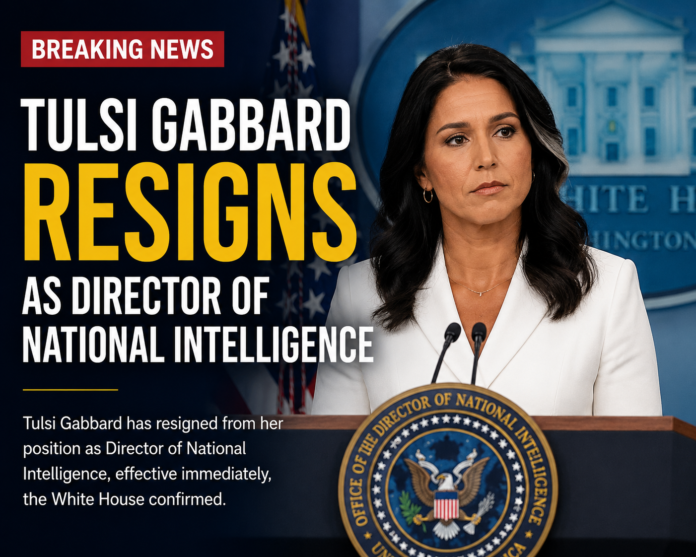
Tulsi Gabbard, the nation’s top intelligence official, has announced her resignation from the Trump administration, citing her husband’s diagnosis with a rare and aggressive form of bone cancer. Her departure, effective June 30, comes after a turbulent tenure marked by congressional friction, internal White House tensions, and a sweeping restructuring of the intelligence community. The exit leaves a significant leadership vacancy at one of the most sensitive positions in the U.S. national security apparatus at a critical moment in the Iran conflict.
Story Highlights
- Gabbard announced her resignation on Friday, stating her husband Abraham Williams was diagnosed with an extremely rare form of bone cancer
- Her last day as Director of National Intelligence will be June 30, with Aaron Lukas stepping in as acting director
- Gabbard’s tenure included overseeing significant downsizing at ODNI and persistent friction with congressional lawmakers throughout her time in the role
What Happened
Tulsi Gabbard informed President Trump in a resignation letter on Friday that she would be leaving the administration, effective June 30. She posted the letter publicly on X, writing that her husband, Abraham Williams, had been diagnosed with “an extremely rare form of bone cancer” and that she must “step away from public service to be by his side and fully support him through this battle.” The letter was delivered in person during a meeting with Trump in the Oval Office, according to a source familiar with the exchange.
President Donald Trump responded on Truth Social, writing that Gabbard had done “an incredible job” and expressing confidence that Williams would recover. He confirmed that Aaron Lukas, the principal deputy director of national intelligence, would assume the role of acting director upon Gabbard’s departure. Trump also hinted at underlying tensions, noting that Gabbard may have held differing views from him on aspects of the Iran war.
- Gabbard had been denying she was leaving the administration as recently as two weeks before her resignation announcement
- White House officials had heard rumors of her potential departure in the weeks leading up to Friday’s announcement
- Her tenure began on February 12, 2025, making her time in the role approximately 16 months
- She oversaw a significant restructuring and downsizing of ODNI, in line with the administration’s broader push to reduce federal agency size
- In April 2026, reports surfaced that Trump had been privately polling Cabinet members on whether Gabbard should be replaced following her Iran war testimony
Why It Matters
The Director of National Intelligence oversees the coordination of 18 intelligence agencies, including the CIA, the NSA, and the Defense Intelligence Agency. Leadership transitions at ODNI during an active military conflict and sensitive peace negotiations introduce genuine uncertainty into the chain of command for national security assessments. With U.S.-Iran ceasefire talks at a delicate stage, the quality and continuity of intelligence analysis has direct implications for the outcome of those negotiations.
Gabbard’s departure also reignites questions about the administration’s broader management of the intelligence community. Critics have argued that the downsizing of ODNI under her leadership weakened the community’s analytical depth, while supporters contend the reforms removed bureaucratic inefficiency. Her exit leaves the administration without one of its most prominent crossover figures — a former Democrat who became a symbol of Trump’s appeal beyond traditional Republican coalitions.
- Any permanent replacement will require Senate confirmation, a process likely to be contentious given existing tensions between the White House and Republican senators
- Democrats are expected to use any confirmation hearings to scrutinize how the intelligence community has been managed during the Iran conflict
- Career intelligence professionals face a period of organizational uncertainty as Lukas navigates the transition in a caretaker capacity
Economic and Global Context
While ODNI is not an economic agency, the effectiveness of the intelligence community has direct consequences for national security decisions that carry significant economic weight. Intelligence gaps or miscalculations during active military conflicts can escalate hostilities, extend wars, and deepen market instability — all of which have measurable economic consequences for American consumers and global markets. The ongoing Iran conflict has already contributed to elevated oil prices and disrupted global shipping, and accurate intelligence assessments will shape the final terms of any peace agreement.
The transition also coincides with the administration managing multiple high-stakes foreign policy challenges simultaneously, including the Iran negotiations, Indo-Pacific tensions, and ongoing concerns about Chinese military activity. Each of these situations requires robust intelligence coordination at the highest levels of government. Adversaries and allies alike monitor leadership transitions at ODNI as signals of American institutional stability and continuity.
- A prolonged vacancy or contentious confirmation fight could create a window of perceived weakness that foreign intelligence services would seek to exploit
- The intelligence community’s credibility with congressional oversight committees — already strained under Gabbard — will be a key factor in any nominee’s confirmation prospects
- Markets have so far not reacted sharply to the news, but sustained leadership uncertainty at ODNI during active hostilities is a risk factor that analysts are monitoring
Implications
The elevation of Aaron Lukas to acting director provides immediate continuity, but acting directors carry less institutional authority than Senate-confirmed officials and are generally regarded as caretakers. In the middle of an active conflict and delicate peace negotiations, the distinction between a confirmed cabinet-level intelligence chief and a caretaker matters in terms of both internal agency authority and external diplomatic signaling. The White House will need to move quickly to identify and nominate a permanent replacement.
For the Trump administration, the nomination process will be a significant political test, requiring a candidate who balances loyalty to the president with the technical credibility needed to survive a Senate confirmation. For Democratic lawmakers, Gabbard’s departure creates an opportunity to demand a full accounting of how the intelligence community has been restructured and whether those changes have compromised national security capabilities. For Republican senators already at odds with the White House over the anti-weaponization fund and immigration spending, adding a contentious ODNI confirmation to the legislative calendar adds further pressure to an already strained relationship.
- The nomination battle could become a proxy fight over the administration’s overall approach to the intelligence community
- If the White House selects another loyalist without traditional intelligence credentials, it should expect the same fierce confirmation resistance Gabbard herself faced in early 2025
- The June 30 effective date gives the administration approximately five weeks to manage the transition before Lukas formally assumes acting authority
Sources
- Tulsi Gabbard Is Resigning as Director of National Intelligence — CNN
- Tulsi Gabbard Resigns as Director of National Intelligence — Axios
- Gabbard Resigns as National Intelligence Director Citing Husband’s Cancer Diagnosis — NPR
- Tulsi Gabbard Resigns as Trump’s Top U.S. Intelligence Official — NBC News
- Tulsi Gabbard Resigns as Trump’s Top US Intelligence Official — Al Jazeera