Signed into law on Independence Day 2025 after a dramatic, overnight congressional battle, President Trump’s “One Big Beautiful Bill Act” stands as one of the most consequential pieces of domestic legislation in decades — and its effects on American families, federal programs, and the national debt are now coming into sharp relief. The 800-plus-page law extended $4.5 trillion in tax cuts, reshaped Medicaid, supercharged military and border spending, and added an estimated $3.4 trillion to the national deficit over ten years according to the Congressional Budget Office. As the country lives with the law’s provisions in the months since its enactment, its political and economic consequences are defining the landscape ahead of the 2026 midterms.
Story Highlights
- The One Big Beautiful Bill Act passed the House 218-214 and the Senate 51-50, with Vice President JD Vance casting the tie-breaking vote, before being signed by Trump on July 4, 2025.
- The CBO estimates the law will increase the national deficit by $3.4 trillion over ten years, while independent analysts note its tax benefits are heavily skewed toward higher-income Americans.
- Key provisions include extensions of 2017 tax cuts, elimination of taxes on tips and overtime, Medicaid restructuring, and increased military and border security spending.
What Happened
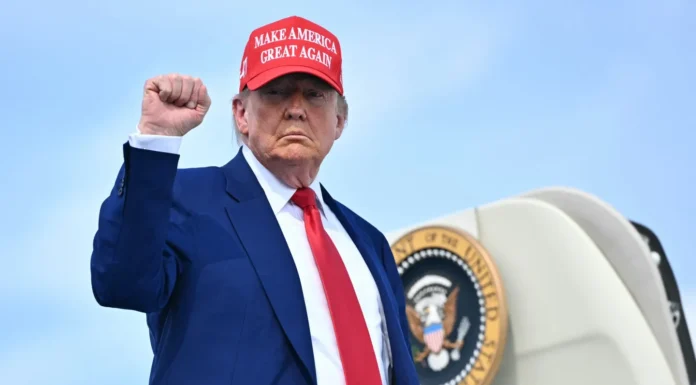
President Donald Trump signed the One Big Beautiful Bill Act into law on July 4, 2025, fulfilling one of his central second-term legislative promises after one of the most turbulent congressional sessions in recent memory. The bill passed the House of Representatives by the narrowest of margins — 218 to 214 — with two Republicans joining all Democrats in opposition. The Senate had passed its version 51-50, with Vice President JD Vance casting the decisive tie-breaking vote after an all-night “vote-a-rama” of amendments and procedural battles.
Speaker Mike Johnson navigated a fractious Republican conference, working alongside White House Cabinet secretaries and the president himself to bring skeptical lawmakers on board in the final hours before the July 4 deadline Trump had publicly set for passage. Members of the conservative House Freedom Caucus met with White House officials in the days before the final vote, and several announced their support only after being assured on specific provisions related to Medicaid and fiscal spending levels.
The bill’s core priorities were the extension of the 2017 Tax Cuts and Jobs Act provisions that were set to expire, along with a series of new tax benefits including the elimination of federal taxes on tips and overtime pay for workers, and a $6,000 annual deduction for most older Americans earning under $75,000 per year. These provisions were designed to deliver tangible, visible benefits to working-class and middle-income voters who form a key part of Trump’s political coalition.
To partially offset the cost of those tax cuts, the bill made significant reductions to social programs, most controversially to Medicaid. Senator Josh Hawley of Missouri and other Republican moderates had made Medicaid cuts their stated line in the sand during Senate deliberations, but the final bill incorporated changes that ultimately held enough of the conference together. Senator Rand Paul pushed for deeper spending cuts than the bill contained and remained a dissenting voice throughout the process.
Senate Budget Committee Chairman Lindsey Graham summarized the legislative challenge memorably, describing the bill as “a jigsaw puzzle with 3,000 pieces and no picture.” The law also sharply increased spending on military readiness and border security infrastructure, reflecting the administration’s top executive priorities and providing fiscal conservatives with political cover to vote in favor of the overall package.
Why It Matters
The law’s passage represents the most significant reshaping of federal tax and spending policy since the Affordable Care Act in 2010, and its political consequences are already evident. Democrats, unified in opposition, are running on the law’s Medicaid provisions as a central campaign issue heading into the 2026 midterm elections. Independent analysis from the Institute on Taxation and Economic Policy found that the bill’s tax benefits are heavily concentrated among higher-income Americans, a finding that has given Democrats a clear economic contrast message.
For working Americans, the immediate benefits are tangible: no federal income tax on tips has been celebrated by service industry workers, and the overtime exemption has resonated with hourly wage earners in manufacturing, logistics, and healthcare. Whether those benefits will outweigh the eventual costs of the law’s deficit financing — and the service reductions embedded in Medicaid restructuring — is a debate that will play out over years.
The Medicaid changes represent the law’s most consequential and contested domestic policy shift. Hundreds of thousands of low-income Americans may see their coverage conditions change under the restructured program, and states — particularly those with large Medicaid populations — are already grappling with how to implement the federal changes. New Hampshire officials, for example, have flagged concerns that new federal Medicaid laws may contradict existing state law, a legal tension that is being replicated in multiple states.
The CBO’s estimate of $3.4 trillion in additional deficit spending over a decade is a number that fiscal conservatives are struggling to reconcile with their stated commitment to balanced budgets. The law’s supporters argue that economic growth spurred by the tax cuts will generate revenue that narrows the gap — a supply-side argument that the CBO’s scoring methodology does not accept, contributing to a longstanding methodological dispute between the administration and the nonpartisan budget office.
Economic and Global Context
The macroeconomic effects of the law are now beginning to register in data. Consumer spending has remained relatively resilient in the months since passage, buoyed in part by the tip and overtime tax provisions that effectively delivered a take-home pay increase to a significant portion of the service sector workforce. Economists are divided on whether this represents a genuine demand boost or a short-term consumption pull-forward financed by future deficit obligations.
Bond markets have been paying close attention. The prospect of $3.4 trillion in additional deficit spending over ten years has kept upward pressure on long-term Treasury yields, complicating the Federal Reserve’s efforts to manage inflation and interest rate policy. Higher yields have, in turn, raised borrowing costs for mortgages, business loans, and consumer credit — a headwind to growth that partially offsets the law’s stimulus effect.
Globally, the law’s energy provisions have drawn attention from international partners. The repeal of the Biden-era methane tax and the opening of additional federal lands to oil and gas development were welcomed by domestic energy producers, who have ramped up production forecasts. International oil markets have incorporated those supply expectations into pricing models, though the broader Iran conflict and Strait of Hormuz disruptions have complicated any clear read on U.S. energy policy’s global price impact.
Implications
The law is now the dominant frame for the 2026 midterm election cycle. Republicans are running on the tip tax elimination, the overtime provision, and the military and border spending increases. Democrats are running against the Medicaid cuts and the CBO deficit projections, arguing that the law delivers for the wealthy at the expense of the vulnerable. Polling suggests the electorate is genuinely divided, with individual provisions polling better than the overall package — a dynamic that makes predicting its electoral impact unusually difficult.
For businesses, the extension of the 2017 tax rates provides the planning certainty they have sought for years. The 2017 provisions were always intended as temporary, and their expiration would have triggered meaningful tax increases for corporations and pass-through business owners. That certainty is now locked in, allowing businesses to make longer-term investment and hiring decisions with more predictable tax liability.
The law’s FAA investment provision — a $12.5 billion allocation to modernize air traffic control facilities, systems, and infrastructure — represents one of its most bipartisan-palatable elements, addressing a genuine public safety need that has received widespread attention following several near-miss incidents at major U.S. airports. Implementation of that provision is already underway.
What remains unresolved is the law’s long-term fiscal trajectory. If growth materializes as the administration projects, the deficit math becomes more manageable. If growth disappoints and interest rates remain elevated, the compounding cost of $3.4 trillion in new deficit spending will become an increasingly pressing political liability — one that future Congresses, regardless of which party controls them, will be forced to confront.
Source
Trump on Fourth of July signs ‘One Big Beautiful Bill’ to implement his agenda