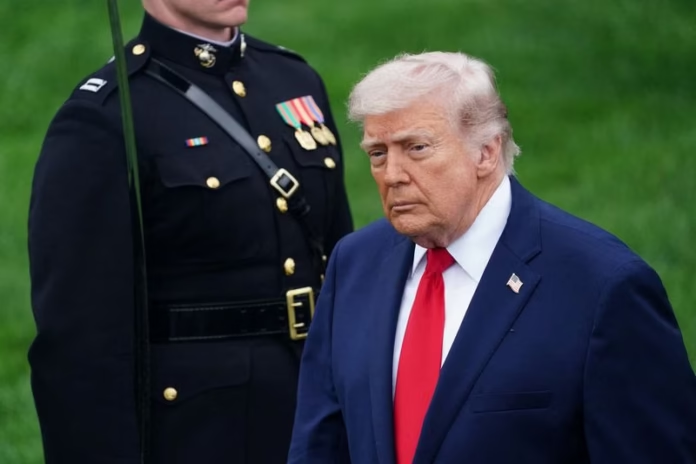
A cascade of new polling data released in mid-to-late May 2026 shows President Donald Trump’s approval rating at its lowest sustained levels since returning to the White House, driven by voter frustration over the ongoing war with Iran and rising costs for fuel, food, and everyday goods. Multiple major pollsters have confirmed the trend, with a New York Times/Siena College survey finding 59 percent of registered voters disapproving of Trump’s job performance — the highest figure that survey has recorded. As the 2026 midterm elections come into clearer view, the polling data is generating serious concern inside Republican congressional campaigns.
Story Highlights
- A Pew Research Center survey conducted in late April found Trump’s approval at 34 percent, the lowest of his second term, with disapproval reaching 64 percent
- A New York Times/Siena College poll found 59 percent of registered voters disapproving, and 50 percent saying they would vote Democratic in their House district if an election were held today
- Trump’s own 2024 voters show declining approval, with support among that group falling to 76 percent — down 6 points from before the Iran conflict began
What Happened
A cluster of major national surveys released between May 11 and May 18, 2026, documented what analysts are describing as a broad and sustained erosion in President Donald Trump‘s public standing, driven by two overlapping crises: the Iran war that began on February 28, and an economic environment in which inflation has re-accelerated following the conflict’s disruption of global oil markets.
The Pew Research Center’s survey, conducted April 20 through April 26 and covering 3,589 adults, found Trump’s approval at 34 percent — the lowest recorded in his second term. Disapproval stood at 64 percent in the same survey, a swing from the low 50s at the start of the year. The decline accelerated sharply after the United States and Israel launched coordinated strikes on Iran in late February, triggering a sustained rise in fuel prices and a broader consumer confidence slump.
The New York Times/Siena College poll, surveying 1,507 registered voters, found that 59 percent disapprove of Trump’s job performance. In the same poll, 50 percent of respondents said they would vote for the Democratic candidate in their congressional district if an election were held today, compared to approximately 42 percent who said they would vote Republican. That nine-point Democratic advantage on the generic congressional ballot is a warning sign for a party already managing difficult midterm mathematics.
The Silver Bulletin polling average, which aggregates multiple surveys, placed Trump’s net approval at -18.9 among registered voters and -20.6 among all adults as of May 17. Among issue-specific ratings, the numbers were more severe: -21.3 net approval on economic handling, and -32.7 on inflation specifically. The AP/NORC poll, conducted May 14 through May 18, found that 37 percent of Republicans now disapprove of Trump’s economic handling — the highest dissatisfaction level recorded within the president’s own party.
Why It Matters
The polling data matters because it represents not just a decline in Trump’s personal standing but a potential structural shift in the political environment heading into the November midterms. Historically, a president’s approval rating is one of the strongest predictors of his party’s midterm performance. Sustained approval below 40 percent has, in past cycles, translated into significant congressional seat losses for the president’s party.
For Republican incumbents, particularly in competitive districts, the data creates a difficult choice. Running closely aligned with Trump has been the dominant electoral strategy for the party since 2016, and it has generally worked. But a president with a 34 percent approval rating and a -32.7 net rating on inflation is not the asset he was in 2024. Candidates who try to distance themselves risk angering the MAGA base; those who embrace him fully inherit his liabilities with independent and moderate voters.
Among independent voters specifically, Trump’s approval has fallen to 22 percent in the YouGov/Economist survey — an extraordinary level of weakness with the voter group that typically determines competitive elections. Independents were decisive in Trump’s 2024 victory, and their near-total abandonment of the president on current economic and foreign policy issues is a severe warning sign for Republican general election prospects.
The Iran war is the single largest driver of the decline, but the economic consequences of the war compound the damage. When the primary driver of a president’s approval collapse is the issue he campaigned on most aggressively — economic competence and cost-of-living relief — the political vulnerability becomes particularly acute. That dynamic is precisely what several Republican strategists have publicly flagged.
Economic and Global Context
The economic backdrop underlying the polling decline is straightforward. The United States and Israeli strikes on Iran in late February closed the Strait of Hormuz, through which a substantial share of global oil trade flows. Gasoline prices at the pump climbed above four dollars per gallon — the first time that level had been reached since 2022 — within weeks of the conflict’s start. Food prices, already elevated by post-pandemic supply chain pressures, have continued to rise as transportation and logistics costs feed through to consumer goods.
The Federal Reserve has faced difficult choices in this environment. An oil-driven inflation spike complicates the path to rate cuts, even as economic growth shows signs of weakening under the weight of elevated energy costs. Financial markets reflected the uncertainty, with equities falling to the lowest levels of the year in the weeks following the Iran strikes, before partially recovering. The stock market’s behavior has further damaged consumer confidence among the upper-middle-income households that tend to be closely attuned to portfolio performance.
Globally, the conflict has strained relationships with allies who depend on stable energy markets. European governments have pressed Washington to move toward a resolution. Gulf states with economies deeply tied to Strait of Hormuz passage have a direct economic interest in the negotiations concluding quickly. The combination of geopolitical uncertainty and energy market disruption has made the Iran conflict a truly global economic event, not merely a regional military one.
Implications
The sustained decline in Trump’s approval numbers has immediate and longer-term implications for multiple constituencies. For Republican congressional candidates, the most pressing concern is whether the political environment will improve enough before November to avoid substantial seat losses. If the Iran war resolves favorably and fuel prices fall, Republican candidates could regain ground quickly. If the conflict drags on or a deal collapses, the environment could worsen further.
For Trump personally, the polling erosion reduces his leverage in several ongoing political and policy fights. A president at 34 percent approval commands less fear from congressional Republicans who are calculating their own electoral interests. That dynamic could complicate his ability to enforce party discipline on votes related to Iran war funding, immigration spending, and other second-term priorities.
For the Democratic Party, the data presents an opportunity but not a guarantee. Generic ballot advantages and presidential approval ratings do not automatically translate into seat gains, particularly given the structural advantages Republicans have accumulated through redistricting. Democrats will need to recruit strong candidates, build effective fundraising operations in competitive districts, and sustain voter enthusiasm through an election cycle that is still several months away.
American voters broadly are sending a consistent signal through the polls: concern about economic conditions and skepticism about the Iran war are dominating their assessments of the administration. How Trump and his allies respond to those concerns — through policy, messaging, or the outcome of the Iran negotiations themselves — will define the political trajectory of the remainder of his second term.