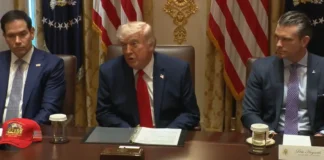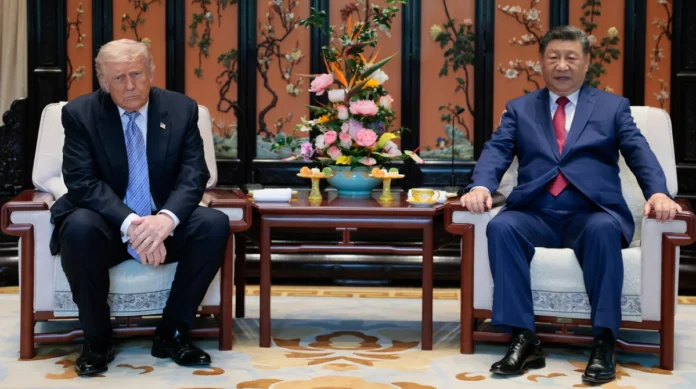
President Donald Trump returned from a two-day summit in Beijing with Chinese President Xi Jinping this week having secured only modest gains, leaving key issues including Iran, Taiwan, and Nvidia chip exports largely unresolved. The visit, which brought together a delegation of top American CEOs, was expected to deliver transformative deals but yielded little beyond a Boeing aircraft purchase and a commitment to stabilize relations. For Americans watching closely, the outcome raises questions about the administration’s leverage in managing the world’s most consequential bilateral relationship.
Story Highlights
- China agreed to purchase 200 Boeing jets, far short of the 500 Trump had floated — Boeing shares fell 4% following the announcement
- No breakthrough was reached on Nvidia chip sales to China, despite CEO Jensen Huang’s last-minute addition to the delegation
- Both sides committed to a framework of “constructive strategic stability” and agreed to preserve the existing trade truce
What Happened
Donald Trump got the pageantry he craved during his trip to China, but the president concluded the summit largely where he began, receiving little help from his self-described “friend” Xi Jinping in dealing with a messy war in Iran and a challenging political climate at home. The two-day meeting in Beijing on May 14 and 15 was structured around grand ceremony and warm displays of diplomacy, with Xi welcoming Trump with military honors, flag-waving children, and a gift of rose seeds.
In the run-up to the summit, Trump gave the impression that, with his large entourage of top American CEOs, he would bring home major contracts for the American economy. But that wasn’t the case. The most visible deal reached was a Boeing aircraft order. Although Xi agreed to purchase 200 Boeing jets, that number was much lower than the 500 Trump had floated before. Consequently, investors in the US were disappointed, with Boeing shares falling 4% on Wall Street.
On a positive note, both sides agreed to work to preserve and extend the fragile trade truce reached after the tariff war of last year. They discussed mechanisms to manage future tariff disputes and export controls rather than allowing tensions to escalate immediately. On the geopolitical front, both governments agreed that the Strait of Hormuz must remain open, a matter of urgent shared concern given the ongoing US-Iran conflict.
Trump also called for continued efforts from Beijing to curb fentanyl flows into the US and ramp up purchases of American agricultural goods, according to a White House official. The two sides also discussed the Middle East conflict, the crisis in Ukraine, and the Korean Peninsula. On Iran, Trump said Xi told him he would “like to be of help,” but no firm commitments from Beijing materialized on forcing Tehran toward a nuclear deal.
According to US officials, both sides had agreed to sell farm goods, but only scant details were available, and there were no signs of a breakthrough on selling Nvidia chips to China, despite CEO Jensen Huang’s dramatic last-minute addition to the trip. The absence of a technology deal was particularly notable given how much attention it had received in advance.
Why It Matters
The summit’s underwhelming outcome carries significant implications for how Americans should understand the administration’s foreign policy capabilities. Trump had campaigned aggressively on his dealmaking credentials and his personal rapport with Xi, promising that his approach to China would yield stronger results than prior administrations. The Beijing meeting tested that premise directly and returned a mixed verdict.
From a US perspective, the immediate outcome of the summit was meagre: no grand breakthrough, but a mere stabilization of relations and a broad effort to prevent the superpower rivalry from spiralling further out of control. That may represent a diplomatic floor rather than a ceiling, but it falls well short of the transformative agreements the White House suggested were within reach.
The Iran dimension of the summit is especially consequential for American policymakers. The administration had hoped that Beijing, which maintains close economic ties with Tehran, would apply pressure on Iran to accelerate nuclear negotiations. That leverage did not translate into visible results. The ceasefire between the US and Iran remained fragile heading into the summit, and no mechanism for Chinese mediation was publicly announced coming out of it.
For American businesses, the summit’s thin yield on technology and market access is also meaningful. The failure to advance Nvidia chip sales denies a major US semiconductor company access to one of the world’s largest markets, affecting shareholders, supply chains, and the broader competitiveness argument that the administration has made about tech trade with China.
Economic and Global Context
The summit took place against a backdrop of enormous economic pressure. The US-Iran war, now in its eleventh week, has kept global oil prices elevated, with Brent crude trading near $106 per barrel — roughly $20 higher than pre-war levels. That price spike has ripple effects throughout the American and global economies, raising transportation costs, consumer goods prices, and inflationary pressures.
The trade truce between the US and China, preserved through the summit, remains a stabilizing factor for markets. All actions taken by both sides remain reversible; either side can resume or implement tariffs, rules, and investigations, or reduce market access. Some actions snap back, expire, or require reinstatement in late 2026, thereby setting a deadline to reassess progress. That built-in expiration means the economic calm is conditional and temporary.
For European leaders nervously watching the summit, the underwhelming outcome should be a reason for relief, as nothing was said that would sideline the EU economically. European allies had been concerned that a sweeping US-China deal could come at their expense, particularly on technology standards or trade preferences.
Boeing’s stock decline following the summit illustrates how tightly financial markets were watching for concrete deliverables. A 200-jet order, while meaningful in absolute terms, disappointed expectations that had been built up by pre-summit signaling. Defense and aerospace investors will now be recalibrating their assumptions about how much market access to China the Trump administration can actually unlock.
Implications
The summit’s limited results set up a critical second half of 2026 for US-China relations. China has generally followed through on some easily verifiable action items from the prior Busan meeting, such as suspending certain rules or purchasing US products. Its implementation of other outcomes, however, has lagged. The same pattern may emerge from Beijing commitments made this week, particularly on fentanyl precursor controls and agricultural purchases.
For Trump politically, the optics carry risks heading into the 2026 midterms. Voters who supported him in part based on his promised toughness toward China may take note that the summit produced ceremony over substance. Democrats are already moving to frame foreign policy outcomes as part of a broader narrative about the administration’s effectiveness.
On Taiwan, the silence was conspicuous. The other big geopolitical issue, central to Chinese politics, is Taiwan — a topic that the American readout of the talks didn’t mention at all. That omission will be interpreted carefully by Taipei, by US allies in the Indo-Pacific, and by defense analysts watching for any softening of the American commitment to Taiwan.
Looking ahead, the trade truce remains the most durable outcome of the meeting. Both sides have economic incentives to maintain it. But absent a resolution to the Iran conflict, a reopening of the Strait of Hormuz, and progress on technology access, the structural tensions between Washington and Beijing are likely to resurface well before the end of Trump’s term.
Source
Underwhelming summit outcome in China brings Trump back to reality