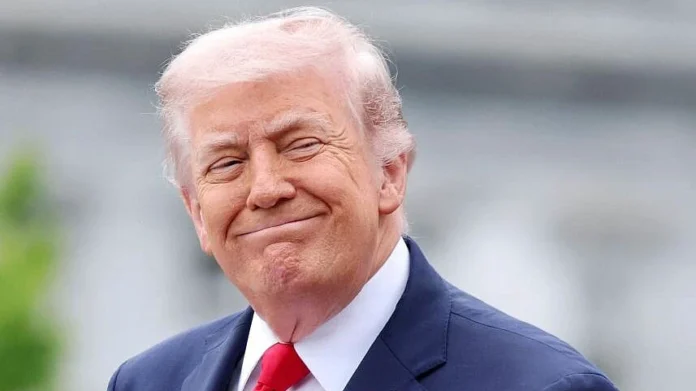
A comprehensive new Pew Research Center survey released in early May shows President Donald Trump’s approval rating has declined significantly across nearly every measured dimension since his second term began, including among his own 2024 voters. With the Iran war dragging on, energy prices elevated, and domestic economic pressures intensifying, Trump enters a critical stretch of his presidency from a position of measurably weakened public support.
Story Highlights
- Trump’s overall approval rating now averages between 37 and 40 percent, down from 47 percent at the start of his second term, according to aggregated polling data.
- Among his own 2024 voters, Trump’s approval has fallen to 78 percent, down from 95 percent in the early days of his term — a 17-point drop.
- His approval rating among Hispanic voters who voted for him in 2024 has declined 27 points since the beginning of his second term.
What Happened
The Pew Research Center conducted a survey of 5,103 U.S. adults between April 20 and April 26, 2026, as part of its ongoing American Trends Panel. The results, released publicly in early May, paint a detailed picture of how Trump’s standing has shifted across demographic groups, policy areas, and personal characteristics since he returned to office in January 2025.
On his overall job performance, just 5 percent of Democrats and Democratic-leaning independents approve of Trump, a figure that has remained essentially flat throughout his term. The more significant finding is the erosion among Republicans. Among all Republicans and Republican-leaning independents, 68 percent currently approve of the way Trump is handling his job — down from 73 percent in January. Among 2024 Trump voters specifically, approval has fallen to 78 percent, a striking drop from the 95 percent who backed him in the earliest weeks of his second term.
Confidence in Trump across specific policy domains has also declined. Only 41 percent of Americans say they are confident in Trump’s ability to make good decisions on immigration policy, down from 53 percent immediately after his 2024 reelection. Confidence in his use of military force wisely stands at 38 percent, an 8-point drop from the prior summer. Confidence in his handling of economic policy has held relatively steadier at 42 percent, a modest decline from 44 percent. The Pew survey also found that 56 percent of Americans say the overall level of ethics and honesty in the federal government has fallen during Trump’s current term, while only 19 percent say it has improved.
The sharpest demographic decline is among Hispanic voters who supported Trump in 2024. Their approval of his job performance has fallen 27 points since early 2025, compared with a 14-point decline among white Trump voters. Trump made notable inroads with Hispanic voters during his 2024 campaign, and the erosion of that coalition has implications for Republican electoral prospects going into the 2026 midterms.
Why It Matters
Presidential approval ratings are not merely abstract political metrics — they shape legislative leverage, negotiating power with allies and adversaries, and the broader political environment entering an election cycle. A president hovering in the upper thirties in approval lacks the political capital to push through major legislation, extract concessions from foreign governments, or shield congressional allies from electoral backlash. For Trump, whose second-term agenda has been ambitious and far-reaching, declining public support represents a genuine constraint.
The midterm elections in November 2026 are now the most consequential near-term political event in American politics. Democrats need a relatively modest number of seats to retake the House of Representatives, and they are aggressively targeting vulnerable Republicans in districts where Trump’s handling of the Iran war, healthcare cuts, and economic policy are most unpopular. Trump’s approval decline among his own voters — particularly Hispanics — is a warning sign for the party’s ability to defend its slim congressional margins.
The policy-specific approval numbers reveal where the greatest vulnerabilities lie. Immigration was the signature issue that returned Trump to the White House, and the fact that confidence in his immigration approach has declined from 53 to 41 percent since his reelection is significant. Experts like Todd Belt, director of the Political Management Program at George Washington University, note that while most Americans support strict border enforcement in principle, the methods Trump has employed — including controversial deportations and confrontations with state and local governments — have generated substantial backlash even among previous supporters.
The ethics dimension is particularly notable. When 56 percent of Americans say federal ethics and honesty have declined under Trump’s current watch — up from the 47 percent who predicted that outcome at the start of his term — it represents a widening gap between Trump’s self-presentation and public perception. This is a metric that tends to be sticky and hard to reverse without significant changes in personnel or policy direction.
Economic and Global Context
Trump’s approval numbers are closely tied to economic conditions, and the economic picture entering mid-May 2026 is mixed at best. The U.S. economy contracted in the first quarter of 2026, weighed down in part by a surge in imports as businesses raced to avoid tariff costs. The Iran war has pushed oil prices above $100 a barrel, feeding inflation that has already worn down consumer confidence. The administration projects a return to growth as tariff revenues flow in and business investment recovers, but voters are experiencing the costs now and the promised benefits later.
The Moody’s credit rating downgrade in May 2025 — which removed the United States from its last remaining top-tier AAA status at any major ratings agency — has lingered as a symbol of fiscal deterioration. Moody’s projected the federal deficit could reach nearly 9 percent of GDP by 2035, driven by the extended Trump tax cuts, rising entitlement costs, and mounting interest payments. The administration dismissed the downgrade, but financial markets took note. Treasury yields rose following the announcement, raising borrowing costs across the economy.
Internationally, the combination of the Iran war, trade tensions with China, and strained NATO relations has created an environment of uncertainty that affects business investment and diplomatic posture. U.S. allies in Europe and Asia are reassessing their dependence on American guarantees, while adversaries are probing for opportunities in the gaps created by U.S. distraction and strategic overextension.
Implications
The political consequences of Trump’s declining approval will unfold most visibly in the 2026 midterm campaigns. Democrats have already announced plans to campaign intensively on the One Big Beautiful Bill’s Medicaid and SNAP cuts, the Iran war’s economic costs, and concerns about federal government ethics. If Trump’s approval remains below 40 percent entering the fall campaign season, the structural headwinds for House Republicans become severe.
For the White House, the challenge is to produce visible wins — a ceasefire agreement with Iran, a trade deal with China, a strengthening economy — before the campaign season fully takes hold in summer and fall 2026. The Beijing summit this week is one such opportunity. A successful summit that generates headline-worthy trade commitments and diplomatic momentum could provide a short-term approval boost.
Among Republican lawmakers, the approval trend creates an uncomfortable calculation. Members in competitive districts cannot afford to be closely associated with an unpopular president on unpopular votes. The tension between loyalty to Trump and political survival will define intraparty dynamics through the midterms.
Source
Trump Loses Ground on Several Personal Traits as Approval Rating Slips