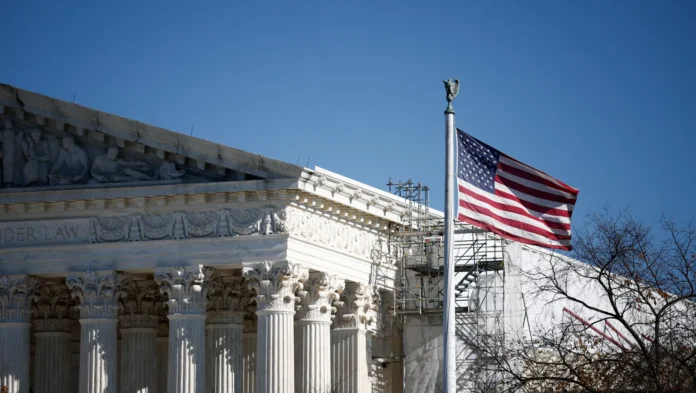
A landmark Supreme Court ruling has set off a redistricting firestorm across the South, with President Trump publicly urging Republican-led states to redraw congressional maps before November’s midterm elections — even in states where early voting has already begun. The decision in Louisiana v. Callais, handed down April 29, significantly narrowed the Voting Rights Act and created an opening for Republicans to redraw maps favorable to their party in multiple southern states. Trump has made his intentions explicit, framing the redistricting push as a direct path to Republican electoral dominance.
Story Highlights
- The Supreme Court’s ruling in Louisiana v. Callais struck down Louisiana’s congressional map with two majority-Black districts as an unconstitutional racial gerrymander
- Republican-controlled states including Tennessee, Alabama, Mississippi, Georgia, and South Carolina are weighing or pursuing special legislative sessions to redraw maps
- Trump has publicly acknowledged the partisan motivation behind the effort, predicting it could yield more than 20 additional Republican House seats
What Happened
The U.S. Supreme Court handed down a 6-3 ruling on April 29 in Louisiana v. Callais, holding that Louisiana’s congressional map — which contained two majority-Black districts — constituted an unconstitutional racial gerrymander under the Equal Protection Clause of the 14th Amendment. Justice Samuel Alito wrote the majority opinion, finding that states are not required to maximize minority electoral opportunity and that doing so through deliberate race-based line-drawing violates constitutional protections. Justice Elena Kagan authored the dissent.
The ruling effectively narrowed Section 2 of the Voting Rights Act, which had long been used to challenge maps that diluted minority voting power. Under the court’s new standard, a redistricting plan only runs afoul of the VRA if a state “intentionally drew its districts to afford minority voters less opportunity because of their race.” That is a substantially higher bar than previous interpretations and gives Republican-led states far more latitude to draw district lines for partisan advantage.
Trump moved quickly. On his Truth Social platform, he called on states — including those that had already begun primary voting — to immediately redraw their maps. “That is more important than administrative convenience,” Trump wrote, adding that the changes would deliver Republicans more than 20 additional House seats in the midterms. In a separate post, he wrote that a combination of redistricting and changes to voting procedures would make it “impossible to lose an election.”
In Tennessee, Governor Bill Lee called a special legislative session and said the state would “ensure our congressional districts accurately reflect the will of Tennessee voters.” Trump confirmed he had spoken to Lee and praised the decision. The redistricting push in Tennessee puts at risk the seat of Representative Steve Cohen, the state’s only Democratic congressman. Mississippi Governor Tate Reeves announced a special session would follow within 21 days of the Louisiana ruling. Louisiana itself suspended its May 16 House primaries to allow time for a new map to be drawn, even as some ballots had already been mailed.
Why It Matters
The redistricting push has introduced profound uncertainty into the 2026 midterm elections. Louisiana suspended its House primaries, Tennessee is convening emergency sessions, and other states are weighing similar moves. Election officials have warned that redrawing maps at this stage of the election cycle — with primaries already underway in some states — creates logistical chaos and threatens to disenfranchise voters who have already cast ballots. “In the partisan war that we are facing that the Supreme Court just inflamed, the parties caught in the middle are the election officials and the voters,” said one election law expert cited by CNN.
Trump’s public framing of the effort in partisan terms is unusual even by the standards of American political hardball. Both parties gerrymander when given the opportunity, but presidents and legislators rarely announce that their goal is specifically to maximize electoral advantage at the expense of the opposing party. Trump has done so repeatedly — on redistricting, on voter ID requirements, on eliminating mail ballots, and on abolishing the Senate filibuster. Critics argue this transparency about intent could be used against the effort in court challenges, where proof of partisan motivation can complicate legal defenses.
For Black voters in the South, the ruling carries significant consequences. Congressional districts that had been specifically constructed to give Black communities electoral representation — districts that sent Black representatives to Congress for years — are now subject to dismantlement. In Tennessee, Cohen’s district includes a large portion of the Memphis metropolitan area. In Louisiana, Representative Cleo Fields, a Democrat whose district was at the center of the Supreme Court’s opinion, called the Republican response to the ruling a direct assault on the political power of Black Louisianans.
The long-term political calculus is complex. Analysts from the Brookings Institution caution that breaking up majority-minority districts does not guarantee easy Republican gains, since displaced Democratic voters are redistributed into surrounding districts, potentially making previously safe Republican seats more competitive. In a political environment where Democratic enthusiasm is surging and Trump’s approval is declining, that tradeoff could backfire badly.
Economic and Global Context
The redistricting battle does not exist in an economic vacuum. Trump’s push to reshape the electoral landscape comes as his administration contends with some of the most challenging economic conditions of his second term. Gas prices have risen sharply due to the Iran war, inflation remains a persistent concern for households, and consumer confidence has weakened. These dynamics are fueling Democratic enthusiasm heading into November and creating political pressure on Republicans in even nominally safe districts.
A CBS News analysis found that in a best-case scenario for Republicans, redistricting across several southern states could yield between one and nine additional GOP-friendly seats for the 2026 cycle. That number could grow for 2028 if more states redraw lines following the ruling. But analysts note that the political environment — specifically Trump’s declining approval ratings and the typical advantage that the party out of power enjoys in midterm elections — could offset much of that structural gain.
The mid-decade redistricting cycle that began in Texas in 2025 sparked a Democratic counter-response in California and Virginia, where voters approved new maps drawn to favor Democrats. New Jersey’s governor has signaled openness to a similar move, though the state legislature has said redistricting is not currently a priority. The result is a national arms race in map-drawing that experts warn will deepen partisanship and reduce the number of competitive congressional districts for years to come.
Implications
For Republican strategists, the Supreme Court’s ruling is an opportunity to extend their structural House majority beyond what normal electoral dynamics would support. Whether that opportunity translates into actual gains before November depends on how quickly states can draw and legally defend new maps. Courts have already blocked some earlier redistricting efforts, and new challenges are certain to emerge from Tuesday’s decisions.
For Democrats, the challenge is simultaneously legal, political, and organizational. Voting rights groups are already filing motions to block implementation of new maps. The party is also hoping that Democratic voter enthusiasm — which has already produced surges in primary turnout in states from Illinois to Mississippi — is sufficient to overcome structural disadvantages imposed by redrawn lines. Early voting data from Ohio ahead of Tuesday’s primaries showed Democrats outvoting Republicans by roughly 11 percent, a signal of energized base turnout.
For voters, particularly Black and minority voters in southern states, the practical effect of the ruling is a reduction in their political representation at a moment when a range of federal policies directly affect their communities. The full scope of the ruling’s impact will take years to assess, but its immediate consequences — suspended primaries, emergency legislative sessions, and open presidential pressure on state lawmakers — are already reordering the political landscape heading into the most consequential midterm election in recent memory.