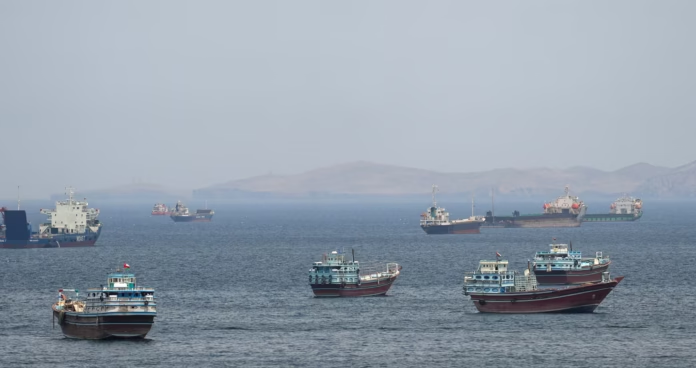
The United States military launched a high-stakes escort operation in the Strait of Hormuz on Monday as Iranian forces attacked commercial vessels and UAE infrastructure, pushing a fragile ceasefire to its limits. The operation, dubbed “Project Freedom” by the Trump administration, successfully guided two American-flagged merchant ships through the waterway for the first time since the Iran war began in late February. The move marks a direct challenge to Iran’s effective blockade of one of the world’s most critical energy corridors.
Story Highlights
- The U.S. military launched “Project Freedom” on Monday, successfully escorting two merchant ships through the Strait of Hormuz
- Iranian drones struck the Fujairah Oil Industry Zone in the UAE, while a South Korean-operated vessel caught fire after an explosion
- Defense Secretary Pete Hegseth declared the U.S. is “locked and loaded” to defend ships, personnel, and aircraft in the strait
What Happened
President Donald Trump announced on his Truth Social platform over the weekend that the U.S. military would begin guiding stranded commercial ships through the Strait of Hormuz, the narrow waterway through which roughly one-fifth of the world’s oil and liquefied natural gas supplies normally pass. The announcement came as a cargo ship near the strait was attacked by multiple small craft, and a second vessel was struck by unidentified projectiles — the first reported attacks in the area since April 22.
Defense Secretary Pete Hegseth confirmed at a Pentagon press briefing Tuesday that the ceasefire with Iran remains technically in effect, though he acknowledged Iran had fired at commercial vessels nine times and seized two container ships since the truce was announced. “Right now the ceasefire certainly holds, but we’re going to be watching very, very closely,” Hegseth said. He added that the U.S. is “locked and loaded to defend our people, our ships, our aircraft, and this mission without hesitation.”
General Dan Caine, Chairman of the Joint Chiefs of Staff, joined Hegseth at the briefing and said Iran’s attacks remain below the threshold that would trigger a resumption of full hostilities. The Pentagon also denied Iran’s claims that it had struck an American Navy vessel southeast of the strait. A separate warning purportedly from Iran’s army chief threatening U.S. aircraft carriers was later traced to a fake social media account, according to Iran’s semi-official Fars News Agency.
Meanwhile, Iranian drones struck the Fujairah Oil Industry Zone in the United Arab Emirates on Monday, prompting air defenses across the Persian Gulf region to go on high alert. A South Korean-operated vessel caught fire after an explosion in the strait and was later towed to port for inspection; none of its 24 crew members, including six South Koreans, were reported injured. The White House posted on X that Trump holds “all the cards” in the confrontation, projecting confidence even as military analysts expressed skepticism about American strategic leverage.
Iran, for its part, submitted a 14-point peace proposal through Pakistani mediators calling for the lifting of U.S. sanctions, an end to the naval blockade on Iranian ports, a withdrawal of American forces from the region, and an end to all hostilities including Israeli operations in Lebanon. Pakistan’s prime minister, foreign minister, and army chief have been actively facilitating communications between Washington and Tehran.
Why It Matters
The Strait of Hormuz has effectively been closed to normal commercial traffic since the war between the U.S., Israel, and Iran began on February 28. Iran’s blockade has stranded hundreds of commercial vessels — many of them oil and gas tankers — in the Persian Gulf. Crew members aboard those ships have described seeing intercepted drones and missiles exploding overhead while supplies of food and drinking water run dangerously low. Many sailors are from India and other South and Southeast Asian nations, raising international humanitarian concerns.
The closure has also reordered global energy markets. Oil and gas prices have surged to levels not seen since the early months of the conflict, and the disruption is being felt across supply chains far beyond the Middle East. Countries from Europe to Asia that rely on Persian Gulf oil have been forced to seek alternative sources at significant expense, and several have implemented emergency austerity measures to cushion the economic blow.
Trump’s decision to launch “Project Freedom” represents a deliberate escalation in American resolve, but it also carries considerable risk. If Iran’s forces disable or sink a vessel under U.S. military escort, the pressure to abandon the ceasefire and resume major combat operations would intensify sharply. The operation’s first day was declared a success, but analysts note that only two ships made it through — a fraction of the traffic the waterway once handled daily.
The situation also tests the durability of American alliances in the region. The UAE, a key U.S. partner, came under direct Iranian drone attack on Monday. While India issued a statement calling for diplomatic resolution and free navigation, the broader international community’s patience with the prolonged conflict is visibly thinning.
Economic and Global Context
Before the war began, the Strait of Hormuz handled roughly 20 to 21 million barrels of oil per day, along with substantial volumes of liquefied natural gas. The effective closure of that corridor has sent global crude benchmarks sharply higher. In the United States, the average price of a gallon of gasoline rose to $4.45 as of early May, up from under $3 before the conflict began — an increase that has accelerated inflation and eroded consumer confidence.
The U.S. stock market has remained near record highs despite the tension, with the S&P 500 slipping just 0.1% on Monday as investors weighed the latest developments. Oil prices, however, climbed further, as uncertainty about when tankers could reliably transit the strait continued to weigh on supply projections. Insurance companies have largely declined to underwrite voyages through the strait regardless of military escorts, which further constrains the practical scale of “Project Freedom.”
Trump also announced on Saturday that the U.S. would cut American troop deployments in Germany far beyond an initial announcement of 5,000 troops — a decision that blindsided NATO allies and came amid escalating tensions with German Chancellor Friedrich Merz over the Iran war. European allies, which have been reluctant to join the conflict, have nonetheless committed to raising national defense spending to 5 percent of GDP in response to American pressure.
The conflict has created a broader strategic test for Washington. Three U.S. carrier strike groups, two Marine Expeditionary Units, hundreds of combat aircraft, and thousands of troops are committed to the theater. Analysts at King’s College London argue that Iran’s asymmetric tactics — including mines, drone swarms, and proxy forces across Iraq, Lebanon, Yemen, and Syria — have consistently blunted American conventional military superiority, limiting strategic leverage in spite of overwhelming firepower.
Implications
The immediate question is whether “Project Freedom” can scale from two ships to meaningful daily traffic. Even if the U.S. military can safely escort vessels through the strait, analysts warn that commercial confidence is the true center of gravity: insurers, shipping companies, and cargo owners will need to believe the route is reliably safe before they resume normal operations. That confidence is unlikely to return as long as the broader conflict remains unresolved.
Iran’s 14-point peace proposal is being reviewed by the Trump administration, but significant gaps between the two sides remain. Washington has made clear it will not simply lift sanctions and withdraw from the region without binding guarantees on Iran’s nuclear and military programs. Tehran, for its part, insists any deal must be comprehensive and include an end to Israeli operations in Lebanon — a condition Washington has shown little appetite for imposing on its ally.
For American consumers and businesses, the trajectory of energy prices over the next several weeks will depend heavily on whether “Project Freedom” succeeds in normalizing traffic through the strait. Every additional week the blockade holds represents billions of dollars in economic damage globally and continued inflationary pressure in the United States ahead of November’s midterm elections.
For Trump, the stakes are profoundly political as well as military. His administration launched the Iran war at a time when his approval ratings were already sliding. The conflict has since become one of the leading drivers of public discontent, and how it resolves — or fails to — will likely define the political environment in which Republicans compete for the House and Senate this fall.