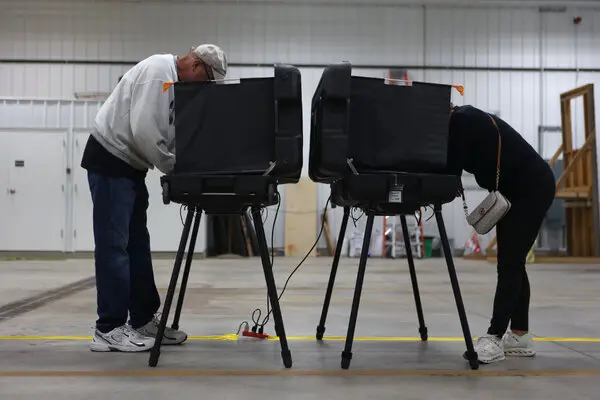
President Donald Trump delivered a decisive political statement Tuesday as five of seven Republican state senators in Indiana who defied his redistricting demands were defeated in their primary elections, with millions of dollars in outside funding flooding ordinarily obscure legislative races. The results demonstrate that Trump’s grip on the Republican Party base remains powerful even as his overall approval ratings have slipped to record lows. The outcome is already reshaping the redistricting landscape in red states across the country as November’s midterms draw closer.
Story Highlights
- Five of seven Trump-targeted Indiana Republican incumbents lost their primaries Tuesday; one race remained too close to call
- Approximately $12 million in advertising was spent across the seven contests, most of it from Trump-allied outside groups
- In Ohio, Vivek Ramaswamy won the Republican gubernatorial primary with 82 percent of the vote, setting up a marquee fall matchup
What Happened
The political reckoning in Indiana had been building since December, when the state’s Republican-controlled Senate voted down a Trump-backed effort to redraw congressional district boundaries in a way that was projected to deliver the GOP two additional U.S. House seats. The defeat was a rare and embarrassing rebuke for a president who had made the redistricting push a top political priority. Trump responded swiftly, announcing his intention to replace every senator who crossed him, and his political operation backed that threat with substantial financial firepower.
James Blair, a senior Trump political adviser, captured the administration’s philosophy plainly in a CNN interview Wednesday. He said that while lawmakers sometimes have latitude to vote their conscience, the president as elected party leader decides which votes fall into that category, and the redistricting vote did not. The message was unmistakable: defying Trump on his stated priorities carries serious electoral consequences.
By Tuesday night, that warning had been borne out in most of the targeted races. At least five incumbent senators fell to Trump-backed challengers, including in races where incumbents had carefully explained their votes as reflecting the wishes of their local constituents. Sen. Spencer Deery, a West Lafayette Republican who survived his race, told CNN he doubted Trump even knew who he was personally, underscoring how nationalized and impersonal the campaign had become.
The financial scale was unprecedented for state legislative primaries. According to the ad-tracking firm AdImpact, roughly $12 million was spent across the seven contests, the overwhelming majority coming from Trump-allied outside groups painting the incumbents as disloyal. State Senate races in Indiana typically see spending in the tens of thousands and draw around 10,000 to 12,000 primary votes. The injection of national money and attention turned them into proxy battles over the future direction of the Republican Party itself.
Why It Matters
The Indiana results send a powerful message to Republicans in every state that there is no safe harbor for defying Trump’s directives, even on traditionally local issues like state legislative districting. Political analysts noted that the results will be closely studied by Republican officeholders across the country who are weighing how much independence they can exercise without drawing the president’s wrath and a well-funded primary opponent.
The timing is especially significant given a Supreme Court ruling just days before the primaries that weakened Section 2 of the Voting Rights Act, opening the door for Republican-dominated states to pursue aggressive redistricting before the November midterms. Florida Governor Ron DeSantis had already signed a new congressional map designed to cut Democrats’ delegation from eight seats to four. Louisiana delayed its primary to allow time to draw new maps. Republican governors in Alabama, South Carolina, and Tennessee are pursuing similar moves. Tuesday’s results in Indiana will give those efforts additional momentum.
Yet the broader political picture is more complicated for the Republican Party. Trump’s approval ratings have hit record lows, and independents have largely abandoned him. Democratic primary turnout is surging. In Ohio, early voting data showed that more ballots were cast in the Democratic primary than the Republican primary by an 11 percent margin. A string of special elections across the country has shown Democrats outperforming their 2024 baselines by consistent margins. Trump may still dominate Republican primaries, but that dominance could be a liability when the general election electorate broadens in November.
The CNN analysis published Wednesday argued that Trump is simultaneously demonstrating he can end Republican careers and creating conditions that make it harder for the party to win competitive seats. Republicans in safe seats can afford to follow Trump loyally, but their deference could cost the party in the swing districts that will decide control of the House.
Economic and Global Context
While the Indiana primaries were primarily a test of party discipline rather than economic policy, the backdrop of Trump’s broader agenda looms over every 2026 race. His tariff regime, the Iran conflict, and elevated consumer prices are all playing into the political environment. Economists have estimated that Trump’s current tariff structure represents an average annual tax increase of approximately $1,500 per U.S. household in 2026, according to the Tax Foundation, a burden that weighs most heavily on middle-income families.
The redistricting battles playing out in Indiana and other states are also directly tied to economic power. Congressional districts determine who controls the House, and House control shapes fiscal policy, government spending, and the administration’s ability to push through its legislative agenda. A more favorable congressional map for Republicans could help the party withstand the headwinds of a difficult midterm cycle and preserve the margins needed to pass Trump’s priorities, including tax legislation currently working its way through Congress.
The Ohio results added another dimension to the picture. Vivek Ramaswamy, the biotech entrepreneur and former presidential candidate, won the Republican gubernatorial primary decisively with 82.47 percent of the vote. His opponent in November will be Amy Acton, the former state health director who ran unopposed in the Democratic primary. Ohio has not elected a Democratic governor in 20 years, but polling shows the race is competitive, reflecting the anti-Trump backlash driving Democratic enthusiasm nationally.
Implications
The Indiana results make it more likely that the state will revisit redistricting before the 2028 cycle, if not sooner. With five of the seven senators who voted against the map now facing defeat or replacement, the path toward a Trump-aligned majority in the state Senate is clearer. Political observers say that while it is too late to redraw Indiana’s map before the November midterms, the newly elected senators could move quickly on the issue in a special session or early 2027 legislative calendar.
For the Republican Party more broadly, the primaries illustrate a tension that could prove decisive in November. The voters who show up to red-state Republican primaries remain intensely loyal to Trump and will punish dissenters. But the overall electorate that decides general elections is increasingly hostile. As CNN noted, the same dynamic that makes Trump powerful in primaries makes him politically costly in a midterm environment where his record-low approval numbers and unpopular policies are motivating the opposition.
Democrats, meanwhile, are watching these results with a mixture of satisfaction and strategic calculation. Every dollar and news cycle Trump spends enforcing party loyalty in deep-red primaries is attention not directed at competitive seats. The Ohio Senate race, expected to be one of the most expensive in the country this cycle, will pit former Senator Sherrod Brown in an effort to reclaim his seat and potentially swing chamber control. Both parties are treating November as a consequential referendum on the Trump agenda at a critical moment for the country.
Sources
“Trump gets revenge, and other takeaways from Tuesday’s Indiana and Ohio primaries”