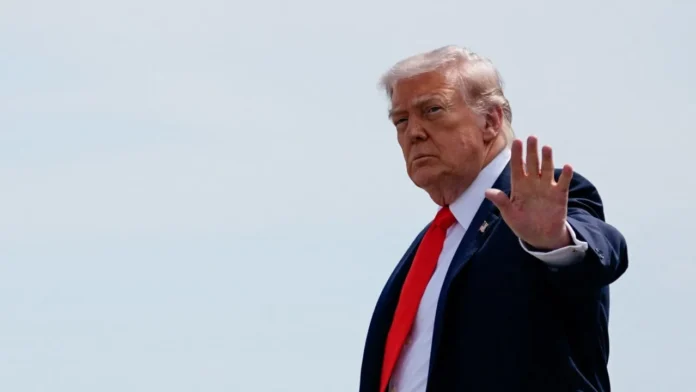
President Donald Trump abruptly halted his military-escorted shipping operation in the Strait of Hormuz on Tuesday, citing what he called significant progress toward a final peace agreement with Iran. The pause came just one day after “Project Freedom” launched amid fierce Iranian resistance, marking a dramatic reversal that rattled diplomats and raised fragile hopes for an end to the ongoing U.S.-Iran conflict. The decision reflects the unstable equilibrium at the center of one of the most consequential foreign policy standoffs in recent American history.
Story Highlights
- Trump announced the pause of “Project Freedom” on Truth Social Tuesday evening, citing “great progress” in Iran negotiations
- At least 10 sailors had died and nearly 23,000 crew members aboard vessels from 87 countries were stranded in the Strait of Hormuz before the pause
- Oil prices remain above $100 per barrel, and average U.S. gas prices have climbed to $4.48 per gallon
What Happened
President Donald Trump launched “Project Freedom” on Sunday, a U.S. military operation designed to escort commercial ships through the Strait of Hormuz after Iran’s de facto closure of the critical waterway trapped tens of thousands of sailors and hundreds of cargo vessels in the Persian Gulf. The initiative quickly escalated into direct military confrontation. On Monday, U.S. Navy destroyers transited the strait while fending off Iranian cruise missiles, drones, and small boat attacks. The United Arab Emirates reported that Iranian ballistic missiles struck its territory, the first such attack on a Gulf neighbor in weeks.
Secretary of State Marco Rubio addressed reporters at the White House on Tuesday afternoon, calling the operation a humanitarian rescue mission. He described the stranded sailors as “sitting ducks,” isolated and vulnerable, with at least ten already confirmed dead as a result of Iran’s blockade. Rubio simultaneously called on both Russia and China to support a United Nations Security Council resolution condemning Iran’s actions, arguing that blocking international shipping harmed the interests of all nations, not just those engaged in the conflict.
Secretary of Defense Pete Hegseth reinforced the administration’s firm posture at a Pentagon press conference the same day, warning Iran that any attack on American forces or commercial shipping would be met with decisive military force. However, just hours after that warning, Trump reversed course entirely. In a Truth Social post Tuesday evening, he announced that Project Freedom would be suspended for a short period to allow diplomatic negotiations to proceed.
Trump cited mediation efforts by Pakistan and other unnamed countries as contributing to the decision, and said that “great progress” had been made toward a comprehensive deal with Iranian representatives. According to two administration officials who spoke to CNN, a one-page framework was being circulated internally that would formally end the war, trigger a 30-day negotiation window on nuclear issues, and address the long-term status of the Strait of Hormuz. The proposal would include a moratorium on Iranian uranium enrichment for more than a decade, along with a requirement that Iran’s stockpile of highly enriched uranium be removed from the country.
Why It Matters
The Strait of Hormuz is one of the most strategically vital waterways on the planet, handling approximately one-third of the world’s seaborne oil. Its continued closure has sent energy prices soaring globally and created a mounting humanitarian crisis for thousands of civilian seafarers from dozens of countries. The Trump administration’s willingness to pause military operations in response to diplomatic signals suggests that even a confrontational White House recognizes the limits of military pressure in such a volatile environment.
The sudden reversal also highlights the significant gap between the administration’s public rhetoric and its behind-the-scenes calculations. Just hours before Trump announced the pause, senior officials were framing the operation in the starkest possible terms, describing it as a matter of life and death. The whiplash leaves American allies and adversaries uncertain about the durability of any policy commitment coming from Washington.
The ceasefire between the U.S. and Iran, struck after the conclusion of a broader military campaign earlier this year, has remained fragile throughout. Both sides have continued to test its limits, and Tuesday’s events brought it to the edge of collapse before diplomatic pressure from Pakistan and others pulled negotiations back from the brink. The question of whether a permanent agreement is achievable remains deeply uncertain. Trump acknowledged as much himself on Wednesday, telling PBS News that he remained hopeful but cautious, noting the administration had been down this road before.
The domestic implications are also significant. With midterm elections approaching in November, the administration faces pressure to show results on both the foreign policy and economic fronts. An oil crisis that has pushed gas prices to $4.48 per gallon nationally is a potent political liability. A durable peace agreement that reopens the strait would represent a major achievement. Failure to deliver one could deepen public frustration.
Economic and Global Context
The closure of the Strait of Hormuz has had sweeping consequences for global energy markets. Oil prices have remained elevated well above $100 per barrel for weeks, straining supply chains and accelerating inflation pressures in economies already weakened by years of pandemic recovery and tariff disruptions. Chevron CEO Mike Wirth warned at the Milken Institute Global Conference this week that physical fuel shortages could materialize if inventories continue to decline, beginning in Asia and eventually reaching the United States.
U.S. oil exports fell 26 percent in the week prior to the Project Freedom announcement, though they remain elevated as European and Asian buyers scramble to replace Middle Eastern crude caught behind the blockade. The economic toll is being felt across industries that depend on stable energy prices, from transportation and logistics to manufacturing and agriculture.
Stock futures rose immediately following Trump’s announcement of the pause, reflecting market relief that direct U.S.-Iran military confrontation had at least temporarily receded. The United Arab Emirates, which has been directly targeted by Iranian missiles during the standoff, activated its air defense systems again on Tuesday in response to a new threat. The Gulf state’s continued exposure underscores that the crisis remains far from resolved.
A new policy proposal called “ARAM Express” has also emerged, outlining a network of overland pipelines through Gulf partner nations that could eventually reduce the world’s dependence on the Strait of Hormuz as an energy transit route. The plan, developed by the Foundation for Defense of Democracies, envisions pipelines extending toward the Mediterranean and Arabian Sea, but any such infrastructure project would take years and enormous capital investment to implement.
Implications
If diplomatic negotiations succeed in producing a formal agreement, the consequences would be far-reaching. Reopening the Strait of Hormuz would ease global energy markets, provide relief for American consumers paying record gas prices, and give the Trump administration a significant foreign policy victory ahead of the midterms. Iranian foreign policy analysts, however, warn that Tehran has consistently used negotiations to buy time and that achieving a durable, verifiable agreement will require resolving deep disputes over nuclear enrichment, sanctions relief, and regional security guarantees.
The upcoming Trump-Xi summit on May 14-15 in Beijing adds another layer of complexity. China is Iran’s largest oil customer and a significant supplier of dual-use technology. Iranian Foreign Minister Abbas Araghchi was scheduled to meet with Chinese Foreign Minister Wang Yi on Wednesday, suggesting that Beijing is positioning itself as a mediating force in the conflict. Trump’s threat earlier this month to impose 50 percent tariffs on any nation supplying military equipment to Iran appeared aimed at China, but analysts say the timing of the Beijing summit makes a serious escalation with China unlikely in the near term.
For the thousands of sailors currently stranded in the Persian Gulf, the pause in Project Freedom offers no immediate relief. Shipowners and maritime operators told CNBC they remain cautious about resuming transit through the strait unless both sides credibly commit to safe passage over a sustained period. The humanitarian situation for those crews, some of whom have been stranded for weeks without adequate supplies, remains urgent regardless of diplomatic progress.
Sources
Trump pauses ‘Project Freedom’ in Strait of Hormuz, citing progress on an Iran deal