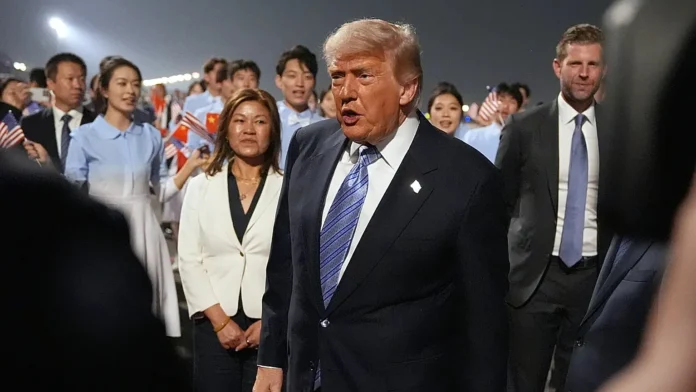
President Donald Trump touched down in Beijing on Wednesday for a two-day summit with Chinese President Xi Jinping, bringing with him the full weight of American trade tensions, a costly war with Iran, and a delegation that includes some of the biggest names in U.S. business. The meeting marks the most consequential diplomatic engagement of Trump’s second term, with the world’s two largest economies attempting to stabilize a fragile relationship under pressure from energy shocks, military conflict, and contested technology supply chains. The stakes could not be higher, and the world is watching.
Story Highlights
- Trump arrived in Beijing on May 13 for a two-day summit with Chinese President Xi Jinping, his most significant diplomatic engagement of the second term.
- The U.S. delegation includes Secretary of State Marco Rubio, Defense Secretary Pete Hegseth, and tech CEOs Elon Musk, Tim Cook, and Jensen Huang.
- Iran, trade, and Taiwan are expected to be the central issues on the agenda, with Trump hoping Xi will pressure Tehran to reopen the Strait of Hormuz.
What Happened
President Donald Trump arrived in China on Wednesday for a two-day summit with Chinese President Xi Jinping that formally begins Thursday in Beijing. The world’s two biggest economies are seeking to extend a fragile trade truce against the backdrop of the U.S. war with Iran.
China rolled out a ceremony full of pomp and pageantry for Trump’s arrival, framing the visit as the start of a high-stakes meeting carrying global consequences as both nations work to define their trade relationship. The reception underscored Beijing’s investment in the diplomatic choreography, even as it faces the challenge of managing an American president known for unpredictability.
Joining Trump in China are his son and daughter-in-law Eric and Lara Trump, Secretary of State Marco Rubio, Defense Secretary Pete Hegseth, and several tech CEOs, including Tesla and SpaceX’s Elon Musk, Apple’s Tim Cook, and Nvidia’s Jensen Huang. First Lady Melania Trump did not make the trip. The inclusion of major technology executives signals that trade and technology policy will figure prominently in the discussions.
Trump told reporters before departing the White House that he was aiming to have a “long talk” with Xi about the war with Iran, though he indicated their meetings would largely focus on trade. The dual emphasis on commerce and conflict resolution reflects the interconnected nature of the two nations’ disputes, as energy market disruptions from the Iran war are rippling through global supply chains that both countries depend on.
Trump gave conflicting answers in the days ahead of his trip about whether he needed China’s help with Iran, at one point saying “I don’t think we need any help” and then moments later saying he would welcome whatever assistance Xi could offer. That ambivalence has raised questions about the coherence of the U.S. diplomatic strategy heading into the summit.
Why It Matters
The Beijing summit arrives at a moment of rare and compounding pressure on the American economy. The Iran war has driven oil prices above $100 per barrel, gasoline has climbed to a national average of $4.50 per gallon, and inflation has surged to a three-year high of 3.8 percent. A diplomatic breakthrough that brought Xi’s influence to bear on Tehran could ease energy market pressure more quickly than any domestic policy response. For ordinary Americans bearing the weight of higher fuel costs, the outcome of these talks carries direct financial consequences.
Senate Minority Leader Chuck Schumer warned that Trump may “concede” too much to China during the summit, specifically flagging the risk that Trump could “sell out Taiwan, whose people want to continue living in freedom.” Schumer added that any threat Xi makes against Taiwan would be “a threat to global democracy” and “a threat to the global economy, given how many semiconductor chips are made in Taiwan.” The warning reflects a bipartisan anxiety about whether the administration will treat Taiwan as a bargaining chip in pursuit of a deal on Iran or trade.
The presence of Musk, Cook, and Huang also raises questions about the boundary between commercial interests and national policy. These executives lead companies with enormous supply chain and revenue exposure to China. Their presence at a presidential summit is without modern precedent and could create the appearance, or the reality, that corporate interests are shaping diplomatic outcomes in real time.
Economic and Global Context
Trump is expected to encourage Xi to push China-ally Iran to reopen the Strait of Hormuz, a chokepoint vital to global oil trade. The U.S. Department of Energy projects oil prices will likely remain above $100 a barrel in the coming weeks, and some analysts warn the national average for gasoline could eventually reach $5 per gallon.
China has quietly emerged as a potential mediator in the Iran conflict. In April, Trump suggested Beijing played a role in getting Tehran to negotiate a ceasefire, though Chinese officials said little about their involvement. Iran’s ambassador to China told Iranian state media that Beijing is “not merely an economic partner” but part of Iran’s “political balancing” against external threats.
The trade truce the two nations are seeking to extend was itself brokered under duress, following rounds of tariff escalation that damaged manufacturers and farmers on both sides. Any new agreement must navigate unresolved disputes over technology exports, Chinese industrial subsidies, and access to U.S. markets. The tech CEO delegation suggests the administration hopes private-sector engagement will unlock concessions that government-to-government diplomacy alone has failed to produce.
Implications
For the Trump administration, a successful summit could provide significant political relief. A credible pathway to reopening the Strait of Hormuz would calm oil markets, ease inflationary pressure, and give the president a foreign policy victory to point to as midterm elections approach. Failure, by contrast, would deepen economic anxiety and strengthen Democratic arguments that the Iran war has been mismanaged.
For U.S. allies in the Indo-Pacific, the summit will be closely monitored for any signs that Taiwan was discussed as a trade-off. Diplomats have noted they need only look at Trump’s recent meeting with Japan’s prime minister, where he joked about Japan’s World War II attack on Pearl Harbor, to understand the risks of unpredictability in this summit. Allies are cautiously optimistic but deeply uncertain.
For China, the summit is an opportunity to reassert its role as an indispensable global power at a moment when U.S. military engagement in the Middle East has stretched Washington’s diplomatic bandwidth. Xi enters the talks from a position of relative strength, with Trump eager for deliverables and constrained by a costly, increasingly unpopular war.