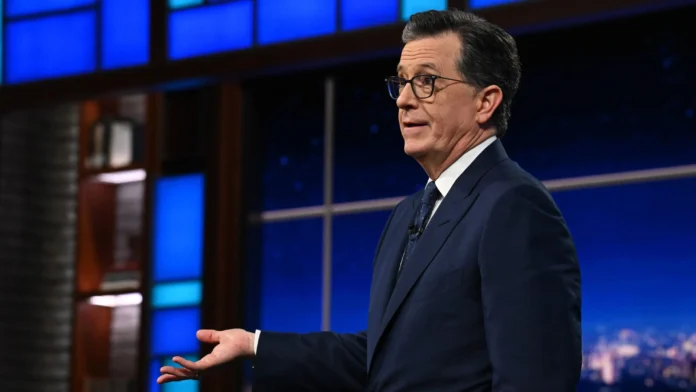
Stephen Colbert hosted the final episode of The Late Show on CBS Thursday night, ending an 11-year run that made him one of the most prominent critics of President Donald Trump on network television. The cancellation, announced last July, followed a $16 million settlement paid by CBS parent company Paramount to resolve a Trump lawsuit — and came just one week before the Trump administration approved Paramount’s major merger with Skydance Media. Critics across the political spectrum say the sequence of events is impossible to ignore.
Story Highlights
- The program’s cancellation removes one of President Trump’s most vocal critics from the airwaves and came after Colbert criticized his own employer for agreeing to pay $16 million to settle a lawsuit brought by President Trump.
- The settlement came as CBS parent company Paramount was seeking the Trump administration’s approval for a merger with Skydance, which the administration approved just one week after CBS announced Colbert’s ouster.
- Liberal critics have accused CBS and Paramount of ending the show to appease Trump and receive approval for the long-planned merger between Paramount Global and Skydance Media.
What Happened
CBS announced last July that The Late Show would air its final episode in May 2026, saying the decision was “not related in any way to the show’s performance, content, or other matters happening at Paramount.” However, the announcement came in the immediate aftermath of Stephen Colbert publicly denouncing the network’s parent company, Paramount, for settling a lawsuit brought by President Donald Trump over a 2024 “60 Minutes” interview.
In his Monday monologue following the settlement announcement, Colbert told his audience that the settlement was a “big fat bribe” and said he didn’t know if anything would repair his trust in the company. Three days after that on-air rebuke, CBS informed Colbert his show would not be renewed. The timing led Colbert and many observers to conclude that the cancellation was connected to his criticism of corporate leadership.
Colbert’s final broadcast featured a farewell that included performances from Paul McCartney, Jon Batiste, and Elvis Costello. Audience members who gathered outside the Ed Sullivan Theater in New York described the evening as a charged mixture of celebration and political protest. Several audience members expressed concern that the government was influencing which voices could remain on the air, with one person stating the cancellation felt political and frightening.
Trump himself weighed in on Truth Social, claiming he was not solely responsible for Colbert’s departure and attributing the cancellation to a “pure lack of talent” and financial losses at CBS. CBS and Paramount maintained throughout that the cancellation was a purely financial decision made against a challenging backdrop for late-night television — a claim that critics noted was undercut by Colbert’s strong ratings.
The most recent Nielsen ratings showed Colbert winning his timeslot, with approximately 2.417 million viewers across 41 new episodes. The Late Show was also the only late-night program to gain viewers that year, and was nominated for a Primetime Emmy Award for outstanding talk show for the sixth consecutive time.
Why It Matters
The end of The Late Show is not simply a television programming change — it is an event with meaningful implications for press freedom and the independence of corporate media from political pressure. Whether or not there was direct coordination between the White House and CBS leadership, the structural incentives at play are visible and consequential. A media company seeking billions of dollars in regulatory approval from a presidential administration had, on its airwaves, one of that president’s most persistent critics. That critic is now gone.
Trump’s FCC Chair Brendan Carr has openly gloated about the administration’s attacks on critics in the media and the defunding of outlets like PBS and NPR, which no longer receive federal funding. That context makes it difficult to evaluate Paramount’s decision in isolation. The administration has made no secret of its desire to reshape the media landscape, and corporate executives at broadcast networks operate with acute awareness of the regulatory environment they depend on.
The $16 million settlement itself is a significant data point. Trump had sued Paramount over the editing of a 2024 “60 Minutes” interview with then-Democratic presidential candidate Kamala Harris. Media law experts widely characterized the lawsuit as legally thin — yet Paramount chose to settle, for a substantial sum, while its merger awaited administration approval. Colbert called it a bribe. Media analysts called it a business calculation. The effect was the same.
Economic and Global Context
Paramount and Skydance are now seeking another megamerger with Warner Bros. Discovery, which would further concentrate media ownership in the hands of the Ellison family, which has a long history of supporting Trump. That pending consolidation means the incentive structure that may have influenced the Colbert cancellation is not going away — it is expanding. Fewer and larger media companies mean fewer decision-makers who are insulated from political pressure, and more decision-makers who have regulatory requests pending with the current administration.
The late-night landscape Colbert is departing is already diminished. Jimmy Kimmel was suspended earlier in Trump’s second term amid separate pressures. The institutional late-night format — an hour of political satire anchored by a single host on a legacy broadcast network — now faces both the structural disruptions of streaming fragmentation and the political pressures of an unusually assertive executive branch. Those two forces together represent a genuine threat to the form.
Internationally, the Colbert cancellation was reported widely as a signal about the state of American press freedom. Freedom of the press indices published by Reporters Without Borders and similar organizations have tracked declining scores for the United States over the past several years, and episodes like this one — in which the cancellation of a prominent critic coincides with regulatory approvals for the critic’s employer — are precisely the kind of event those indices are designed to capture.
Implications
For the television industry, the immediate practical consequence is that the Ed Sullivan Theater, one of the most iconic venues in American broadcast history, goes dark as a late-night home. CBS has not announced a replacement program, and there is no obvious successor to Colbert’s audience. The network will absorb the ratings loss at 11:35 p.m. and presumably reallocate the production budget elsewhere.
For the broader media and political ecosystem, the lasting implication is one of precedent and chill. Even if the Colbert cancellation was entirely financially motivated — a claim that strains credibility given the ratings — other broadcast executives will have noted the sequence of events. Future critics of the administration will operate with an awareness that their employers are not unconditionally committed to protecting their platform.
Dozens of anti-Trump protesters gathered outside the Ed Sullivan Theater on the final night of taping to protest CBS’s decision to cancel the show. Their presence, and the broader national conversation the cancellation generated, suggests that the audience Colbert built over 11 years is not going to disengage from politics simply because his show is over. The questions raised by the cancellation — about media independence, corporate incentives, and the administration’s relationship with the press — will continue to shape the political conversation well into the coming year.