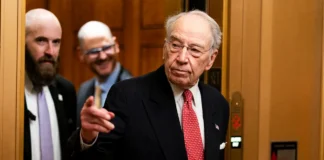
The U.S. Senate took a significant step toward challenging President Trump’s authority to wage war against Iran on Tuesday, advancing a war powers resolution for the first time with bipartisan support sufficient to move the measure forward. The breakthrough came as Republican Senator Bill Cassidy, freshly eliminated from his own primary by a Trump-backed opponent, reversed his previous votes and sided with Democrats — a dramatic display of political consequence in real time.
Story Highlights
- The Senate voted 50-47 to advance legislation seeking to force Trump to withdraw from the Iran war, a breakthrough for the Democratic-led effort.
- Four Republicans — Sens. Rand Paul, Susan Collins, Lisa Murkowski, and Bill Cassidy — joined Democrats in the procedural vote.
- Democrats have forced votes on seven similar resolutions since the start of the war, but Republicans had always been able to block them until now.
What Happened
The Senate advanced legislation Tuesday seeking to force President Donald Trump to withdraw from the Iran war, as a growing number of Republicans defied the president’s direction on a conflict that has spanned well over two months. The procedural vote was the first time Democrats had secured enough Republican support to move such a resolution forward since the conflict began.
Sen. Bill Cassidy who had just lost his primary for renomination over the weekend after he faced opposition from Trump, voted “yes” to advance the measure — the first time he had done so after having repeatedly voted “no.” Cassidy’s reversal provided the decisive margin that tipped the vote.
In a statement explaining his change of position, Cassidy said: “While I support the administration’s efforts to dismantle Iran’s nuclear program, the White House and Pentagon have left Congress in the dark on Operation Epic. Until the administration provides clarity, no congressional authorization or extension can be justified.”
Sen. Tim Kaine who has spearheaded Democrats’ strategy on the war, argued that a lull in active hostilities provided an opening for Congress to reassert itself. “If we’re in a ceasefire where we are trying to find a diplomatic path forward, rather than precipitously start a bombing campaign again, this is exactly the time where Congress should be having a debate about the rationale for the war,” Kaine said on the Senate floor.
Sen. John Fetterman was the lone Democrat to vote no. The final vote on the resolution itself has not yet been scheduled, and the measure still faces a path complicated by absent senators and a near-certain presidential veto.
Why It Matters
The vote showed the growing number of Republicans willing to defy the president’s wishes on the war. Since Trump ordered the attack on Iran at the end of February, Democrats had forced repeated votes on war powers resolutions, but Republicans had always mustered the votes to reject those proposals. Tuesday’s result marks a qualitative shift in that dynamics.
The War Powers Resolution of 1973 is the legal foundation for this effort. It requires presidents to remove U.S. forces from any conflict that Congress has not formally authorized within a defined timeframe. The Trump administration blew past a legal deadline established under that law earlier this month, escalating congressional pressure to act. The constitutional question of whether a president can sustain a prolonged military campaign without legislative authorization now sits at the center of Washington’s war debate.
The political dimension is equally significant. Cassidy’s vote demonstrates that politicians freed from the electoral consequences of Trump’s disapproval may behave differently than those still seeking re-election. His willingness to reverse course immediately after losing his primary suggests that Republican silence on the Iran war has, in part, been driven by political self-preservation rather than genuine policy agreement.
The resolution also reflects broader public unease. The vote showed how Republicans are increasingly uneasy with a conflict that is in a fragile ceasefire and has caused rising gas prices in the U.S. Constituents across party lines are feeling the economic effects of the war, which adds real-world urgency to the congressional debate.
Economic and Global Context
The Iran conflict has had measurable effects on global energy markets since it began in late February. Oil prices were already up 55% after four weeks of fighting. Although a ceasefire has since taken hold, prices remain elevated compared to pre-conflict levels, squeezing American consumers at the pump and affecting transportation and manufacturing costs across the economy.
Global trading partners are watching the congressional effort closely. A successful war powers resolution — even if ultimately vetoed — sends a signal to allies and adversaries alike that U.S. military commitments under Trump do not have unified domestic support. That perception can affect diplomatic negotiations and the credibility of U.S. threats in other theaters.
The resolution’s advancement also intersects with the broader fiscal picture. Military operations in Iran have added to federal spending at a time when Congress is already debating large tax and spending packages. Defense appropriators on both sides of the aisle have raised concerns about the war’s long-term costs, which remain incompletely disclosed to Congress.
Implications
Even if the resolution passes the Senate, it faces a veto-certain fate at the White House and would need a two-thirds majority in both chambers to override — a threshold that current vote counts make implausible. However, the 50-47 procedural vote was described as a breakthrough for Democrats, though the measure still faces considerable hurdles before it could force Trump to end the war.
The more lasting implication may be the precedent it sets. Each successive vote that draws more Republican support normalizes congressional resistance to Trump’s wartime authority and builds a record that future courts or legislators could reference. It also pressures the administration to provide more information to Congress about the conflict’s scope and objectives.
For Republican senators facing reelection in 2028 in states where the Iran war is unpopular, Tuesday’s vote provides political cover. They can point to it as evidence of institutional responsibility without necessarily following Cassidy’s full reversal. The political arithmetic will vary state by state.
For the White House, the vote is a warning. While a veto remains available, a sustained congressional challenge to war powers erodes the president’s freedom of action diplomatically and could complicate any future escalation should the Iran ceasefire break down.
Source
Senate advances bill aimed at ending Iran war as Cassidy flips