President Donald Trump has given Iran a window of just two to three days to accept a nuclear agreement, escalating diplomatic pressure on Tehran while a fragile ceasefire holds following months of military conflict. The ultimatum represents the latest in a series of rolling deadlines that have defined the administration’s high-stakes effort to permanently end Iran’s nuclear ambitions. With Pakistan’s army chief visiting Tehran and both sides signaling narrowing gaps, the coming days may prove decisive.
Story Highlights
- Trump stated the deadline could run through Friday, Saturday, Sunday, or into early the following week
- Iran’s semiofficial ISNA news agency reported that Washington’s latest proposal had “reduced the gaps to some extent”
- A visit by Pakistan’s army chief to Tehran was described as aimed at helping Iran accept a memorandum of understanding
What Happened
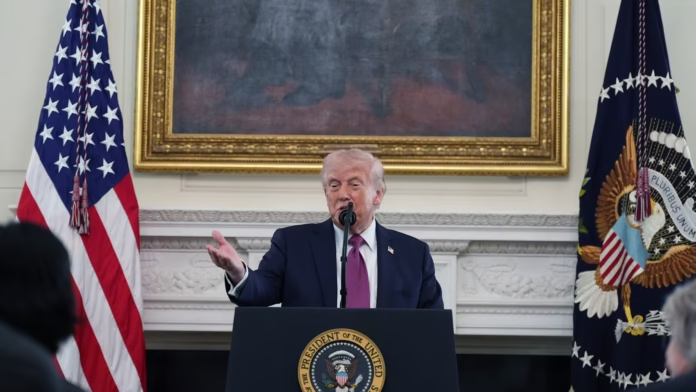
President Donald Trump issued a fresh ultimatum to Iran from the White House, giving Tehran a “two or three-day” window to agree to a nuclear deal. Trump described the existing ceasefire as “remarkably fragile” and stated: “I’m saying two or three days. Maybe by Friday, Saturday, or Sunday. Perhaps early next week. It’s a limited timeframe.”
A new burst of diplomatic activity intensified on Thursday as Tehran responded to Washington’s latest proposal. Iran’s semiofficial ISNA news agency reported early Thursday that the proposal had “reduced the gaps to some extent” between the two sides. The agency noted that a visit by Pakistan’s army chief was aimed at reducing those gaps and reaching the point of officially announcing acceptance of a memorandum of understanding.
The ultimatum came a day after Trump halted a planned strike on Iran, citing serious negotiations underway. The divide between both nations, however, remains significant. Iran proposed a three-phase plan with a 15-year pause on enrichment, which Trump dismissed on May 11 as “totally unacceptable.” Tehran also insists it will not discuss nuclear details while armed conflict continues, and asserts its right to enrichment as recognized under the Nuclear Non-Proliferation Treaty.
The International Atomic Energy Agency confirmed in March 2026 that Iran had amassed 5,500 kilograms of uranium enriched to 60%, enough to produce several nuclear weapons if further processed. The military backdrop remains tense. The U.S. and Israel launched Operation Epic Fury on February 28, 2026, targeting over 2,000 sites within Iranian territory. Iran retaliated on April 28 with Operation True Promise 4, deploying over 500 missiles and 2,000 drones against Israel and 27 American bases.
Secretary of State Marco Rubio and administration officials have maintained that Iran must open the Strait of Hormuz and turn over enriched uranium to prevent the country from developing nuclear weapons. Trump has threatened for weeks to restart attacks if Iran does not reach a deal, though he has yet to commit to a final military response following the April ceasefire.
Why It Matters
The stakes of these negotiations extend far beyond the Middle East. A failed deal would almost certainly result in the resumption of U.S. and Israeli strikes against Iranian energy infrastructure and military sites, drawing the region deeper into a conflict that has already strained global alliances and disrupted energy markets. For American policymakers, the next 72 hours represent a genuine inflection point in one of the most consequential foreign policy challenges of Trump’s second term.
For the American public, the Iran conflict is already having tangible domestic consequences. The latest inflation report shows prices are at their highest in three years, driven by the spike in fuel costs caused by the closure of the Strait of Hormuz, through which about 20% of the world’s oil passes. Every day the conflict continues without a resolution compounds that burden on ordinary households.
The diplomacy also carries implications for U.S. credibility. Trump has now issued multiple deadlines to Iran over the course of several months, each of which has passed without a decisive outcome. While administration officials argue the continued talks represent progress, critics warn that repeated extensions undermine the leverage that ultimatums are supposed to create.
The involvement of Pakistan as a mediating party adds a new dimension to the negotiations. Islamabad’s army chief engaging directly with Tehran signals that regional powers are actively working to broker a resolution, suggesting that both the U.S. and Iran may be closer to an agreement than public statements indicate.
Economic and Global Context
The conflict has its roots in long-running disputes over Iran’s nuclear and ballistic missile program, the timing of sanctions relief, and U.S. demands that Iran cease all uranium enrichment. Those demands were rejected by Iran on multiple occasions. The situation deteriorated sharply following the triggering of snapback sanctions by the UK, Germany, and France in October 2025.
Oil markets have experienced significant volatility throughout the conflict. The Strait of Hormuz closure directly threatens approximately one-fifth of the world’s daily oil supply, a disruption that has rippled through global commodities markets and contributed to elevated consumer fuel prices in the United States and internationally. Energy analysts have warned that any resumption of strikes on Iranian infrastructure could push crude prices sharply higher.
Allied nations have watched the negotiations with deep concern. European governments, which had pushed for continued diplomacy even as U.S.-Israeli military operations began, are pressing Washington to reach a durable agreement before any further military escalation. Gulf Arab states, which fear regional blowback from a prolonged war, have also quietly supported mediation efforts.
The global financial system has priced in the uncertainty. Equity markets in the U.S. and Europe remain cautious, with energy sector stocks outperforming while consumer-facing companies face pressure from elevated input costs. A successful deal could deliver a meaningful market rally; a breakdown in talks would likely trigger a sharp reversal.
Implications
If the negotiations succeed, Trump would claim one of the most significant foreign policy achievements of any recent American president — the verifiable denuclearization of Iran. Such an outcome would reshape Middle Eastern security architecture and likely ease fuel prices globally, delivering economic relief to American consumers ahead of the November midterm elections.
If talks collapse and strikes resume, the United States faces a prolonged engagement with no defined endpoint. Iran’s threat to retaliate against U.S. bases — and the country’s demonstrated ability to execute large-scale missile and drone attacks — raises the prospect of direct American casualties, a scenario that would dramatically reshape the domestic political debate.
For Iran’s government, accepting Trump’s terms would require a fundamental reversal of positions it has publicly defended for decades. Any deal that appears to strip Iran of its nuclear rights or disarm it unilaterally will face intense internal resistance from hardliners, complicating the Supreme Leader’s ability to sign off on terms that U.S. officials would find acceptable.
For Congress, the Iran situation remains an unresolved constitutional question. Trump has framed the military operations as executive action rather than declared war, a position that legal scholars and some lawmakers have contested. The coming days will determine whether that debate remains theoretical or erupts into a full-blown political confrontation at home.