Story Highlights
- SpaceX leadership has indicated artificial intelligence revenue is projected to exceed all other product lines within the coming months
- The aerospace industry is experiencing a significant shift toward AI-driven services and capabilities
- This development reflects broader trends across the technology and aerospace sectors toward AI commercialization
- Revenue diversification through AI represents a strategic evolution for major space companies
What Happened
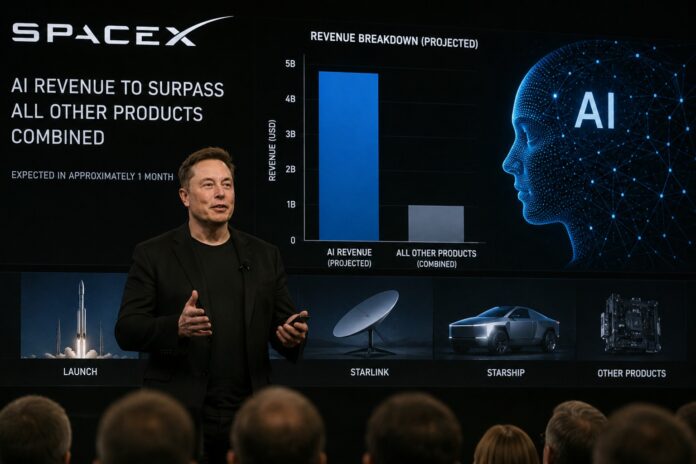
SpaceX has announced expectations that its artificial intelligence revenue will surpass the combined revenues from all other product offerings in the near term. This projection marks a notable shift in the company’s revenue composition and underscores the growing commercial viability of AI technologies within the aerospace sector. The timeline suggested for this transition is remarkably compressed, with leadership indicating this milestone could be reached within approximately one month from the announcement.
The aerospace industry has increasingly recognized AI as a critical component of modern space operations, satellite communications, and related technologies. SpaceX’s pivot toward AI revenue dominance reflects both internal strategic decisions and broader market forces reshaping how space technology companies generate income and create value for stakeholders.
- SpaceX projects AI revenue to exceed all other product revenues within one month
- The shift represents a fundamental change in the company’s revenue structure and business priorities
- AI-related services are becoming commercially viable at scale within the aerospace sector
- This development occurs amid rapid expansion of artificial intelligence applications across multiple industries
Why It Matters
The anticipated dominance of AI revenue at SpaceX carries significant implications for how aerospace companies structure their business models and allocate resources. This development suggests that AI capabilities have moved from experimental or supplementary functions to primary profit drivers. For investors and industry observers, this represents a clear signal that the aerospace sector is undergoing fundamental transformation driven by artificial intelligence applications.
The shift also indicates that commercial demand for AI-powered aerospace services has reached critical mass. Companies operating in space technology, satellite operations, and related fields are increasingly willing to invest in AI solutions, suggesting these technologies deliver measurable value and competitive advantages. This trend could accelerate adoption across the industry as competitors recognize the revenue potential and market opportunities in AI-driven aerospace applications.
For the broader economy, the emergence of AI as a primary revenue driver in aerospace demonstrates how artificial intelligence is reshaping traditional industries. This transformation extends beyond software and technology companies to affect manufacturing, engineering, and space operations sectors that have historically relied on different business models.
- AI commercialization in aerospace demonstrates the technology’s broad applicability beyond software sectors
- Industry-wide adoption of AI services could accelerate as companies recognize competitive advantages and revenue opportunities
- Investors are gaining concrete evidence that AI implementations generate measurable financial returns
- The aerospace sector’s pivot toward AI revenue reflects shifting customer demands and market dynamics
Political and Public Context
The emergence of AI as a dominant revenue source in aerospace occurs within a broader context of increased government interest in space technology and artificial intelligence capabilities. Federal policy in recent years has emphasized the importance of maintaining technological leadership in both sectors, with significant investments in research, development, and infrastructure. The commercial aerospace industry’s success in monetizing AI applications supports policy objectives around technological innovation and economic competitiveness.
Public discourse surrounding artificial intelligence has evolved considerably, with discussions moving from theoretical possibilities toward concrete commercial applications and measurable business outcomes. SpaceX’s projection that AI revenue will dominate its product mix provides tangible evidence that AI technologies have transitioned from experimental phases into operational, revenue-generating tools. This shift influences broader conversations about AI’s role in the economy and the timeline for meaningful AI-driven business transformation.
The aerospace industry historically has been subject to regulatory oversight and government involvement due to national security considerations. AI applications in this sector may attract additional scrutiny from policymakers and regulators seeking to balance commercial innovation with national security interests. The rapid growth of AI revenue in aerospace companies could prompt policy discussions about data security, export controls, and government oversight of AI technologies used in space operations.
- Government policy increasingly emphasizes technological leadership in both aerospace and artificial intelligence sectors
- Commercial success in AI monetization supports policy objectives around economic competitiveness
- Regulatory bodies may increase oversight of AI applications in aerospace due to national security considerations
- The shift toward AI dominance in aerospace revenue reflects broader patterns of AI commercialization across multiple industries
Elon Musk says SpaceX's AI revenue will outpace all its other products by next month https://t.co/CH0T9UIOrg
— Automation Workz (@AutomationWorkz) August 12, 2026
What Happens Next
The aerospace industry will likely intensify its focus on AI development and commercialization in response to SpaceX’s achievement. Competitors and other space technology companies may accelerate their own AI initiatives to capture market share and establish revenue streams in this emerging segment. Investors may increase capital allocation toward aerospace companies demonstrating strong AI capabilities and clear paths to AI revenue generation.
Technical challenges and opportunities in AI application to aerospace will continue to evolve. Companies will need to address questions around data management, system reliability, security, and integration with existing aerospace operations. The practical implementation of AI at scale in space-related applications will generate real-world lessons that influence how other industries adopt similar technologies.
Workforce and talent considerations will become increasingly important as aerospace companies compete for expertise in artificial intelligence engineering and development. Educational institutions and training programs may need to adapt to prepare workers for roles bridging aerospace engineering and AI technology specialization.
- Competing aerospace companies likely to accelerate AI development and commercialization efforts
- Investor focus may shift toward aerospace companies with demonstrable AI capabilities and revenue generation
- Technical implementation challenges will provide industry-wide learning opportunities and influence best practices
- Talent competition in AI engineering may intensify as aerospace companies seek specialized expertise